British Army officer (1887–1976)
Bernard Montgomery
Field Marshal Bernard Law Montgomery, 1st Viscount Montgomery of Alamein, was a senior British Army officer who served in the First World War, the Irish War of Independence, and the Second World War.
By globalcelebwiki Editorial Desk, adapted from Wikipedia · Published 29 September 2026
- Profession
- British Army officer (1887–1976)
- Born
- 17 November 1887
- Birthplace
- Kennington
- Nationality
- British

Overview
Field Marshal Bernard Law Montgomery, 1st Viscount Montgomery of Alamein (17 November 1887 – 24 March 1976), was a senior British Army officer who served in the First World War, the Irish War of Independence, and the Second World War.
Montgomery first saw action in the First World War as a junior officer of the Royal Warwickshire Regiment. At Méteren, near the Belgian border at Bailleul, he was shot through the right lung by a sniper during the First Battle of Ypres. On returning to the Western Front as a general staff officer, he took part in the Battle of Arras in April–May 1917. He also took part in the Battle of Passchendaele in late 1917 before finishing the war as chief of staff of the 47th (2nd London) Division. In the inter-war years he commanded the 17th (Service) Battalion, Royal Fusiliers and, later, the 1st Battalion, Royal Warwickshire Regiment before becoming commander of the 9th Infantry Brigade and then general officer commanding (GOC), 8th Infantry Division.
During the Western Desert campaign of the Second World War, Montgomery commanded the Eighth Army from August 1942. He subsequently commanded the Eighth Army during the Allied invasion of Sicily and the Allied invasion of Italy. During the Normandy campaign, he was in command of all Allied ground forces from 6 June 1944 until 1 September 1944. He then continued in command of the 21st Army Group for the rest of the North West Europe campaign, including the failed attempt to cross the Rhine during Operation Market Garden.
When German armoured forces broke through the US lines in Belgium during the Battle of the Bulge, Montgomery received command of the northern shoulder of the Bulge. Montgomery's 21st Army Group, including the US Ninth Army and the First Allied Airborne Army, crossed the Rhine in Operation Plunder in March 1945. By the end of the war, troops under Montgomery's command had taken part in the encirclement of the Ruhr Pocket, liberated the Netherlands, and captured much of north-west Germany. On 4 May 1945, Montgomery accepted the surrender of the German forces in north-western Europe at Lüneburg Heath, south of Hamburg, after the surrender of Berlin to the USSR on 2 May.
After the war he became Commander-in-Chief of the British Army of the Rhine (BAOR) in Germany and then Chief of the Imperial General Staff (1946–1948). From 1948 to 1951, he served as Chairman of the Commanders-in-Chief Committee of the Western Union. He then served as NATO's Deputy Supreme Allied Commander Europe until his retirement in 1958.
Early life
Montgomery was born in Kennington, Surrey, in 1887, the fourth child of nine, to a Church of Ireland priest, Henry Montgomery, and his wife Maud (née Farrar). The Montgomerys, an Ulster Scots 'Ascendancy' gentry family, were the County Donegal branch of the Clan Montgomery. Henry Montgomery, at that time Vicar of St Mark's Church, Kennington, was the second son of Sir Robert Montgomery, a native of Inishowen in County Donegal in the north-west of Ulster, and a noted colonial administrator in British India. Sir Robert died a month after his grandson's birth. He was probably a descendant of Colonel Alexander Montgomery. Bernard's mother, Maud, was the daughter of Frederic William Farrar, the famous children's novelist and preacher, and was 18 years younger than her husband.
After the death of Sir Robert Montgomery, Henry inherited the Montgomery ancestral estate of New Park in Moville, a small town in Inishowen in the north of County Donegal in Ulster, the northern province in Ireland. There was still £13,000 to pay on a mortgage, a large debt in the 1880s (equivalent to £1,477,893 in 2025), and Henry was at the time still only an Anglican vicar. Despite selling off all the farms that were in the townland of Ballynally, on the north-western shores of Lough Foyle, "there was barely enough to keep up New Park and pay for the blasted summer holiday" (i.e., at New Park).
It was a financial relief of some magnitude when, in 1889, Henry was made Bishop of Tasmania, then still a British colony, and Bernard spent his formative years there. Bishop Montgomery considered it his duty to spend as much time as possible in the rural areas of Tasmania and was away for up to six months at a time. While he was away, his wife, still in her mid-20s, gave her children "constant" beatings, then ignored them most of the time. Of Bernard's siblings, Sibyl died prematurely in Tasmania, and Harold, Donald and Una all emigrated. Maud Montgomery took little active interest in the education of her young children other than to have them taught by tutors brought from Britain, although Bernard briefly attended the then coeducational St Michael's Collegiate School. The loveless environment made Bernard something of a bully, as he himself recalled: "I was a dreadful little boy. I don't suppose anybody would put up with my sort of behaviour these days." Later in life Montgomery refused to allow his son David to have anything to do with his grandmother, and refused to attend her funeral in 1949.
The family returned to England once for a Lambeth Conference in 1897, and Bernard and his brother Harold were educated at The King's School, Canterbury. In 1901, Bishop Montgomery became secretary of the Society for the Propagation of the Gospel, and the family returned to London. Montgomery attended St Paul's School and then the Royal Military College, Sandhurst, from which he was almost expelled for rowdiness and violence. On graduation in September 1908 he was commissioned into the 1st Battalion the Royal Warwickshire Regiment as a second lieutenant, and first saw overseas service later that year in India. He was promoted to lieutenant in 1910, and in 1912 became adjutant of the 1st Battalion of his regiment at Shorncliffe Army Camp.
First World War
The Great War began in August 1914 and Montgomery moved to France with his battalion that month, which was at the time part of the 10th Infantry Brigade of the 4th Division of the British Expeditionary Force (BEF). He was promoted to temporary captain on 14 September. He saw action at the Battle of Le Cateau that month and during the retreat from Mons. At Méteren, near the Belgian border at Bailleul on 13 October 1914, during an Allied counter-offensive, he was shot through the right lung by a sniper. Lying in the open, he remained still and pretended to be dead, in the hope that he would not receive any more enemy attention. One of his men did attempt to rescue him but was shot dead by a hidden enemy sniper and collapsed over Montgomery. The sniper continued to fire and Montgomery was hit once more, in the knee, but the dead soldier, in Montgomery's words, "received many bullets meant for me." Assuming them to both be dead, the officers and men of Montgomery's battalion chose to leave them where they were until darkness arrived and stretcher bearers managed to recover the two bodies, with Montgomery by this time barely clinging on to life. The doctors at the advanced dressing station (ADS), too, had no hope for him and ordered a grave to be dug. Miraculously, however, Montgomery was still alive and, after being placed in an ambulance and then being sent to a hospital, was treated and eventually evacuated to England, where he would remain for well over a year. He was appointed a Companion of the Distinguished Service Order (DSO), for his gallant leadership during this period: the citation for this award, published in The London Gazette in December 1914 reads:
Conspicuous gallant leading on 13th October, when he turned the enemy out of their trenches with the bayonet. He was severely wounded.
After recovering in early 1915, he was appointed brigade major, first of the 112th Infantry Brigade, and then with 104th Infantry Brigade, then training in Lancashire. He returned to the Western Front in early 1916 with his brigade, seeing service with it during the Battle of the Somme later in the year. In January 1917 he was assigned as a general staff officer, grade 2 (GSO2) with the 33rd Division and took part in the Battle of Arras in April–May. In July he transferred over as a GSO2 to IX Corps, part of General Sir Herbert Plumer's Second Army.
It was in this role that Montgomery served at the Battle of Passchendaele which began in late July 1917. He was promoted to the temporary rank of major in February 1918, and brevet major in June. He finished the war in November 1918 as GSO1 (effectively chief of staff) of the 47th (2nd London) Division, with the temporary rank of lieutenant colonel, to which appointment and rank he had been assigned on 16 July. A photograph from October 1918, reproduced in many biographies, shows the then unknown Lieutenant-Colonel Montgomery standing in front of Winston Churchill (then the Minister of Munitions) at the parade following the liberation of Lille.
Montgomery was profoundly influenced by his experiences during the war, in particular by the lack of leadership displayed by senior commanders. He later wrote:
After the First World War, Montgomery commanded the 17th (Service) Battalion of the Royal Fusiliers, a battalion in the British Army of the Rhine, before reverting to his substantive rank of captain (brevet major) in November 1919. He had not at first been selected for the Staff College, Camberley, Surrey (his only hope of ever achieving high command). But at a tennis party in Cologne, he was able to persuade the Commander-in-chief (C-in-C) of the British Army of Occupation, Field Marshal Sir William Robertson, to add his name to the list.
After graduating from the Staff College, he was appointed brigade major in the 17th Infantry Brigade in January 1921. The brigade was stationed in County Cork, Ireland, carrying out counter-guerilla operations during the final stages of the Irish War of Independence.
In one noteworthy incident on 2 May 1922, Montgomery led a force of 60 soldiers and four armoured cars to the town of Macroom to search for four British officers who were missing in the area. While he had hoped the show of force would assist in finding the men, he was under strict orders not to attack the IRA. On arriving in the town square in front of Macroom Castle, he summoned the IRA commander, Charlie Browne, to parley. At the castle gates Montgomery spoke to Browne, explaining what would happen should the officers not be released. Once finished, Browne responded with his own ultimatum to Montgomery to "leave town within 10 minutes". Browne then turned heels and returned to the Castle. At this point another IRA officer, Pat O'Sullivan, whistled to Montgomery drawing his attention to scores of IRA volunteers who had quietly taken up firing positions all around the square—surrounding Montgomery's forces. Realising his precarious position, Montgomery led his troops out of the town, a decision which raised hostile questions in the House of Commons but was later approved by Montgomery's own superiors. Unknown to Montgomery at this time, the four missing officers had already been killed by the IRA.
Montgomery eventually came to the conclusion that only ruthless measures would suppress the rebels, and because that was politically unacceptable, self-government for Ireland was the only feasible option. In 1923, after the establishment of the Irish Free State and during the Irish Civil War, Montgomery wrote to Colonel Arthur Percival of the Essex Regiment:
Personally, my whole attention was given to defeating the rebels but it never bothered me a bit how many houses were burnt. I think I regarded all civilians as 'Shinners' and I never had any dealings with any of them. My own view is that to win a war of this sort, you must be ruthless. Oliver Cromwell, or the Germans, would have settled it in a very short time. Nowadays public opinion precludes such methods, the nation would never allow it, and the politicians would lose their jobs if they sanctioned it. That being so, I consider that Lloyd George was right in what he did, if we had gone on we could probably have squashed the rebellion as a temporary measure, but it would have broken out again like an ulcer the moment we removed the troops. I think the rebels would probably have refused battles, and hidden their arms etc. until we had gone. The only way therefore was to give them some form of self government, and let them squash the rebellion themselves, they are the only people who could really stamp it out.
In 1925, in his first known courtship of a woman, Montgomery, then in his late thirties, proposed to a 17-year-old girl, Betty Anderson. His approach included drawing diagrams in the sand of how he would deploy his tanks and infantry in a future war, a contingency which seemed very remote at that time. She respected his ambition and single-mindedness but declined his proposal.
In 1927, he met and married Elizabeth (Betty) Carver, née Hobart. She was the sister of the future Second World War commander Sir Percy Hobart. Betty Carver had two sons in their early teens, John and Dick, from her first marriage to Oswald Carver. Dick Carver later wrote that it had been "a very brave thing" for Montgomery to take on a widow with two children. Montgomery's son, David, was born in August 1928.
In January 1929, Montgomery was promoted to brevet lieutenant-colonel. That month he returned to the 1st Battalion, Royal Warwickshire Regiment again, as Commander of Headquarters Company; he went to the War Office to help write the Infantry Training Manual in mid-1929. In 1931 Montgomery was promoted to substantive lieutenant-colonel and became the Commanding officer (CO) of the 1st Battalion, Royal Warwickshire Regiment and saw service in Palestine and British India. He was promoted to colonel in June 1934 (seniority from January 1932). He attended and was then recommended to become an instructor at the Indian Army Staff College (now the Pakistan Command and Staff College) in Quetta, British India.
On completion of his tour of duty in India, Montgomery returned to Britain in June 1937 where he took command of the 9th Infantry Brigade with the temporary rank of brigadier. His wife died that year.
In 1938, he organised an amphibious combined operations landing exercise that impressed the new C-in-C of Southern Command, General Sir Archibald Wavell. He was promoted to major-general on 14 October 1938 and took command of the 8th Infantry Division in the British mandate of Palestine. In Palestine, Montgomery was involved in suppressing an Arab revolt which had broken out over opposition to Jewish emigration. He returned in July 1939 to Britain, suffering a serious illness on the way, to command the 3rd Infantry Division. Reporting the suppression of the revolt in April 1939, Montgomery wrote, "I shall be sorry to leave Palestine in many ways, as I have enjoyed the war out here".
Britain declared war on Germany on 3 September 1939 and the 3rd Division, together with its new General Officer Commanding (GOC), was deployed to France as part of the British Expeditionary Force (BEF), commanded by General Lord Gort. Shortly after the division's arrival overseas, Montgomery faced serious trouble from his military superiors and the clergy for his frank attitude regarding the sexual health of his soldiers, but was defended from dismissal by his superior Alan Brooke, commander of II Corps, of which Montgomery's division formed a part. Montgomery had issued a circular on the prevention of venereal disease, worded in such "obscene language" that both the Church of England and Roman Catholic senior chaplains objected; Brooke told Monty that he did not want any further errors of this kind, though deciding not to get him to formally withdraw it as it would remove any "vestige of respect" left for him.
Although Montgomery's new command was a Regular Army formation, comprising the 7th (Guards), and the 8th and 9th Infantry Brigades along with supporting units, he was not impressed with its readiness for battle. As a result, while most of the rest of the BEF set about preparing defences for an expected German attack sometime in the future, Montgomery began training his 3rd Division in offensive tactics, organising several exercises, each of which lasted for several days at a time. Mostly they revolved around the division advancing towards an objective, often a river line, only to come under attack and forced to withdraw to another position, usually behind another river. These exercises usually occurred at night with only very minimal lighting being allowed. By the spring of 1940 Montgomery's division had gained a reputation of being a very agile and flexible formation. By then the Allies had agreed to Plan D, where they would advance deep into Belgium and take up positions on the River Dyle by the time the German forces attacked. Brooke, Montgomery's corps commander, was pessimistic about the plan but Montgomery, in contrast, was not concerned, believing that he and his division would perform well regardless of the circumstances, particularly in a war of movement.
Montgomery's training paid off when the Germans began their invasion of the Low Countries on 10 May 1940 and the 3rd Division advanced to its planned position, near the Belgian city of Leuven. Soon after arrival, the division was fired on by members of the Belgian 10th Infantry Division who mistook them for German paratroopers; Montgomery resolved the incident by approaching them and offering to place himself under Belgian command, although Montgomery himself took control when the Germans arrived. During this time he began to develop a particular habit, which he would keep throughout the war, of going to bed at 21:30 every night without fail and giving only a single order—that he was not to be disturbed—which was only very rarely disobeyed.
The 3rd Division saw comparatively little action but, owing to the strict training methods of Montgomery, the division always managed to be in the right place at the right time, especially so during the retreat into France. By 27 May, when the Belgian Army on the left flank of the BEF began to disintegrate, the 3rd Division achieved something very difficult, the movement at night from the right to the left of another division and only 2,000 yards behind it. This was performed with great professionalism and occurred without any incidents and thereby filled a very vulnerable gap in the BEF's defensive line. On 29/30 May, Montgomery temporarily took over from Brooke, who received orders to return to the United Kingdom, as GOC of II Corps for the final stages of the Dunkirk evacuation.
The 3rd Division, temporarily commanded by Kenneth Anderson in Montgomery's absence, returned to Britain intact with minimal casualties. Operation Dynamo—codename for the Dunkirk evacuation—saw 330,000 Allied military personnel, including most of the BEF, to Britain, although the BEF was forced to leave behind a significant amount of equipment.
On his return Montgomery antagonised the War Office with trenchant criticisms of the command of the BEF and was briefly relegated to divisional command of 3rd Division, which was the only fully equipped division in Britain. He was made a Companion of the Order of the Bath.
Montgomery was ordered to make ready the 3rd Division to invade the neutral Portuguese Azores. Models of the islands were prepared and detailed plans worked out for the invasion. The invasion plans did not go ahead and plans switched to invading the Cape Verde islands also belonging to neutral Portugal. These invasion plans also did not go ahead. Montgomery was then ordered to prepare plans for the invasion of neutral Ireland and to seize Cork, Cobh and Cork harbour. These invasion plans, like those of the Portuguese islands, also did not go ahead and in July 1940, Montgomery was appointed acting lieutenant-general and after handing over command of his division to James Gammell, he was placed in command of V Corps, responsible for the defence of Hampshire and Dorset and started a long-running feud with the new Commander-in-chief (C-in-C) of Southern Command, Lieutenant-General Claude Auchinleck.
In April 1941, he became commander of XII Corps responsible for the defence of Kent. During this period he instituted a regime of continuous training and insisted on high levels of physical fitness for both officers and other ranks. He was ruthless in sacking officers he considered unfit for command in action. He was promoted to temporary lieutenant-general in July, overseeing the defence of Kent, Sussex and Surrey. In December Montgomery was given command of South-Eastern Command. He renamed his command the South-Eastern Army to promote offensive spirit. During this time he further developed and rehearsed his ideas and trained his soldiers, culminating in Exercise Tiger in May 1942, a combined forces exercise involving 100,000 troops.
In 1942, a new field commander was required in the Middle East, where Auchinleck was fulfilling both the role of C-in-C of Middle East Command and commander Eighth Army. He had stabilised the Allied position at the First Battle of El Alamein, but after a visit in August 1942, the Prime Minister, Winston Churchill, replaced him as C-in-C with General Sir Harold Alexander and William Gott as commander of the Eighth Army in the Western Desert. However, after Gott was killed flying back to Cairo, Churchill was persuaded by Brooke, who by this time was Chief of the Imperial General Staff (CIGS), to appoint Montgomery, who had only just been nominated to replace Alexander, as commander of the British First Army for Operation Torch, the invasion of French North Africa.
A story, probably apocryphal but popular at the time, is that the appointment caused Montgomery to remark that "After having an easy war, things have now got much more difficult." A colleague is supposed to have told him to cheer up—at which point Montgomery said "I'm not talking about me, I'm talking about Rommel!"
He ordered the creation of the X Corps, which contained all armoured divisions, to fight alongside his XXX Corps, which was all infantry divisions. This arrangement differed from the German Panzer Corps: one of Rommel's Panzer Corps combined infantry, armour and artillery units under one corps commander. The only common commander for Montgomery's all-infantry and all-armour corps was the Eighth Army Commander himself. Writing post-war the English historian Correlli Barnett commented that Montgomery's solution "was in every way opposite to Auchinleck's and in every way wrong, for it carried the existing dangerous separatism still further."
Montgomery reinforced the 30 miles (48 km) long front line at El Alamein, something that would take two months to accomplish. He asked Alexander to send him two new British divisions (51st Highland and 44th Home Counties) that were then arriving in Egypt and were scheduled to be deployed in defence of the Nile Delta. He moved his field HQ to Burg al Arab, close to the Air Force command post in order to better coordinate combined operations.
Montgomery was determined that the army, navy and air forces should fight their battles in a unified, focused manner according to a detailed plan. He ordered immediate reinforcement of the vital heights of Alam Halfa, just behind his own lines, expecting the German commander, Erwin Rommel, to attack with the heights as his objective, something that Rommel soon did. Montgomery ordered all contingency plans for retreat to be destroyed. "I have cancelled the plan for withdrawal. If we are attacked, then there will be no retreat. If we cannot stay here alive, then we will stay here dead", he told his officers at the first meeting he held with them in the desert, though, in fact, Auchinleck had no plans to withdraw from the strong defensive position he had chosen and established at El Alamein.
Rommel attempted to turn the left flank of the Eighth Army at the Battle of Alam el Halfa from 31 August 1942. The German/Italian armoured corps infantry attack was stopped in very heavy fighting. Rommel's forces had to withdraw urgently lest their retreat through the British minefields be cut off. Montgomery was criticised for not counter-attacking the retreating forces immediately, but he felt strongly that his methodical build-up of British forces was not yet ready. A hasty counter-attack risked ruining his strategy for an offensive on his own terms in late October, planning for which had begun soon after he took command. He was confirmed in the permanent rank of lieutenant-general in mid-October.
The conquest of Libya was essential for airfields to support Malta and to threaten the rear of Axis forces opposing Operation Torch. Montgomery prepared meticulously for the new offensive after convincing Churchill that the time was not being wasted. (Churchill sent a telegram to Alexander on 23 September 1942 which began, "We are in your hands and of course a victorious battle makes amends for much delay.") He was determined not to fight until he thought there had been sufficient preparation for a decisive victory, and put into action his beliefs with the gathering of resources, detailed planning, the training of troops—especially in clearing minefields and fighting at night—and in the use of 252 of the latest American-built Sherman tanks, 90 M7 Priest self-propelled howitzers, and making a personal visit to every unit involved in the offensive. By the time the offensive was ready in late October, Eighth Army had 231,000 men on its ration strength.
The Second Battle of El Alamein began on 23 October 1942, and ended 12 days later with one of the first large-scale, decisive Allied land victories of the war. Montgomery correctly predicted both the length of the battle and the number of casualties (13,500).
Historian Correlli Barnett has pointed out that the rain also fell on the Germans, and that the weather is therefore an inadequate explanation for the failure to exploit the breakthrough, but nevertheless the Battle of El Alamein had been a great success. Over 30,000 prisoners of war were taken, including the German second-in-command, General Ritter von Thoma, as well as eight other general officers.
Montgomery was advanced to KCB and promoted to full general. He kept the initiative, applying superior strength when it suited him, forcing Rommel out of each successive defensive position. On 6 March 1943, Rommel's attack on the over-extended Eighth Army at Medenine (Operation Capri) with the largest concentration of German armour in North Africa was successfully repulsed. At the Mareth Line, 20 to 27 March, when Montgomery encountered fiercer frontal opposition than he had anticipated, he switched his major effort into an outflanking inland pincer, backed by low-flying RAF fighter-bomber support. For his role in North Africa he was awarded the Legion of Merit by the United States government in the rank of Chief Commander.
The next major Allied attack was the Allied invasion of Sicily (Operation Husky). Montgomery considered the initial plans for the Allied invasion, which had been agreed in principle by General Dwight D. Eisenhower, the Supreme Allied Commander Allied Forces Headquarters, and General Alexander, the 15th Army Group commander, to be unworkable because of the dispersion of effort. He managed to have the plans recast to concentrate the Allied forces, having Lieutenant General George Patton's US Seventh Army land in the Gulf of Gela (on the Eighth Army's left flank, which landed around Syracuse in the south-east of Sicily) rather than near Palermo in the west and north of Sicily. Inter-Allied tensions grew as the American commanders, Patton and Omar Bradley (then commanding US II Corps under Patton), took umbrage at what they saw as Montgomery's attitudes and boastfulness. However, while they were considered three of the greatest soldiers of their time, due to their competitiveness they were renowned for "squabbling like three schoolgirls" thanks to their "bitchiness", "whining to their superiors" and "showing off".
Montgomery's Eighth Army was then fully involved in the Allied invasion of Italy in early September 1943, becoming the first of the Allied forces to land in Western Europe. Led by Lieutenant General Sir Miles Dempsey's XIII Corps, the Eighth Army landed on the toe of Italy in Operation Baytown on 3 September, four years to the day after Britain declared war on Germany. They encountered little enemy resistance. The Germans had made the decision to fall back and did what they could to stall the Eighth Army's advance, including blowing up bridges, laying mines, and setting up booby-traps. All of these slowed the Army's advance north on the awful Italian roads, although it was Montgomery who was later much criticised for the lack of progress.
On 9 September the British 1st Airborne Division landed at the key port of Taranto in the heel of Italy as part of Operation Slapstick, capturing the port unopposed. On the same day the U.S. Fifth Army under Lieutenant General Mark W. Clark (which actually contained a large number of British troops) landed at Salerno, near Naples, as part of Operation Avalanche but soon found itself fighting for its very existence with the Germans launching several determined counterattacks to try to push the Allies back into the sea, with Montgomery's men being too far away to provide any real assistance. The situation was tense over the next few days but the two armies (both of which formed the 15th Army Group under General Alexander) finally began to meet on 16 September, by which time the crisis at Salerno was virtually over.
Clark's Fifth Army then began to advance to the west of the Apennine Mountains while Montgomery, with Lieutenant General Charles Allfrey's V Corps having arrived to reinforce Dempsey's XIII Corps, advanced to the east. The Foggia airfields soon fell to Allfrey's V Corps, but the Germans fought hard in the defence of Termoli and Biferno. Movement soon came to an almost complete halt in the early part of November when the Eighth Army came up against a new defensive line established by the Germans on the River Sangro, which was to be the scene of much bitter and heavy fighting for the next month. While some ground was gained, it was often at the expense of heavy casualties and the Germans always managed to retreat to new defensive positions.
Montgomery abhorred what he considered to be a lack of coordination, a dispersion of effort, a strategic muddle and a lack of opportunism in the Allied campaign in Italy, describing the whole affair as a "dog's breakfast".
As a result of his dissatisfaction with Italy, he was delighted to receive the news that he was to return to Britain in January 1944. He was assigned to command the 21st Army Group consisting of all Allied ground forces participating in Operation Overlord, codename for the Allied invasion of Normandy. Overall direction was assigned to the Supreme Allied Commander of the Allied Expeditionary Forces, American General Dwight D. Eisenhower. Both Churchill and Eisenhower had found Montgomery difficult to work with in the past and wanted the position to go to the more affable General Sir Harold Alexander. However Montgomery's patron, General Sir Alan Brooke, firmly argued that Montgomery was a much superior general to Alexander and ensured his appointment. Without Brooke's support, Montgomery would have remained in Italy. At his headquarters St Paul's School on 7 April and 15 May Montgomery presented his strategy for the invasion. He envisaged a ninety-day battle, with all forces reaching the Seine. The campaign would pivot on an Allied-held Caen in the east of the Normandy bridgehead, with relatively static British and Canadian armies forming a shoulder to attract and defeat German counter-attacks, relieving the US armies who would move and seize the Cotentin Peninsula and Brittany, wheeling south and then east on the right forming a pincer.
During the ten weeks of the Battle of Normandy, unfavourable autumnal weather conditions disrupted the Normandy landing areas. Montgomery's initial plan was for the Anglo-Canadian troops under his command to break out immediately from their beachheads on the Calvados coast towards Caen with the aim of taking the city on either D Day or two days later. Montgomery attempted to take Caen with the 3rd Infantry Division, the 50th (Northumbrian) Infantry Division and the 3rd Canadian Division, but was stopped from 6–8 June by the 21st Panzer Division and 12th SS Panzer Division Hitlerjugend, who hit the advancing Anglo-Canadian troops very hard. The 12th Waffen SS Division Hitlerjugend, as its name implies, was drawn entirely from the more fanatical elements of the Hitler Youth, and commanded by the ruthless SS-Brigadeführer Kurt Meyer, aka "Panzer Meyer". Rommel followed up this success by ordering the 2nd Panzer Division to Caen while Field Marshal Gerd von Rundstedt received permission from Hitler to have the elite 1st SS Panzer Division Leibstandarte SS Adolf Hitler and 2nd SS Panzer Division Das Reich sent to Caen as well. Montgomery thus had to face what Stephen Badsey called the "most formidable" of all the German divisions in France.
The failure to take Caen immediately has been the source of an immense historiographical dispute with bitter nationalist overtones. Broadly, there has been a "British school" which accepts Montgomery's post-war claim that he never intended to take Caen at once, and instead the Anglo-Canadian operations around Caen were a "holding operation" intended to attract the bulk of the German forces towards the Caen sector to allow the Americans to stage the "break out operation" on the left flank of the German positions, which was all part of Montgomery's "Master Plan" that he had conceived long before the Normandy campaign. By contrast, the "American school" argued that Montgomery's initial "master plan" was for the 21st Army Group to take Caen at once and move his tank divisions into the plains south of Caen, to then stage a breakout that would lead the 21st Army Group into the plains of northern France and hence into Antwerp and finally the Ruhr. Letters written by Eisenhower at the time of the battle make it clear that Eisenhower was expecting from Montgomery "the early capture of the important focal point of Caen". Later, when this plan had clearly failed, Eisenhower wrote that Montgomery had "evolved" the plan to have the US forces achieve the break-out instead.
As the campaign progressed, Montgomery altered his initial plan for the invasion and continued the strategy of attracting and holding German counter-attacks in the area north of Caen rather than to the south, to allow the U.S. First Army in the west to take Cherbourg. A memo summarising Montgomery's operations written by Eisenhower's chief of staff, General Walter Bedell Smith, who met with Montgomery in late June 1944 says nothing about Montgomery conducting a "holding operation" in the Caen sector, and instead speaks of him seeking a "breakout" into the plains south of the Seine. On 12 June, Montgomery ordered the 7th Armoured Division into an attack against the Panzer Lehr Division that made good progress at first, but ended when the Panzer Lehr was joined by the 2nd Panzer Division. At the Battle of Villers-Bocage on 13 June, the British lost twenty Cromwell tanks to five Tiger tanks led by SS Obersturmführer Michael Wittmann, in about five minutes. Despite the setback at Villers Bocage, Montgomery was still optimistic as the Allies were landing more troops and supplies than they were losing in battle, and though the German lines were holding, the Wehrmacht and Waffen SS were suffering considerable attrition. Air Chief Marshal Sir Arthur Tedder complained that it was impossible to move fighter squadrons to France until Montgomery had captured some airfields, something he asserted that Montgomery appeared incapable of doing. The first V-1 flying bomb attacks on London, which started on 13 June, further increased the pressure on Montgomery from Whitehall to speed up his advance.
On 18 June, Montgomery ordered Bradley to take Cherbourg while the British were to take Caen by 23 June. In Operation Epsom, the British VII Corps commanded by Sir Richard O'Connor attempted to outflank Caen from the west by breaking through the dividing line between the Panzer Lehr and the 12th SS to take the strategic Hill 112. Epsom began well with O'Connor's assault force (the British 15th Scottish Division) breaking through and with the 11th Armoured Division stopping the counter-attacks of the 12th SS Division. General Friedrich Dollmann of Seventh Army had to commit the newly arrived II SS Panzer Corps to stop the British offensive. Dollmann, fearing that Epsom would be a success, committed suicide and was replaced by SS Oberstegruppenführer Paul Hausser. O'Connor, at the cost of about 4,000 men, had won a salient only 5 miles (8.0 km) deep and 2 miles (3.2 km) wide, but placed the Germans in an unviable long-term position. There was a strong sense of crisis in the Allied command, as the Allies had advanced only about 15 miles (24 km) inland, at a time when their plans called for them to have already taken Rennes, Alençon and St. Malo. After Epsom, Montgomery had to tell General Harry Crerar that the activation of the First Canadian Army would have to wait as there was only room at present, in the Caen sector, for the newly arrived XII Corps under Lieutenant-General Neil Ritchie, which caused some tension with Crerar, who was anxious to get into the field. Epsom had forced further German forces into Caen but all through June and the first half of July Rommel, Rundstedt, and Hitler were engaged in planning for a great offensive to drive the British into the sea; it was never launched and would have required the commitment of a large number of German forces to the Caen sector.
Eisenhower took over Ground Forces Command on 1 September, while continuing as Supreme Commander, with Montgomery continuing to command the 21st Army Group, now consisting mainly of British and Canadian units. Montgomery vehemently opposed this change, although it had been agreed before the D-Day invasion, instead proposing that either he or Bradley should remain in the job of Ground Forces command. He argued that the two roles were fundamentally different and that Eisenhower possessed the skillset for the former but not the latter; as such, he was liable to neglect the duties of one or the other, rendering the force off-balance. Instead, there was a need for a single decisive master plan under a leader free from the more administrative and political duties of the Supreme Commander - Montgomery felt he was the best equipped to deliver this, but was clear that he would also have been willing to work under Bradley.
Eisenhower and many others failed to grasp this however, and would misinterpret this as Montgomery's pride being wounded at having command removed. As such, they would attempt to placate him by reassuring him of the areas remaining under his command, and Winston Churchill had Montgomery promoted to Field Marshal by way of compensation. In addition, the British journalist Mark Urban points out that Montgomery seemed unable to grasp however that as the majority of the 2.2 million Allied soldiers fighting against Germany on the Western Front were now American (the ratio was 3:1) that it was politically unacceptable to American public opinion to have Montgomery remain as Land Forces Commander as: "Politics would not allow him to carry on giving orders to great armies of Americans simply because, in his view, [he was the best man for the job]".
By September, ports like Cherbourg were too far away from the front line, causing the Allies great logistical problems. Antwerp was the third largest port in Europe. It was a deep water inland port connected to the North Sea via the river Scheldt. The Scheldt was wide enough and dredged deep enough to allow the passage of ocean-going ships.
On 3 September 1944 Hitler ordered Fifteenth Army, which had been stationed in the Pas de Calais region and was withdrawing north into the Low Countries, to hold the mouth of the river Scheldt to deprive the Allies of the use of Antwerp. Von Rundstedt, the German commander of the Western Front, ordered General Gustav-Adolf von Zangen, the commander of 15th Army, that: "The attempt of the enemy to occupy the West Scheldt in order to obtain the free use of the harbor of Antwerp must be resisted to the utmost" (emphasis in the original). Rundstedt argued with Hitler that as long as the Allies could not use the port of Antwerp, the Allies would lack the logistical capacity for an invasion of Germany.
The Witte Brigade (White Brigade) of the Belgian resistance had captured the Port of Antwerp before the Germans could destroy key port facilities, and on 4 September, Antwerp was captured by Horrocks with its harbour mostly intact. The British declined to immediately advance over the Albert Canal, and an opportunity to destroy the German Fifteenth Army was lost. The Germans had mined the river Scheldt, the mouth of the Scheldt was still in German hands making it impossible for the Royal Navy to clear the mines in the river, and therefore the port of Antwerp was still useless to the Allies.
On 5 September, SHAEF's naval commander, Admiral Sir Bertram Ramsay, had urged Montgomery to make clearing the mouth of the Scheldt his number-one priority. Alone among the senior commanders, only Ramsay saw opening Antwerp as crucial. Thanks to "Ultra," Montgomery was aware of Hitler's order by 5 September.
On 9 September, Montgomery wrote to Brooke that "one good Pas de Calais port" would be sufficient to meet all the logistical needs of the 21st Army Group, but only the supply needs of the same formation. At the same time, Montgomery noted that "one good Pas de Calais port" would be insufficient for the American armies in France, which would thus force Eisenhower, if for no other reasons than logistics, to favour Montgomery's plans for an invasion of northern Germany by the 21st Army Group, whereas if Antwerp were opened up, then all of the Allied armies could be supplied.
Montgomery was able to persuade Eisenhower to allow him to test his strategy of a single thrust to the Ruhr with Operation Market Garden in September 1944. The offensive was strategically bold, although Lieutenant General Humfrey Gale, the "senior administrative and logistics officer" for SHAEF (Supreme Headquarters Allied Expeditionary Force) considered Montgomery's narrow-thrust strategy to be "logistically unrealistic", and in his opinion "a ruse merely to demonstrate later that he had been prevented from winning the war quickly by Eisenhower's caution." At a strategy meeting on 10 September 1944, Montgomery became so belligerent that Eisenhower was prompted into saying "Steady, Monty! You can't speak to me like that. I'm your boss." Following the Allied breakout from Normandy, Eisenhower favored pursuing the German armies northwards and eastwards to the Rhine on a broad front. Eisenhower relied on speed, which in turn depended on logistics, which were "stretched to the limit". SHAEF did provide Montgomery with additional resources, principally additional locomotives and rolling stock, and priority for air supply. Eisenhower's decision to launch Market Garden was influenced by his desire to keep the retreating Germans under pressure, and by the pressure from the United States to use the First Allied Airborne Army as soon as possible.
Montgomery's plan for Operation Market Garden (17–25 September 1944) was to outflank the Siegfried Line and cross the Rhine, setting the stage for later offensives into the Ruhr region. The 21st Army Group would attack north from Belgium, 60 miles (97 km) through the Netherlands, across the Rhine and consolidate north of Arnhem on the far side of the Rhine. The risky plan required three Airborne Divisions to capture numerous intact bridges along a single-lane road, on which an entire Corps had to attack and use as its main supply route. The offensive failed to achieve its objectives.
Both Churchill and Montgomery claimed that the operation was nearly or 90% successful, "since they had got nine-tenths of the way to Arnhem", prompting Air Chief Marshal Tedder to derisively comment that "one jumps off a cliff with an even higher success rate, until the last few inches." However, in Montgomery's equivocal acceptance of responsibility he blames lack of support, and also refers to the Battle of the Scheldt, which was undertaken by Canadian troops not involved in Market Garden. Montgomery later said:
It was a bad mistake on my part—I underestimated the difficulties of opening up the approaches to Antwerp ... I reckoned the Canadian Army could do it while we were going for the Ruhr. I was wrong ... In my—prejudiced—view, if the operation had been properly backed from its inception, and given the aircraft, ground forces, and administrative resources necessary for the job, it would have succeeded in spite of my mistakes, or the adverse weather, or the presence of the 2nd SS Panzer Corps in the Arnhem area. I remain Market Garden's unrepentant advocate.
In the aftermath of Market Garden, Montgomery made holding the Arnhem salient his first priority, arguing that the British Second Army might still be able to break through and reach the wide open plains of northern Germany, and that he might be able to take the Ruhr by the end of October. The Germans under Generalfeldmarschall Walther Model attempted to retake the Nijmegen salient in early October, but were beaten back. In the meantime, the First Canadian Army finally achieved the task of clearing the mouth of the river Scheldt, despite the fact that, in the words of Copp and Vogel, "Montgomery's Directive required the Canadians to continue to fight alone for almost two weeks in a battle which everyone agreed could only be won with the aid of additional divisions".
On 16 December 1944, at the start of the Battle of the Bulge, Montgomery's 21st Army Group was on the northern flank of the allied lines. Bradley's US 12th Army Group was to Montgomery's south, with William Simpson's U.S. Ninth Army adjacent to 21st Army Group, Courtney Hodges' U.S. First Army holding the Ardennes and Patton's U.S. Third Army further south.
SHAEF believed the Wehrmacht was no longer capable of launching a major offensive, and that no offensive could be launched through such rugged terrain as the Ardennes Forest. Because of this, the area was held by refitting and newly arrived American formations. The Wehrmacht planned to exploit this by making a surprise attack through the Ardennes Forest whilst bad weather grounded Allied air power, splitting the Allied Armies in two. They would then turn north to recapture the port of Antwerp. If the attack were to succeed in capturing Antwerp, the whole of 21st Army Group, along with U.S. Ninth Army and most of U.S. First Army would be trapped without supplies behind German lines.
The attack initially advanced rapidly, splitting U.S. 12th Army Group in two, with all of U.S. Ninth Army and the bulk of U.S. First Army on the northern shoulder of the German 'bulge'. The 12th Army Group commander, Bradley, was located in Luxembourg, making command of the U.S. forces north of the bulge problematic. As Montgomery was the nearest army group commander on the ground, on 20 December, Eisenhower temporarily transferred command of U.S. Ninth Army and U.S. First Army to Montgomery's 21st Army Group. Bradley was "concerned because it might discredit the American command" but that it might mean Montgomery would commit more of his reserves to the battle. In practice the change led to "great resentment on the part of many Americans, particularly at Headquarters, 12th Army Group, and Third Army".
With the British and American forces under Montgomery's command holding the northern flank of the German assault, General Patton's Third Army, which was 90 miles (140 km) to the south, turned north and fought its way through the severe weather and German opposition to relieve the besieged American forces in Bastogne. Four days after Montgomery took command of the northern flank, the bad weather cleared and the USAAF and RAF resumed operations, inflicting heavy casualties on German troops and vehicles. Six days after Montgomery took command of the northern flank, Patton's Third Army relieved the besieged American forces in Bastogne. Unable to advance further, and running out of fuel, the Wehrmacht abandoned the offensive.
Morelock states that Montgomery was preoccupied with leading a "single thrust offensive" to Berlin as the overall commander of Allied ground forces, and that he accordingly treated the Ardennes counteroffensive "as a sideshow, to be finished with the least possible effort and expenditure of resources."
In February 1945, Montgomery's 21st Army Group advanced to the Rhine in Operation Veritable and Operation Grenade. It crossed the Rhine on 24 March 1945, in Operation Plunder, which took place two weeks after U.S. First Army had crossed the Rhine after capturing the Ludendorff Bridge during the Battle of Remagen, and two days after Patton's Third Army crossed the Rhine at Oppenheim.
21st Army Group's river crossing was followed by the encirclement of the Ruhr Pocket. During this battle, U.S. Ninth Army, which had remained part of 21st Army Group after the Battle of the Bulge, formed the northern arm of the envelopment of German Army Group B, with U.S. First Army forming the southern arm. The two armies linked up on 1 April 1945, encircling 370,000 German troops, and on 4 April 1945, Ninth Army reverted to Omar Bradley's 12th Army Group.
By the war's end, the remaining formations of 21st Army group, First Canadian Army and British Second Army, had liberated the northern part of the Netherlands and captured much of north-west Germany, occupied Hamburg and Rostock and sealed off the Jutland peninsula.
On 4 May 1945, on Lüneburg Heath, Montgomery accepted the surrender of German forces in north-west Germany, Denmark and the Netherlands.
Stephen Hart has argued Montgomery and the British high command were not only concerned about winning the war, but also conserving sufficient manpower to maintain British leadership and prestige within its empire and in post-war Europe in particular. This led to a strategy of "casualty conservation" and "excessive caution". Other academic commentators have suggested that the British strategy was "to avoid the heavy casualties of the major battles of the First World War"."
After the war, Montgomery became the C-in-C of the British Army of the Rhine (BAOR), the name given to the British Occupation Forces, and was the British member of the Allied Control Council.
Montgomery was Chief of the Imperial General Staff (CIGS) from 1946 to 1948, succeeding Alan Brooke. However, Montgomery was barely on speaking terms with his fellow service chiefs, sending his deputy Kenneth Crawford to attend their meetings and he clashed particularly with Sir Arthur Tedder, who was by now Chief of the Air Staff (CAS).
As CIGS, Montgomery toured Africa in 1947 and in a secret 1948 report to Prime Minister Clement Attlee's government proposed a "master plan" to amalgamate British Africa territories and to exploit the raw materials of Africa, thereby counteracting the loss of British influence in Asia. Montgomery sought to strengthen white rule to serve as a bulwark against communism. He described Africans as uncivilized, stating "he is a complete savage and is quite incapable of developing the country himself." His statements were publicised in 1999. After learning of Montgomery's remarks, one of his biographers, Lord Chalfont, said his reputation had been "irredeemably damaged... I find it very disappointing and depressing."
When Montgomery's term of office expired, Prime Minister Attlee appointed Sir William Slim from retirement with the rank of field marshal as his successor. When Montgomery protested that he had told his protégé, General Sir John Crocker, former commander of I Corps in the 1944–45 North-West Europe Campaign, that the job was to be his, Attlee is said to have retorted "Untell him."
Montgomery was then appointed Chairman of the Western Union Defence Organisation's C-in-C committee. Volume 3 of Nigel Hamilton's Life of Montgomery of Alamein gives an account of the bickering between Montgomery and his land forces chief, French General Jean de Lattre de Tassigny, which created splits through the Union headquarters.
On the creation of the North Atlantic Treaty Organisation's Supreme Headquarters Allied Powers Europe in 1951, Montgomery became Eisenhower's deputy. He would continue to serve under Eisenhower's successors, Generals Matthew Ridgway and Alfred Gruenther, until his retirement, aged nearly 71, in 1958.
Montgomery was created 1st Viscount Montgomery of Alamein in the 1946 New Year Honours.
Montgomery's mother, Maude Montgomery, died in 1949. Montgomery did not attend the funeral, claiming he was "too busy".
Montgomery's memoirs (1958) criticised many of his wartime comrades in harsh terms, including Eisenhower. Montgomery was stripped of his honorary citizenship of Montgomery, Alabama, and was challenged to a duel by an Italian lawyer.
He was threatened with legal action by Field Marshal Auchinleck for suggesting that Auchinleck had intended to retreat from the Alamein position if attacked again, and had to give a radio broadcast (20 November 1958) expressing his gratitude to Auchinleck for having stabilised the front at the First Battle of Alamein. The 1960 paperback edition of Montgomery's memoirs contains a publisher's note drawing attention to that broadcast, and stating that although the reader might assume from Montgomery's text that Auchinleck had been planning to retreat "into the Nile Delta or beyond" in the publisher's view it had been Auchinleck's intention to launch an offensive as soon as the Eighth Army was "rested and regrouped".
Montgomery mentioned to the American journalist John Gunther in April 1944 that (like Alanbrooke) he kept a secret diary. Gunther remarked that it would surely be an essential source for historians. When Montgomery asked whether it would be worth money one day, Gunther suggested "at least $100,000." This was converted into pounds sterling, and he is supposed to have grinned and said "Well, I guess I won't die in the poor house after all."
Montgomery twice met Israeli general Moshe Dayan. After an initial meeting in the early 1950s, Montgomery met Dayan again in the 1960s to discuss the Vietnam War, which Dayan was studying. Montgomery was harshly critical of US strategy in Vietnam, which involved deploying large numbers of combat troops, aggressive bombing attacks, and uprooting entire village populations and forcing them into strategic hamlets. Montgomery said that the Americans' most important problem was that they had no clear objective, and allowed local commanders to set military policy. At the end of their meeting, Montgomery asked Dayan to tell the Americans, in his name, that they were "insane". In a 1968 interview, he expressed the opinion that the United States should give up its efforts and accept a Communist-dominated Vietnam, remarking "you have got to stop this war. You can't win. What is the point of all these casualties?" He argued that the war was unwinnable and making the United States internationally unpopular. He expressed the opinion that China would eventually dominate Asia, with all countries bordering China except for India eventually come under Chinese influence and that the United States should focus on maintaining dominance of the oceans rather than committing land forces to Asia.
During a visit to the Alamein battlefields in May 1967, he bluntly told high-ranking Egyptian Army officers that they would lose any war with Israel, a warning that was shown to be justified only a few weeks later in the Six-Day War.
In retirement, Montgomery publicly supported apartheid after a visit to South Africa in 1962, and after a visit to China declared himself impressed by the Chinese leadership led by Mao Tse-tung. He spoke out against the legalisation of homosexuality in the United Kingdom, arguing that the Sexual Offences Act 1967 was a "charter for buggery" and that "this sort of thing may be tolerated by the French, but we're British—thank God".
Montgomery was a non-smoking teetotaller, a vegetarian and a Christian.
Death
Montgomery died in 1976 at his home Isington Mill in Isington, Hampshire, aged 88. After a funeral at St George's Chapel, Windsor, his body was buried in Holy Cross churchyard, in Binsted, Hampshire.
Legacy
His Garter banner, which had hung in St. George's Chapel in Windsor during his lifetime, is now on display in the Collegiate Church of St Mary, Warwick.
Montgomery's portrait by Frank O. Salisbury (1945) hangs in the National Portrait Gallery.
A statue of Montgomery by Oscar Nemon stands outside the Ministry of Defence in Whitehall, alongside those of Field Marshal Lord Slim and Field Marshal Lord Alanbrooke.
Montgomery gave his name to the French commune Colleville-Montgomery in Normandy.
The Imperial War Museum holds a variety of material relating to Montgomery in its collections. These include Montgomery's Grant command tank (on display in the atrium at the museum's London branch), his command caravans as used in North West Europe (on display at IWM Duxford), and his papers are held by the museum's Department of Documents. The museum maintains a permanent exhibition about Montgomery, entitled Monty: Master of the Battlefield.
Personality
Throughout the war, Montgomery was notorious for his lack of tact and diplomacy. Even his "patron", the Chief of the Imperial General Staff, General Sir Alan Brooke, frequently mentions it in his war diaries: "he is liable to commit untold errors in lack of tact" and "I had to haul him over the coals for his usual lack of tact and egotistical outlook which prevented him from appreciating other people's feelings". Montgomery suffered from "an overbearing conceit and an uncontrollable urge for self-promotion." General Hastings Ismay, who was at the time Winston Churchill's chief staff officer and trusted military adviser, once said of him: "I have come to the conclusion that his love of publicity is a disease, like alcoholism or taking drugs, and that it sends him equally mad." The psychiatrist Michael Fitzgerald has argued that Montgomery was likely autistic, and it has been speculated that this was the cause of many of his apparent behaviours and eccentricities.
A notorious instance of Montgomery's behaviour occurred during the North African campaign when he bet Walter Bedell Smith that he could capture Sfax by the middle of April 1943. Smith jokingly replied that if Montgomery could do it he would give him a Flying Fortress complete with crew. Smith promptly forgot all about it, but Montgomery did not, and when Sfax was taken on 10 April, he sent a message to Smith "claiming his winnings". Smith tried to laugh it off, but Montgomery insisted on his aircraft. The incident was finally resolved by Eisenhower who, with his renowned skill in diplomacy, ensured Montgomery did get his Flying Fortress, though at a great cost in ill feeling.
Honours and awards
Viscountcy as Montgomery of Alamein (UK, January 1946)
Knight Companion of the Most Noble Order of the Garter (UK, 1946)
Knight Grand Cross of the Most Honourable Order of the Bath (UK, 1945) KCB – 11 November 1942, CB – 11 July 1940
Companion of the Distinguished Service Order (UK, 1914)
Mentioned in Despatches (UK, 17 February 1915, 4 January 1917, 11 December 1917, 20 May 1918, 20 December 1918, 5 July 1919, 15 July 1939, 24 June 1943, 13 January 1944)
Sources and references
Spotted something wrong? Report a correction.
Related profiles
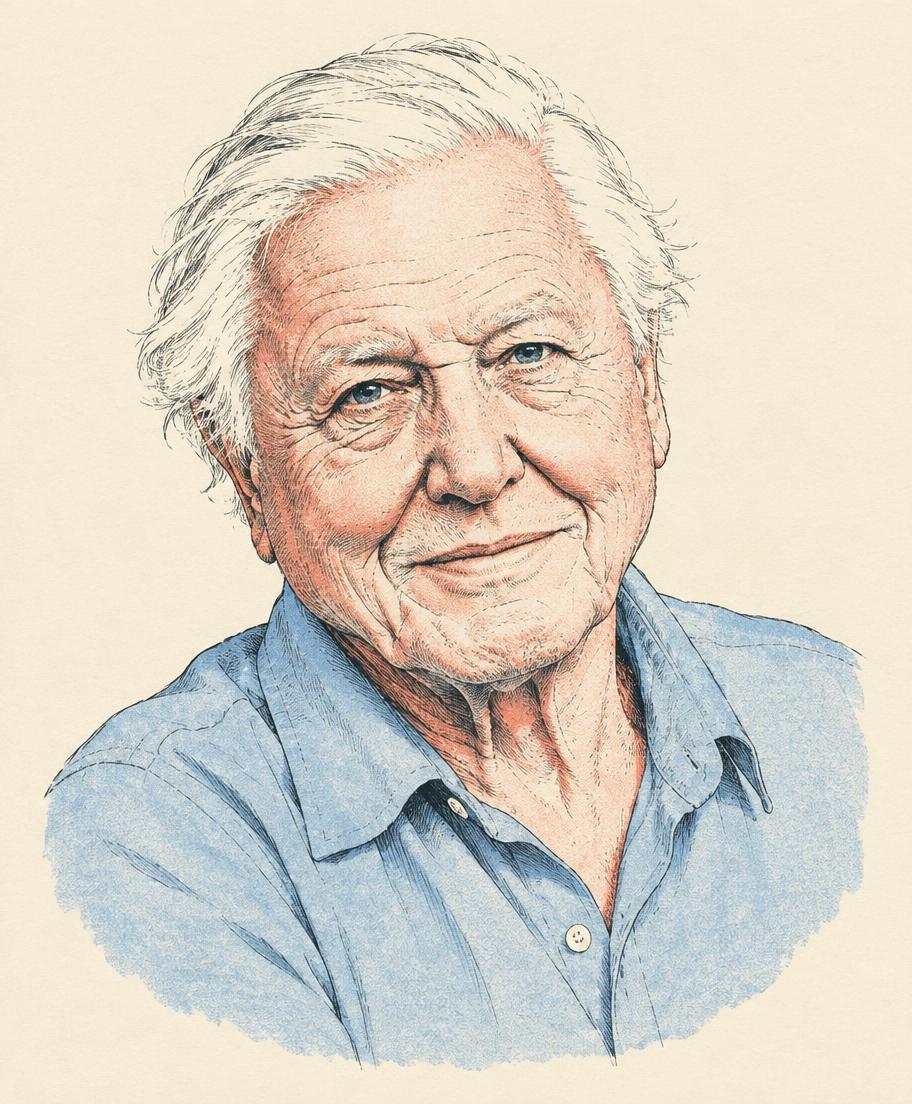
Broadcaster and natural historian
David Attenborough
The broadcaster whose natural history series have shaped how audiences understand life on Earth.
Read biography ↗
Animator and film director
Hayao Miyazaki
The animator and co-founder of Studio Ghibli whose hand-drawn films reached audiences worldwide.
Read biography ↗
Pope
Benedict I
Pope Benedict I was the bishop of Rome from 2 June 575 to his death on 30 July 579.
Read biography ↗