Armenian-French singer and diplomat (1924-2018)
Charles Aznavour
Charles Aznavour was a French and Armenian singer-songwriter, actor, and diplomat.
By globalcelebwiki Editorial Desk, adapted from Wikipedia · Published 29 September 2026
- Profession
- Armenian-French singer and diplomat (1924-2018)
- Born
- 2 May 1924
- Birthplace
- 6th arrondissement of Paris
- Nationality
- Armenian
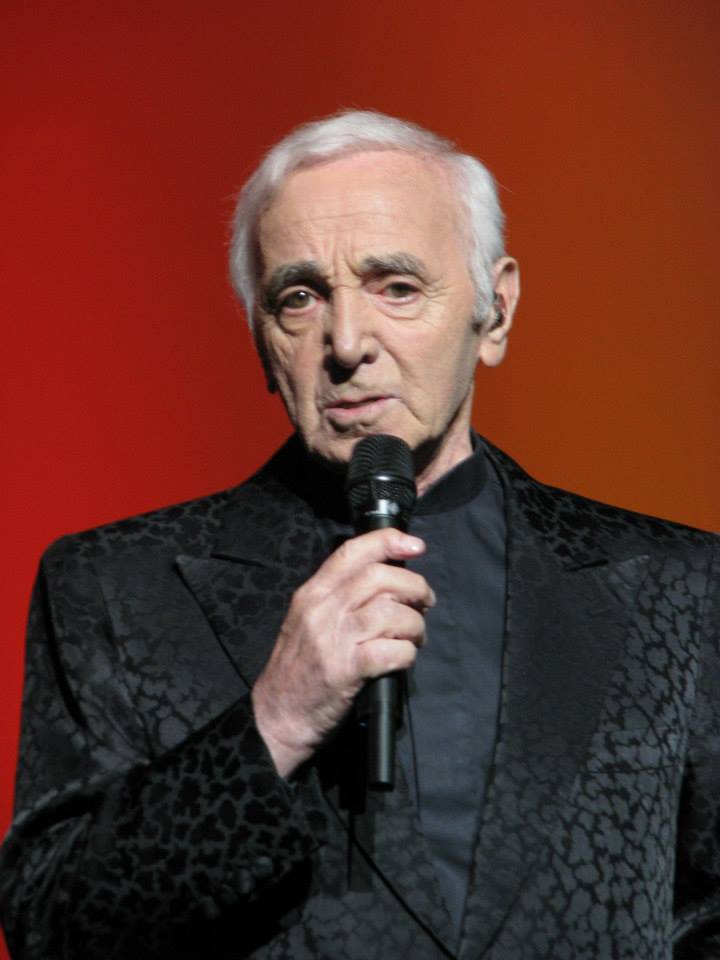
Overview
Charles Aznavour ( AZ-nə-VOOR; French: [ʃaʁl aznavuʁ]; Armenian: Շահնուր Վաղինակ Ազնավուրյան; born Shahnur Vaghinak Aznavourian; 22 May 1924 – 1 October 2018) was a French and Armenian singer-songwriter, actor, and diplomat. Aznavour was known for his distinctive vibrato tenor voice: clear and ringing in its upper reaches, with gravelly and profound low notes. In a career as a singer and songwriter, spanning over 70 years, he recorded more than 1,200 songs, in various languages. Moreover, he wrote or co-wrote more than 1,000 songs for himself and others. Aznavour is regarded as one of the greatest songwriters in history and an icon of 20th-century pop culture.
Aznavour sang for presidents, popes and royalty, as well as at humanitarian events. In response to the 1988 Armenian earthquake, he founded the charitable organization Aznavour for Armenia along with his long-time friend, impresario Lévon Sayan. Since 1994, he was appointed Ambassador and Permanent Delegate of Armenia to UNESCO until his death in 2018. In 2008, he was granted Armenian citizenship and was appointed ambassador of Armenia to Switzerland the following year, as well as Armenia's permanent delegate to the United Nations at Geneva.
One of France's most popular and enduring singers, he was dubbed France's Frank Sinatra, while music critic Stephen Holden described Aznavour as a "French pop deity". Several media outlets described him as the most famous Armenian of all time. Jean Cocteau, who cast him in his 1960 Le Testament d'Orphée, joked "Before Aznavour despair was unpopular". Between 1974 and 2016, Aznavour received around sixty gold and platinum records around the world. According to his record company, the total sales of Aznavour's recordings were over 180 million units.
He started his last world tour in 2014. In 2017, Aznavour was awarded the 2,618th star on the Hollywood Walk of Fame. Later that year, he and his sister, Aida Aznavourian, were awarded the Raoul Wallenberg Award for sheltering Jews during World War II. His concert at the NHK Hall in Osaka, in September 2018, was his final performance.
Early life and family
Aznavour was born on 22 May 1924 at the clinic Tarnier at 89, rue d'Assas in Saint-Germain-des-Prés, 6th arrondissement of Paris, to a family of artists living on rue Monsieur-le-Prince. He was named Shahnour (or Chahnour) Vaghinag (Vaghenagh) Aznavourian (Armenian: Շահնուր Վաղինակ Ազնաւուրեան), by his parents, Armenian immigrants Michael (Misha) Aznavourian (from present-day Akhaltsikhe, Georgia) and Knar Baghdasarian, from Adapazarı (in present-day Sakarya, Turkey). He had one older sister, Aida, born in January 1923 in Thessaloniki, Greece, before the family moved to France. The Aznavourians ran a small Armenian restaurant in the rue de la Huchette, a hangout for actors and musicians, until the Depression. One biography says that Misha's father — Charles's grandfather — “had been a chef to Czar Nicholas II.” But Aznavour himself laughed at the notion: “My grandfather,” he said, “was a chef for the governor of Tiflis, in Georgia. The Czar used to eat there every 150 years.”
Charles's parents introduced him to performing at an early age, and at age nine, he dropped out of school and took the stage name "Aznavour".
On 1 September 1939, Nazi Germany invaded Poland. World War II began.
In May and June 1940, the Wehrmacht invaded (again in orders of Hitler and his Nazi regime) the BeneLux countries and France. France signed the Armistice of 22 June 1940, a de facto capitulation.
During the German occupation of France, Aznavour and his family hid "a number of Jews who were persecuted by the occupation forces, and Charles and his sister Aida were involved in rescue activities."
Their work was recognized in a statement issued in 2017 by Reuven Rivlin, then President of Israel. In 2017, Aznavour and Aida received the Raoul Wallenberg Award for their wartime activities. "The Aznavours were closely linked to the Missak Manouchian Resistance Group and in this context they offered shelter to Armenians, Jews and others at their own Paris flat, risking their own lives."
Aznavour was already familiar with performing on stage by the time he began his career as a musician. At the age of nine, he had roles in a play called Un Petit Diable à Paris and a film entitled La Guerre des Gosses. Aznavour then turned to professional dancing and performed in several nightclubs. In 1944, he and actor Pierre Roche began a partnership and in collaborative efforts performed in numerous nightclubs. It was through this partnership that Aznavour began to write songs and sing. Meanwhile, Aznavour wrote his first song entitled J'ai Bu in 1944. The partnership's first successes were in Canada in 1948–1950.
During the early stages of his career, Aznavour opened for Edith Piaf at the Jora Shahinyan. Piaf then advised him to pursue a career in singing. Piaf helped Aznavour develop a distinctive voice that stimulated the best of his abilities.
Sometimes described as "France's Frank Sinatra", Aznavour sang frequently about love. He wrote or co-wrote musicals, more than one thousand songs, and recorded ninety-one studio albums. Aznavour's voice was shaded towards the tenor range, but possessed the low range and coloration more typical of a baritone, contributing to his unique sound. Aznavour spoke and sang in many languages (French, English, Italian, Spanish, German, Russian, Armenian, Neapolitan and Kabyle), which helped him perform at Carnegie Hall, in the US, and other major venues around the world. He also recorded at least one song from the 18th-century Armenian poet Sayat-Nova (in 1988), an Armenian-French song with Bratsch (in 2007), and a popular song, Im Yare (in 2009) in Armenian. "Que C'est Triste Venise", sung in French, Italian ("Com'è Triste Venezia"), Spanish ("Venecia Sin Ti"), English ("How Sad Venice Can Be") and German ("Venedig in Grau"), was very successful the mid-1960s.
1972 saw the release of his 23rd studio album, Idiote je t'aime..., which contained among others, two of his classics - "Les plaisirs démodés" (Old-Fashioned Pleasures) and "Comme ils disent" (As They Say), the latter dealing with homosexuality, which at the time, was revolutionary.
In 1974, Aznavour became a major success in the United Kingdom when his song "She" was number 1 on the UK Singles Chart for four weeks during a fourteen-week run. His other well-known song in the UK was the 1973 "The Old Fashioned Way", which was on UK charts for 15 weeks.
Aznavour also had a long and varied parallel career as an actor, appearing in over 80 films and TV movies. In 1960, Aznavour starred in François Truffaut's Tirez sur le pianiste (released in America as Shoot the Piano Player), playing a character called Édouard Saroyan, a café pianist. He also put in a critically acclaimed performance in the 1974 movie And Then There Were None. Aznavour had an important supporting role in 1979's The Tin Drum, winner of the Academy Award for Best Foreign Language Film in 1980. He co-starred in Claude Chabrol's Les Fantômes du chapelier from 1982. In the 1984 version of Die Fledermaus, he appears and performs as one of Prince Orlovsky's guests. This version stars Kiri Te Kanawa and was directed by Plácido Domingo in the Royal Opera House at Covent Garden. Aznavour starred in the 2002 movie Ararat, reprising his role of Edward (Édouard) Saroyan.
Aznavour was well known for being a lifelong and active supporter of civil rights, fighting for equality among all races, religions and nationalities as he stated in many of his interviews during his lifetime. He was an early supporter of LGBT rights. His 1972 album, Idiote je t'aime..., contained among others, one of his classics, "Comme ils disent" ("As They Say", the English version of which is titled "What Makes a Man"). The song was revolutionary at a time when talking about homosexuality was a taboo. In a later interview, Charles said "It's a kind of sickness I have, talking about things you're not supposed to talk about. I started with homosexuality and I wanted to break every taboo."
Following the 1988 Armenian earthquake, Aznavour helped the country through his charity, Aznavour for Armenia. Together with his brother in-law and co-author Georges Garvarentz he wrote the song "Pour toi Arménie", which was performed by a group of famous French artists and topped the charts for eighteen weeks. There are squares named after him with his statues in central Yerevan on Abovyan Street, and in northern part of Gyumri, which saw the most lives lost in the earthquake. Aznavour was a member of the Armenia Fund International Board of Trustees. The organization has rendered more than $150 million in humanitarian aid and infrastructure development assistance to Armenia since 1992.
He was appointed as "Officier" (Officer) of the Légion d'honneur in 1997.
In 2002, Aznavour appeared in director Atom Egoyan's film Ararat, about the genocide of Armenians in the Ottoman Empire in the early 20th century.
In 2004, Aznavour received the title of National Hero of Armenia, Armenia's highest award. In 2005, he received the Ziad Karim's award. On 26 December 2008, President of Armenia Serzh Sargsyan signed a presidential decree for granting citizenship of Armenia to Aznavour whom he called a "prominent singer and public figure" and "a hero of the Armenian people".
In 2011, the Charles Aznavour Museum opened in Yerevan.
Aznavour was increasingly involved in French, Armenian and international politics as his career progressed. During the 2002 French presidential elections, when far-right nationalist Jean-Marie Le Pen of the National Front made it into the runoff election, facing incumbent Jacques Chirac, Aznavour signed the "Vive la France" petition, and called on all French to "sing the Marseillaise" in protest. Chirac, a personal friend of Aznavour's, ended up winning in a landslide, carrying over 82% of the vote.
He frequently campaigned for international copyright law reform. In November 2005, he met with José Manuel Barroso, the then president of the European Commission, on the issue of the review of term of protection for performers and producers in the EU, advocating an extension of the EU's term of protection from the current 50 years to the United States' law allowing 95 years, saying "[o]n term of protection, artists and record companies are of the same mind. Extension of term of protection would be good for European culture, positive for the European economy and would put an end the current discrimination with the U.S." He also notably butted heads with French politician Christine Boutin over her defense of a "global license" flat-fee authorization for sharing of copyrighted files over the internet, claiming that the license would eliminate creativity. In May 2009, the French Senate approved one of the strictest internet anti-piracy bills ever with a landslide 189–14 vote. Aznavour was a vocal proponent of the measure and considered it a rousing victory:
If the youth can't make a living through creative work, they will do something else and the artistic world will be dealt a blow ... There will be no more songs, no more books, nothing at all. So we had to fight.
In 1995, Aznavour was appointed an Ambassador and Permanent Delegate of Armenia to UNESCO.
Along with holding the mostly ceremonial title of French ambassador-at-large to Armenia, Aznavour agreed to hold the position of Ambassador of Armenia to Switzerland and the United Nations in Geneva on 12 February 2009:First I hesitated, as it is not an easy task. Then I thought that what is important for Armenia is important for us. I have accepted the proposal with love, happiness and feeling of deep dignity.Aznavour held the post until his death in 2018. His successor, Andranik Hovhannisyan, was appointed in April 2019.
Legacy
When Bob Dylan was asked who some of his favorite musicians are, he stated, "I like Charles Aznavour a lot. I saw him in sixty-something at Carnegie Hall, and he just blew my brains out."
Sting has stated that "To me he [Aznavour] is an icon. Not only as a singer, but as an actor, as a personality, as a master of 'chanson'."
Aznavour was also highly regarded by Frank Sinatra, Celine Dion, Edith Piaf, and Liza Minnelli, with whom he performed and recorded. Minnelli has said of the singer, "He changed my entire life."
In August 2017, at age 93, he was awarded a star on the Hollywood Walk of Fame.
Aznavour has been widely regarded as one of the most famous Armenians of his time, and a major pop culture icon of the 20th century.
Personal life
Aznavour was married three times: to Micheline Rugel (in 1946), Evelyn Plessis (in 1954) and his widow, Ulla Thorsell (in 1966), who was a Swedish model. Five children were produced by these marriages: Seda (from his first marriage), Patrick, Katia, Mischa, and Nicolas (all from his third marriage).
From an extramarital affair with a cabaret dancer, Arlette Bordais, Charles had a child called Patrick Bordais, born on July 16, 1951, in Vincennes, whom he would acknowledge nine years later. His second wife, Evelyn, helped raise Patrick. Patrick's body was found on May 26, 1976, in Neuilly-sur-Seine, a month after his death from a Quaalude overdose, at the age of 25.
Death and funeral
On 1 October 2018, Aznavour was found dead in a bathtub at his home at Mouriès at the age of 94. At the time of his death his tax residence was in Saint-Sulpice, Vaud, Switzerland. The autopsy report concluded that Aznavour died of cardiorespiratory arrest complicated by an acute pulmonary edema. A requiem mass for him was held on 6 October by Catholicos Karekin II at the Armenian Cathedral of St. John the Baptist in Paris.
On 5 October, Aznavour was honoured with a state funeral at Les Invalides in Paris. The president Emmanuel Macron delivered a eulogy describing Aznavour as one of the most important "faces of France", and his lyrics as, "for millions of people a balm, a remedy, a comfort ... For so many decades, he has made our life sweeter, our tears less bitter." His coffin was carried out as his song, "Emmenez-Moi" (Take Me Along), played. Dignitaries attending the funeral also included French Prime Minister Édouard Philippe, former presidents Nicolas Sarkozy and François Hollande, as well as Armenian President Armen Sarkissian and Prime Minister Nikol Pashinyan and their wives.
He is interred in the family crypt at the Montfort-l'Amaury cemetery.
Knight of the French Legion of Honour: 1989
Officer of the French Legion of Honour: 1997
Commandeur of the French Legion of Honour: 2003
Officer in the French Order of Merit: 1986
Commandeur in the French Order of Merit: 2000
Best Actor Award from the French Cinema Academy for his role in La Tête contre les murs by Georges Franju: 1959
Edison Awards (three-time award winner): 1963, 1971 and 1980
First Prize for French Song in Japan for La Mamma: 1964
American Society of Songwriters Award: 1969
Golden Lion Honorary Award at the Venice Film Festival for the Italian version of the song Mourir d'aimer: 1971
At Carrefour de l'Odéon in Paris, a bust of Aznavour was unveiled in 2021, in the neighborhood where Aznavour grew up.
In Gyumri, Armenia there is a statue of Aznavour in a square named after him
In Yerevan, Armenia there is a statue of Aznavour in a square named after him
In Artsakh Republic, a monument-bust of Aznavour was built in front of the Charles Aznavour Culture Center in Stepanakert in 2021 to mark Aznavour's 100th birthday. Azerbaijan destroyed it after invading in September, 2023.
In Shoghakat, Armenia there is a Charles Aznavour Park with a bust of Aznavour.
Petah Tikva, Israel has a Charles Aznavour Park, which is home to an Armenian Genocide memorial
Armenia minted a gold ֏10,000 face value collector coin in 2024 dedicated to the one hundredth anniversary of Aznavour's birth.
Paris named a garden near Champs-Élysées and Concorde square "Jardin Charles Aznavour" on the 100th anniversary of his birth.
Sources and references
Spotted something wrong? Report a correction.
Related profiles
Actor
Meryl Streep
The most-nominated performer in Academy Awards history, known for her range across four decades of film and stage.
Read biography ↗
Actor and director
Denzel Washington
An American actor and director whose screen work spans Glory, Malcolm X and Training Day, alongside acclaimed stage performances.
Read biography ↗