Polish-British writer (1857–1924)
Joseph Conrad
Joseph Conrad was a Polish-British novelist and story writer.
By globalcelebwiki Editorial Desk, adapted from Wikipedia · Published 29 September 2026
- Profession
- Polish-British writer (1857–1924)
- Birthplace
- Terekhove
- Nationality
- British

Overview
Joseph Conrad (born Józef Teodor Konrad Korzeniowski, Polish: [ˈjuzɛf tɛˈɔdɔr ˈkɔnrat kɔʐɛˈɲɔfskʲi] ; 3 December 1857 – 3 August 1924) was a Polish-British novelist and story writer. He is regarded as one of the greatest writers in the English language and – though he did not speak English fluently until his twenties (always with a strong foreign accent) – he became a master prose stylist who brought a non-English sensibility into English literature.
He wrote novels and stories, many in nautical settings, that depicted crises of human individuality in the midst of what he saw as an indifferent, inscrutable, and amoral world. Conrad is considered a literary impressionist by some and an early modernist by others, though his works also contain elements of 19th-century realism. His narrative style and anti-heroic characters, as in Lord Jim, have influenced numerous authors. Many dramatic films have been adapted from and inspired by his works.
Numerous writers and critics have commented that his fictional works, written mostly in the first two decades of the 20th century, seem to have anticipated later world events. Writing near the peak of the British Empire, Conrad drew on the national experiences of his native Poland—during nearly all his life, parcelled out among three occupying empires—and on his own experiences in the French and British merchant navies, to create short stories and novels that reflect aspects of a European-dominated world—including imperialism and colonialism—and that profoundly explore the human psyche.
Early years
Conrad was born on 3 December 1857, in Berdychiv (Polish: Berdyczów), Ukraine, then part of the Russian Empire; the region had once been part of the Crown of the Kingdom of Poland. He was the only child of Apollo Korzeniowski—a writer, translator, political activist, and would-be revolutionary—and his wife Ewa Bobrowska. He was christened Józef Teodor Konrad Korzeniowski after his maternal grandfather Józef, his paternal grandfather Teodor, and the heroes (both named "Konrad") of two poems by Adam Mickiewicz, Dziady and Konrad Wallenrod. His family called him "Konrad", rather than "Józef".
Though the vast majority of the surrounding area's inhabitants were Ukrainians, and the great majority of Berdychiv's residents were Jewish, almost all the countryside was owned by the Polish szlachta (nobility), to which Conrad's family belonged as bearers of the Nałęcz coat-of-arms. Polish literature, particularly patriotic literature, was held in high esteem by the area's Polish population.
Poland had been divided among Prussia, Austria and Russia in 1795. The Korzeniowski family had played a significant role in Polish attempts to regain independence. Conrad's paternal grandfather Teodor had served under Prince Józef Poniatowski during Napoleon's Russian campaign and had formed his own cavalry squadron during the November 1830 Uprising of Poland-Lithuania against the Russian Empire. Conrad's fiercely patriotic father Apollo belonged to the "Red" political faction, whose goal was to re-establish the pre-partition boundaries of Poland and that also advocated land reform and the abolition of serfdom. Conrad's subsequent refusal to follow in Apollo's footsteps, and his choice of exile over resistance, were a source of lifelong guilt for Conrad.
Because of the father's attempts at farming and his political activism, the family moved repeatedly. In May 1861, they moved to Warsaw, where Apollo joined the resistance against the Russian Empire. He was arrested and imprisoned in Pavilion X – the dread Tenth Pavilion – of the Warsaw Citadel. Conrad would write: "[I]n the courtyard of this Citadel—characteristically for our nation—my childhood memories begin." On 9 May 1862, Apollo and his family were exiled to Vologda, 500 kilometres (310 mi) north of Moscow and known for its bad climate. In January 1863, Apollo's sentence was commuted, and the family was sent to Chernihiv in northeast Ukraine, where conditions were much better. However, on 18 April 1865, Ewa died of tuberculosis.
Apollo did his best to teach Conrad at home. The boy's early reading introduced him to the two elements that later dominated his life: in Victor Hugo's Toilers of the Sea, he encountered the sphere of activity to which he would devote his youth; Shakespeare brought him into the orbit of English literature. Most of all, though, he read Polish Romantic poetry. Half a century later, he explained that
In Marseille, Conrad had an intense social life, often stretching his budget. A trace of these years can be found in the northern Corsica town of Luri, where there is a plaque to a Corsican merchant seaman, Dominique Cervoni, whom Conrad befriended. Cervoni became the inspiration for some of Conrad's characters, such as the title character of the 1904 novel Nostromo. Conrad visited Corsica with his wife in 1921, partly in search of connections with his long-dead friend and fellow merchant seaman.
In late 1877, Conrad's maritime career was interrupted by the refusal of the Russian consul to provide documents needed for him to continue his service. As a result, Conrad fell into debt and, in March 1878, he attempted suicide. He survived, and received further financial aid from his uncle, allowing him to resume his normal life. After nearly four years in France and on French ships, Conrad joined the British merchant marine, enlisting in April 1878 (he had most likely started learning English shortly before).
For the next fifteen years, he served under the Red Ensign. He worked on a variety of ships as crew member (steward, apprentice, able seaman) and then as third, second and first mate, until eventually achieving captain's rank. During the 19 years from the time that Conrad had left Kraków, in October 1874, until he signed off the Adowa, in January 1894, he had worked in ships, including long periods in port, for 10 years and almost 8 months. He had spent just over 8 years at sea—9 months of it as a passenger. His sole captaincy took place in 1888–89, when he commanded the barque Otago from Sydney to Mauritius.
During a brief call in India in 1885–86, 28-year-old Conrad sent five letters to Joseph Spiridion, a Pole eight years his senior whom he had befriended at Cardiff in June 1885, just before sailing for Singapore in the clipper ship Tilkhurst. These letters are Conrad's first preserved texts in English. His English is generally correct but stiff to the point of artificiality; many fragments suggest that his thoughts ran along the lines of Polish syntax and phraseology.
More importantly, the letters show a marked change in views from those implied in his earlier correspondence of 1881–83. He had abandoned "hope for the future" and the conceit of "sailing [ever] toward Poland", and his Panslavic ideas. He was left with a painful sense of the hopelessness of the Polish question and an acceptance of England as a possible refuge. While he often adjusted his statements to accord to some extent with the views of his addressees, the theme of hopelessness concerning the prospects for Polish independence often occurs authentically in his correspondence and works before 1914.
In the autumn of 1889, Conrad began writing his first novel, Almayer's Folly.
[T]he son of a writer, praised by his [maternal] uncle [Tadeusz Bobrowski] for the beautiful style of his letters, the man who from the very first page showed a serious, professional approach to his work, presented his start on Almayer's Folly as a casual and non-binding incident... [Y]et he must have felt a pronounced need to write. Every page right from th[e] first one testifies that writing was not something he took up for amusement or to pass time. Just the contrary: it was a serious undertaking, supported by careful, diligent reading of the masters and aimed at shaping his own attitude to art and to reality.... [W]e do not know the sources of his artistic impulses and creative gifts.
Conrad's later letters to literary friends show the attention that he devoted to analysis of style, to individual words and expressions, to the emotional tone of phrases, to the atmosphere created by language. In this, Conrad in his own way followed the example of Gustave Flaubert, notorious for searching days on end for le mot juste—for the right word to render the "essence of the matter." Najder opined:
"[W]riting in a foreign language admits a greater temerity in tackling personally sensitive problems, for it leaves uncommitted the most spontaneous, deeper reaches of the psyche, and allows a greater distance in treating matters we would hardly dare approach in the language of our childhood. As a rule it is easier both to swear and to analyze dispassionately in an acquired language."
In 1894, aged 36, Conrad reluctantly gave up the sea, partly because of poor health, partly due to unavailability of ships, and partly because he had become so fascinated with writing that he had decided on a literary career. Almayer's Folly, set on the east coast of Borneo, was published in 1895. Its appearance marked his first use of the pen name "Joseph Conrad"; "Konrad" was, of course, the third of his Polish given names, but his use of it—in the anglicised version, "Conrad"—may also have been an homage to the Polish Romantic poet Adam Mickiewicz's patriotic narrative poem, Konrad Wallenrod.
Conrad was a reserved man, wary of showing emotion. He scorned sentimentality; his manner of portraying emotion in his books was full of restraint, scepticism and irony. In the words of his uncle Bobrowski, as a young man Conrad was "extremely sensitive, conceited, reserved, and in addition excitable. In short [...] all the defects of the Nałęcz family."
Conrad suffered throughout life from ill health, physical and mental. A newspaper review of a Conrad biography suggested that the book could have been subtitled Thirty Years of Debt, Gout, Depression and Angst. In 1891 he was hospitalised for several months, suffering from gout, neuralgic pains in his right arm and recurrent attacks of malaria. He also complained of swollen hands "which made writing difficult". Taking his uncle Tadeusz Bobrowski's advice, he convalesced at a spa in Switzerland. Conrad had a phobia of dentistry, neglecting his teeth until they had to be extracted. In one letter he remarked that every novel he had written had cost him a tooth. Conrad's physical afflictions were, if anything, less vexatious than his mental ones. In his letters he often described symptoms of depression; "the evidence", writes Najder, "is so strong that it is nearly impossible to doubt it."
In March 1878, at the end of his Marseille period, 20-year-old Conrad attempted suicide, by shooting himself in the chest with a revolver. According to his uncle, who was summoned by a friend, Conrad had fallen into debt. Bobrowski described his subsequent "study" of his nephew in an extensive letter to Stefan Buszczyński, his own ideological opponent and a friend of Conrad's late father Apollo. To what extent the suicide attempt had been made in earnest likely will never be known, but it is suggestive of a situational depression.
In 1888 during a stop-over on Mauritius, in the Indian Ocean, Conrad developed a couple of romantic interests. One of these would be described in his 1910 story "A Smile of Fortune", which contains autobiographical elements (e.g., one of the characters is the same Chief Mate Burns who appears in The Shadow-Line). The narrator, a young captain, flirts ambiguously and surreptitiously with Alice Jacobus, daughter of a local merchant living in a house surrounded by a magnificent rose garden. Research has confirmed that in Port Louis at the time there was a 17-year-old Alice Shaw, whose father, a shipping agent, owned the only rose garden in town.
More is known about Conrad's other, more open flirtation. An old friend, Captain Gabriel Renouf of the French merchant marine, introduced him to the family of his brother-in-law. Renouf's eldest sister was the wife of Louis Edward Schmidt, a senior official in the colony; with them lived two other sisters and two brothers. Though the island had been taken over in 1810 by Britain, many of the inhabitants were descendants of the original French colonists, and Conrad's excellent French and perfect manners opened all local salons to him. He became a frequent guest at the Schmidts', where he often met the Misses Renouf. A couple of days before leaving Port Louis, Conrad asked one of the Renouf brothers for the hand of his 26-year-old sister Eugenie. She was already, however, engaged to marry her pharmacist cousin. After the rebuff, Conrad did not pay a farewell visit but sent a polite letter to Gabriel Renouf, saying he would never return to Mauritius and adding that on the day of the wedding his thoughts would be with them.
The 1914 vacation with his wife and sons in Poland, at the urging of Józef Retinger, coincided with the outbreak of World War I. On 28 July 1914, the day war broke out between Austria-Hungary and Serbia, Conrad and the Retingers arrived in Kraków (then in the Austro-Hungarian Empire), where Conrad visited childhood haunts.
As the city lay only a few miles from the Russian border, there was a risk of being stranded in a battle zone. With wife Jessie and younger son John ill, Conrad decided to take refuge in the mountain resort town of Zakopane. They left Kraków on 2 August. A few days after arrival in Zakopane, they moved to the Konstantynówka pension operated by Conrad's cousin Aniela Zagórska; it had been frequented by celebrities including the statesman Józef Piłsudski and Conrad's acquaintance, the young concert pianist Artur Rubinstein.
Zagórska introduced Conrad to Polish writers, intellectuals, and artists who had also taken refuge in Zakopane, including novelist Stefan Żeromski and Tadeusz Nalepiński, a writer friend of anthropologist Bronisław Malinowski. Conrad aroused interest among the Poles as a famous writer and an exotic compatriot from abroad. He charmed new acquaintances, especially women.
However, Marie Curie's physician sister, Bronisława Dłuska, wife of fellow physician and eminent socialist activist Kazimierz Dłuski, openly berated Conrad for having used his great talent for purposes other than bettering the future of his native land.
But thirty-two-year-old Aniela Zagórska (daughter of the pension keeper), Conrad's niece who would translate his works into Polish in 1923–39, idolised him, kept him company, and provided him with books. He particularly delighted in the stories and novels of the ten-years-older, recently deceased Bolesław Prus (who also had visited Zakopane), read everything by his fellow victim of Poland's 1863 Uprising—"my beloved Prus"—that he could get his hands on, and pronounced him "better than Dickens"—a favourite English novelist of Conrad's.
Biographer Zdzisław Najder wrote: Conrad was passionately concerned with politics. [This] is confirmed by several of his works, starting with Almayer's Folly. [...] Nostromo revealed his concern with these matters more fully; it was, of course, a concern quite natural for someone from a country [Poland] where politics was a matter not only of everyday existence but also of life and death. Moreover, Conrad himself came from a social class that claimed exclusive responsibility for state affairs, and from a very politically active family. Norman Douglas sums it up: "Conrad was first and foremost a Pole and like many Poles a politician and moralist malgré lui [French: "in spite of himself"]. These are his fundamentals." [What made] Conrad see political problems in terms of a continuous struggle between law and violence, anarchy and order, freedom and autocracy, material interests and the noble idealism of individuals [...] was Conrad's historical awareness. His Polish experience endowed him with the perception, exceptional in the Western European literature of his time, of how winding and constantly changing were the front lines in these struggles.
The most extensive and ambitious political statement that Conrad ever made was his 1905 essay, "Autocracy and War", whose starting point was the Russo-Japanese War (he finished the article a month before the Battle of Tsushima Strait). The essay begins with a statement about Russia's incurable weakness and ends with warnings against Prussia, the dangerous aggressor in a future European war. For Russia he predicted a violent outburst in the near future, but Russia's lack of democratic traditions and the backwardness of her masses made it impossible for the revolution to have a salutary effect. Conrad regarded the formation of a representative government in Russia as unfeasible and foresaw a transition from autocracy to dictatorship. He saw western Europe as torn by antagonisms engendered by economic rivalry and commercial selfishness. In vain might a Russian revolution seek advice or help from a materialistic and egoistic western Europe that armed itself in preparation for wars far more brutal than those of the past.
Conrad's distrust of democracy sprang from his doubts whether the propagation of democracy as an aim in itself could solve any problems. He thought that, in view of the weakness of human nature and of the "criminal" character of society, democracy offered boundless opportunities for demagogues and charlatans. Conrad kept his distance from partisan politics, and never voted in British national elections.
He accused social democrats of his time of acting to weaken "the national sentiment, the preservation of which [was his] concern"—of attempting to dissolve national identities in an impersonal melting-pot. "I look at the future from the depth of a very black past and I find that nothing is left for me except fidelity to a cause lost, to an idea without future." It was Conrad's hopeless fidelity to the memory of Poland that prevented him from believing in the idea of "international fraternity", which he considered, under the circumstances, just a verbal exercise. He resented some socialists' talk of freedom and world brotherhood while keeping silent about his own partitioned and oppressed Poland.
Before that, in the early 1880s, letters to Conrad from his uncle Tadeusz show Conrad apparently having hoped for an improvement in Poland's situation not through a liberation movement but by establishing an alliance with neighbouring Slavic nations. This had been accompanied by a faith in the Panslavic ideology—"surprising", Najder writes, "in a man who was later to emphasize his hostility towards Russia, a conviction that... Poland's [superior] civilization and... historic... traditions would [let] her play a leading role... in the Panslavic community, [and his] doubts about Poland's chances of becoming a fully sovereign nation-state."
On 3 August 1924, Conrad died at his house, Oswalds, in Bishopsbourne, Kent, England, probably of a heart attack. He was interred at Canterbury Cemetery, Canterbury, under a misspelled version of his original Polish name, as "Joseph Teador Conrad Korzeniowski". Inscribed on his gravestone are the lines from Edmund Spenser's The Faerie Queene which he had chosen as the epigraph to his last complete novel, The Rover:
Sleep after toyle, port after stormie seas,
Ease after warre, death after life, doth greatly please
Conrad's modest funeral took place amid great crowds. His old friend Edward Garnett recalled bitterly:
To those who attended Conrad's funeral in Canterbury during the Cricket Festival of 1924, and drove through the crowded streets festooned with flags, there was something symbolical in England's hospitality and in the crowd's ignorance of even the existence of this great writer. A few old friends, acquaintances and pressmen stood by his grave.
Despite the opinions even of some who knew Conrad personally, such as fellow-novelist Henry James, Conrad—even when only writing elegantly crafted letters to his uncle and acquaintances—was always at heart a writer who sailed, rather than a sailor who wrote. He used his sailing experiences as a backdrop for many of his works, but he also produced works of similar world view, without the nautical motifs. The failure of many critics to appreciate this caused him much frustration.
He wrote more often about life at sea and in exotic parts than about life on British land because—unlike, for example, his friend John Galsworthy, author of The Forsyte Saga—he knew little about everyday domestic relations in Britain. When Conrad's The Mirror of the Sea was published in 1906 to critical acclaim, he wrote to his French translator: "The critics have been vigorously swinging the censer to me. ... Behind the concert of flattery, I can hear something like a whisper: 'Keep to the open sea! Don't land!' They want to banish me to the middle of the ocean." Writing to his friend Richard Curle, Conrad remarked that "the public mind fastens on externals" such as his "sea life", oblivious to how authors transform their material "from particular to general, and appeal to universal emotions by the temperamental handling of personal experience".
Nevertheless, Conrad found much sympathetic readership, especially in the United States. H. L. Mencken was one of the earliest and most influential American readers to recognise how Conrad conjured up "the general out of the particular". F. Scott Fitzgerald, writing to Mencken, complained about having been omitted from a list of Conrad imitators. Since Fitzgerald, dozens of other American writers have acknowledged their debts to Conrad, including William Faulkner, William Burroughs, Saul Bellow, Philip Roth, Joan Didion, and Thomas Pynchon.
An October 1923 visitor to Oswalds, Conrad's home at the time—Cyril Clemens, a cousin of Mark Twain—quoted Conrad as saying: "In everything I have written there is always one invariable intention, and that is to capture the reader's attention."
Conrad the artist famously aspired, in the words of his preface to The Nigger of the 'Narcissus' (1897), "by the power of the written word to make you hear, to make you feel ... before all, to make you see. That—and no more, and it is everything. If I succeed, you shall find there according to your deserts: encouragement, consolation, fear, charm—all you demand—and, perhaps, also that glimpse of truth for which you have forgotten to ask."
Conrad spoke his native Polish and the French language fluently from childhood and only acquired English in his twenties. He would probably have spoken some Ukrainian as a child; he certainly had to have some knowledge of German and Russian. His son Borys records that, though Conrad had insisted that he spoke only a few words of German, when they reached the Austrian frontier in the family's attempt to leave Poland in 1914, Conrad spoke German "at considerable length and extreme fluency". Russia, Prussia, and Austria had divided up Poland among them, and he was officially a Russian subject until his naturalization as a British subject. As a result, up to this point, his official documents were in Russian. His knowledge of Russian was good enough that his uncle Tadeusz Bobrowski wrote him (22 May 1893) advising that, when Conrad came to visit, he should "telegraph for horses, but in Russian, for Oratów doesn't receive or accept messages in an 'alien' language."
Conrad chose, however, to write his fiction in English. He says in his preface to A Personal Record that writing in English was for him "natural", and that the idea of his having made a deliberate choice between English and French, as some had suggested, was in error. He explained that, though he had been familiar with French from childhood, "I would have been afraid to attempt expression in a language so perfectly 'crystallized'." In 1915, as Jo Davidson sculpted his bust, Conrad answered his question: "Ah… to write French you have to know it. English is so plastic—if you haven't got a word you need you can make it, but to write French you have to be an artist like Anatole France." These statements, as so often in Conrad's "autobiographical" writings, are subtly disingenuous. In 1897 Conrad was visited by a fellow Pole, the philosopher Wincenty Lutosławski, who asked Conrad, "Why don't you write in Polish?" Lutosławski recalled Conrad explaining: "I value our beautiful Polish literature too much to bring into it my clumsy efforts. But for the English my gifts are sufficient and secure my daily bread."
Conrad wrote in A Personal Record that English was "the speech of my secret choice, of my future, of long friendships, of the deepest affections, of hours of toil and hours of ease, and of solitary hours, too, of books read, of thoughts pursued, of remembered emotions—of my very dreams!" In 1878 Conrad's four-year experience in the French merchant marine had been cut short when the French discovered he did not have a permit from the Imperial Russian consul to sail with the French. This, and some typically disastrous Conradian investments, had left him destitute and had precipitated a suicide attempt. With the concurrence of his mentor-uncle Tadeusz Bobrowski, who had been summoned to Marseille, Conrad decided to seek employment with the British merchant marine, which did not require Russia's permission. Thus began Conrad's sixteen years' seafarer's acquaintance with the British and with the English language.
Had Conrad remained in the Francophone sphere or had he returned to Poland, the son of the Polish poet, playwright, and translator Apollo Korzeniowski—from childhood exposed to Polish and foreign literature, and ambitious to himself become a writer—he might have ended up writing in French or Polish instead of English. Certainly his Uncle Tadeusz thought Conrad might write in Polish; in an 1881 letter he advised his 23-year-old nephew:
As, thank God, you do not forget your Polish... and your writing is not bad, I repeat what I have... written and said before—you would do well to write... for Wędrowiec [The Wanderer] in Warsaw. We have few travelers, and even fewer genuine correspondents: the words of an eyewitness would be of great interest and in time would bring you... money. It would be an exercise in your native tongue—that thread which binds you to your country and countrymen—and finally a tribute to the memory of your father who always wanted to and did serve his country by his pen.
Citizenship
Conrad was a Russian subject, having been born in the Russian part of what had once been the Polish–Lithuanian Commonwealth. After his father's death, Conrad's uncle Bobrowski had attempted to secure Austrian citizenship for him—to no avail, probably because Conrad had not received permission from Russian authorities to remain abroad permanently and had not been released from being a Russian subject. Conrad could not return to the Russian Empire—he would have been liable to many years of military service and, as the son of political exiles, to harassment.
In a letter of 9 August 1877, Conrad's uncle Bobrowski broached two important subjects: the desirability of Conrad's naturalisation abroad (tantamount to release from being a Russian subject) and Conrad's plans to join the British merchant marine. "[D]o you speak English?... I never wished you to become naturalized in France, mainly because of the compulsory military service... I thought, however, of your getting naturalized in Switzerland..." In his next letter, Bobrowski supported Conrad's idea of seeking citizenship of the United States or of "one of the more important Southern [American] Republics".
Eventually Conrad would make his home in England. On 2 July 1886 he applied for British nationality, which was granted on 19 August 1886. Yet, in spite of having become a subject of Queen Victoria, Conrad had not ceased to be a subject of Tsar Alexander III. To achieve his freedom from that subjection, he had to make many visits to the Russian Embassy in London and politely reiterate his request. He would later recall the Embassy's home at Belgrave Square in his novel The Secret Agent. Finally, on 2 April 1889, the Russian Ministry of Home Affairs released "the son of a Polish man of letters, captain of the British merchant marine" from the status of Russian subject.
Memorials
An anchor-shaped monument to Conrad at Gdynia, on Poland's Baltic Seacoast, features a quotation from him in Polish: "Nic tak nie nęci, nie rozczarowuje i nie zniewala, jak życie na morzu" ("[T]here is nothing more enticing, disenchanting, and enslaving than the life at sea" – Lord Jim, chapter 2, paragraph 1).
In Circular Quay, Sydney, Australia, a plaque in a "writers walk" commemorates Conrad's visits to Australia between 1879 and 1892. The plaque notes that "Many of his works reflect his 'affection for that young continent.'"
In San Francisco in 1979, a small triangular square at Columbus Avenue and Beach Street, near Fisherman's Wharf, was dedicated as "Joseph Conrad Square" after Conrad. The square's dedication was timed to coincide with the release of Francis Ford Coppola's Heart of Darkness-inspired film, Apocalypse Now. Conrad does not appear to have ever visited San Francisco.
In the latter part of World War II, the Royal Navy cruiser HMS Danae was rechristened ORP Conrad and served as part of the Polish Navy.
Notwithstanding the undoubted sufferings that Conrad endured on many of his voyages, sentimentality and canny marketing place him at the best lodgings in several of his destinations. Hotels across the Far East still lay claim to him as an honoured guest, with, however, no evidence to back their claims: Singapore's Raffles Hotel continues to claim he stayed there though he lodged, in fact, at the Sailors' Home nearby. His visit to Bangkok also remains in that city's collective memory, and is recorded in the official history of The Oriental Hotel (where he never, in fact, stayed, lodging aboard his ship, the Otago) along with that of a less well-behaved guest, Somerset Maugham, who pilloried the hotel in a short story in revenge for attempts to eject him.
Legacy
Conrad is regarded as one of the greatest writers in the English language. After the publication of Chance in 1913, he was the subject of more discussion and praise than any other English writer of the time. He had a genius for companionship, and his circle of friends, which he had begun assembling even prior to his first publications, included authors and other leading lights in the arts, such as Henry James, Robert Bontine Cunninghame Graham, John Galsworthy, Galsworthy's wife Ada Galsworthy (translator of French literature), Edward Garnett, Garnett's wife Constance Garnett (translator of Russian literature), Stephen Crane, Hugh Walpole, George Bernard Shaw, H. G. Wells (whom Conrad dubbed "the historian of the ages to come"), Arnold Bennett, Norman Douglas, Jacob Epstein, T. E. Lawrence, André Gide, Paul Valéry, Maurice Ravel, Valery Larbaud, Saint-John Perse, Edith Wharton, James Huneker, anthropologist Bronisław Malinowski, Józef Retinger (later a founder of the European Movement, which led to the European Union, and author of Conrad and His Contemporaries). In the early 1900s Conrad composed a short series of novels in collaboration with Ford Madox Ford.
In 1919 and 1922 Conrad's growing renown and prestige among writers and critics in continental Europe fostered his hopes for a Nobel Prize in Literature. It was apparently the French and Swedes—not the English—who favoured Conrad's candidacy.
In April 1924 Conrad, who possessed a hereditary Polish status of nobility and coat-of-arms (Nałęcz), declined a (non-hereditary) British knighthood offered by Labour Party Prime Minister Ramsay MacDonald. Conrad kept a distance from official structures—he never voted in British national elections—and seems to have been averse to public honours generally; he had already refused honorary degrees from Cambridge, Durham, Edinburgh, Liverpool, and Yale universities.
In the Polish People's Republic, translations of Conrad's works were openly published, except for Under Western Eyes, which in the 1980s was published as an underground "bibuła".
Conrad's narrative style and anti-heroic characters have influenced many authors, including T. S. Eliot, Maria Dąbrowska, F. Scott Fitzgerald, William Faulkner, Gerald Basil Edwards, Ernest Hemingway, Antoine de Saint-Exupéry, André Malraux, George Orwell, Graham Greene, William Golding, William Burroughs, Saul Bellow, Gabriel García Márquez, Peter Matthiessen, John le Carré, V. S. Naipaul, Philip Roth, Joan Didion, Thomas Pynchon J. M. Coetzee, and Salman Rushdie. Many films have been adapted from, or inspired by, Conrad's works.
Impressions
A portrait of Conrad, aged about 46, was drawn by the historian and poet Henry Newbolt, who met him about 1903:
One thing struck me at once—the extraordinary difference between his expression in profile and when looked at full face. [W]hile the profile was aquiline and commanding, in the front view the broad brow, wide-apart eyes and full lips produced the effect of an intellectual calm and even at times of a dreaming philosophy. Then [a]s we sat in our little half-circle round the fire, and talked on anything and everything, I saw a third Conrad emerge—an artistic self, sensitive and restless to the last degree. The more he talked the more quickly he consumed his cigarettes... And presently, when I asked him why he was leaving London after... only two days, he replied that... the crowd in the streets... terrified him. "Terrified? By that dull stream of obliterated faces?" He leaned forward with both hands raised and clenched. "Yes, terrified: I see their personalities all leaping out at me like tigers!" He acted the tiger well enough almost to terrify his hearers: but the moment after he was talking again wisely and soberly as if he were an average Englishman with not an irritable nerve in his body.
On 12 October 1912, American music critic James Huneker visited Conrad and later recalled being received by "a man of the world, neither sailor nor novelist, just a simple-mannered gentleman, whose welcome was sincere, whose glance was veiled, at times far-away, whose ways were French, Polish, anything but 'literary,' bluff or English."
After respective separate visits to Conrad in August and September 1913, two British aristocrats, the socialite Lady Ottoline Morrell and the mathematician and philosopher Bertrand Russell—who were lovers at the time—recorded their impressions of the novelist. In her diary, Morrell wrote:
I found Conrad himself standing at the door of the house ready to receive me.... [His] appearance was really that of a Polish nobleman. His manner was perfect, almost too elaborate; so nervous and sympathetic that every fibre of him seemed electric... He talked English with a strong accent, as if he tasted his words in his mouth before pronouncing them; but he talked extremely well, though he had always the talk and manner of a foreigner.... He was dressed very carefully in a blue double-breasted jacket. He talked... apparently with great freedom about his life—more ease and freedom indeed than an Englishman would have allowed himself. He spoke of the horrors of the Congo, from the moral and physical shock of which he said he had never recovered... [His wife Jessie] seemed a nice and good-looking fat creature, an excellent cook, ... a good and reposeful mattress for this hypersensitive, nerve-wracked man, who did not ask from his wife high intelligence, only an assuagement of life's vibrations.... He made me feel so natural and very much myself, that I was almost afraid of losing the thrill and wonder of being there, although I was vibrating with intense excitement inside .... His eyes under their pent-house lids revealed the suffering and the intensity of his experiences; when he spoke of his work, there came over them a sort of misty, sensuous, dreamy look, but they seemed to hold deep down the ghosts of old adventures and experiences—once or twice there was something in them one almost suspected of being wicked.... But then I believe whatever strange wickedness would tempt this super-subtle Pole, he would be held in restraint by an equally delicate sense of honour.... In his talk he led me along many paths of his life, but I felt that he did not wish to explore the jungle of emotions that lay dense on either side, and that his apparent frankness had a great reserve.
"The Black Mate": written, according to Conrad, in 1886; may be counted as his "opus double zero"?; published 1908; posthumously collected in Tales of Hearsay, 1925.
"The Idiots": Conrad's truly first short story, which may be counted as his opus zero, was written during his honeymoon (1896), published in The Savoy periodical, 1896, and collected in Tales of Unrest, 1898.
"The Lagoon": composed 1896; published in Cornhill Magazine, 1897; collected in Tales of Unrest, 1898: "It is the first short story I ever wrote."
"An Outpost of Progress": written 1896; published in Cosmopolis, 1897, and collected in Tales of Unrest, 1898: "My next [second] effort in short-story writing"; it shows numerous thematic affinities with Heart of Darkness; in 1906, Conrad described it as his "best story".
"The Return": novella completed early 1897, while writing "Karain"; never published in magazine form; collected in Tales of Unrest, 1898: "[A]ny kind word about 'The Return' (and there have been such words said at different times) awakens in me the liveliest gratitude, for I know how much the writing of that fantasy has cost me in sheer toil, in temper, and in disillusion." Conrad, who suffered while writing this psychological chef-d'oeuvre of introspection, once remarked: "I hate it."
The Mirror of the Sea (collection of autobiographical essays first published in various magazines 1904–06), 1906
A Personal Record (also published as Some Reminiscences), 1912
The Lesson of the Collision: A monograph upon the loss of the "Empress of Ireland", 1919
Last Essays, edited by Richard Curle, 1926
The Congo Diary and Other Uncollected Pieces, edited by Zdzisław Najder, 1978, ISBN 978-0-385-00771-9
Adaptations
A number of works in various genres and media have been based on, or inspired by, Conrad's writings, including:
Victory (1919), directed by Maurice Tourneur
Gaspar the Strong Man (1920), adapted by Conrad from "Gaspar Ruiz"
Lord Jim (1925), directed by Victor Fleming
Niebezpieczny raj (Dangerous Paradise, 1930), a Polish adaptation of Victory
Dangerous Paradise (1930), an adaptation of Victory directed by William Wellman
Heart of Darkness (1958), a CBS 90-minute loose adaption on the anthology show Playhouse 90, starring Roddy McDowall, Boris Karloff, and Eartha Kitt
The Secret Agent (1992 TV series) and The Secret Agent (2016 TV series), BBC TV series adapted from the novel The Secret Agent
Heart of Darkness (1993) a TNT feature-length adaptation, directed by Nicolas Roeg, starring John Malkovich and Tim Roth; also released on VHS and DVD
Nostromo (1997), a BBC TV adaptation, co-produced with Italian and Spanish TV networks and WGBH Boston
Heart of Darkness (2011), a chamber opera in one act by Tarik O'Regan, with an English-language libretto by artist Tom Phillips.
Suite from Heart of Darkness (2013) for orchestra and narrator by Tarik O'Regan, extrapolated from the 2011 opera of the same name.
Spec Ops: The Line (2012) by Yager Development, inspired by Heart of Darkness.
Sources and references
Spotted something wrong? Report a correction.
Related profiles
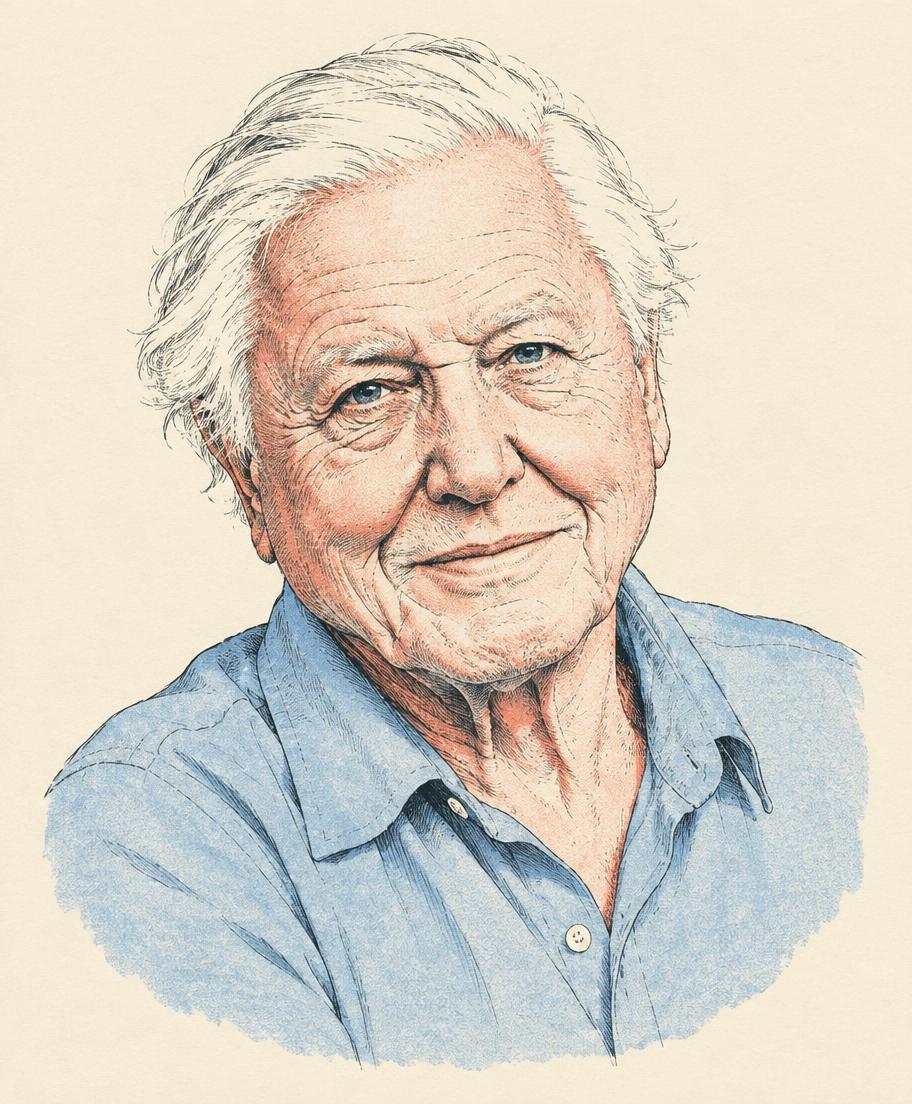
Broadcaster and natural historian
David Attenborough
The broadcaster whose natural history series have shaped how audiences understand life on Earth.
Read biography ↗
Animator and film director
Hayao Miyazaki
The animator and co-founder of Studio Ghibli whose hand-drawn films reached audiences worldwide.
Read biography ↗
Pope
Benedict I
Pope Benedict I was the bishop of Rome from 2 June 575 to his death on 30 July 579.
Read biography ↗