Turkish communist poet, playwright and novelist (1902–1963)
Nâzım Hikmet
Mehmed Nâzım Ran, commonly known as Nâzım Hikmet, was a Turkish poet, playwright, novelist, screenwriter, director, and memoirist.
By globalcelebwiki Editorial Desk, adapted from Wikipedia · Published 29 September 2026
- Profession
- Turkish communist poet, playwright and novelist (1902–1963)
- Born
- 15 January 1902
- Birthplace
- Thessaloniki
- Nationality
- Turkish

Overview
Mehmed Nâzım Ran (17 January 1902 – 3 June 1963), commonly known as Nâzım Hikmet (Turkish: [naːˈzɯm hicˈmet] ), was a Turkish poet, playwright, novelist, screenwriter, director, and memoirist. He was acclaimed for the "lyrical flow of his statements". Described as a "romantic communist" and a "romantic revolutionary", he was repeatedly arrested for his political beliefs and spent much of his adult life in prison or in exile. His poetry has been translated into more than 50 languages.
Family
According to Nâzım Hikmet, he was of paternal Turkish and maternal German, Polish, French and Georgian descent. His mother came from a distinguished cosmopolitan family with predominantly-Circassian (Adyghe) roots, along with high social position and relations to the Polish nobility. From his father's side, he had Turkish heritage. His father, Hikmet Bey, was the son of Mehmet Nâzım Pasha, after whom Nâzım Hikmet was named.
Nâzım's maternal grandfather, Hasan Enver Pasha, was the son of the Polish nobleman Mustafa Celalettin Pasha (born: Konstanty Borzęcki) who had emigrated to the Ottoman Empire after the failure of the 1848 Polish uprising, and of Saffet Hanım, the daughter of Omar Pasha, a Serbian, and of Adviye Hanım, a Circassian who was the daughter of Çerkes Hafız Pasha.
Early life
Nâzım was born on 15 January 1902, in Selânik (Salonica), where his father was serving as an Ottoman government official. He attended the Taşmektep Primary School in the Göztepe district of Istanbul and later enrolled in the junior high school section of the prestigious Galatasaray High School in the Beyoğlu district, where he began to learn French. However, in 1913, he was transferred to the Numune Mektebi, in the Nişantaşı district. In 1918, he graduated from the Ottoman Naval School on Heybeliada, one of the Princes' Islands, in the Sea of Marmara. His school days coincided with a period of political upheaval, during which the Ottoman government entered the First World War and was allied with Germany. For a brief period, he was assigned as a naval officer to the Ottoman Navy cruiser Hamidiye, but in 1919 he became seriously ill and was not able to fully recover. That got him exempted from naval service in 1920.
In 1921, together with his friends Vâlâ Nureddin (Vâ-Nû), Yusuf Ziya Ortaç, Faruk Nafiz Çamlıbel, and a Kurdish friend, Las Govand he went to İnebolu in Anatolia to join the Turkish War of Independence. From there he, together with Vâlâ Nûreddin, walked to Ankara, where the Turkish liberation movement was headquartered. In Ankara, they were introduced to Mustafa Kemal Pasha, later called Atatürk, who wanted the two friends to write a poem that would invite and inspire Turkish volunteers in Istanbul and elsewhere to join their struggle. The poem was much appreciated, and Muhittin Bey (Birgen) decided to appoint them as teachers to the Sultani (high college) in Bolu, rather than to send them to the front as soldiers. However, their communist views were not appreciated by the conservative officials in Bolu and so both of them decided to go to Batumi in the Georgian Soviet Socialist Republic to witness the results of the Russian Revolution of 1917 and arrived there on 30 September 1921. In July 1922, both friends went to Moscow, where Ran studied Economics and Sociology at the Communist University of the Toilers of the East in the early 1920s. There, he was influenced by the artistic experiments of Vladimir Mayakovsky and Vsevolod Meyerhold, as well as the ideological vision of Vladimir Lenin.
Style and achievements
Despite writing his first poems in syllabic meter, Nâzım Hikmet distinguished himself from the "syllabic poets" in concept. With the development of his poetic conception, the narrow forms of syllabic verse became too limiting for his style, and he set out to seek new forms for his poems.
He was influenced by the young Soviet poets who advocated Futurism. On his return to Turkey, he became the charismatic leader of the Turkish avant-garde by producing streams of innovative poems, plays and film scripts.
In Moscow in 1922, he broke the boundaries of syllabic meter, changed his form and began writing in free verse.
He has been compared by Turkish and non-Turkish men of letters to such figures as Federico García Lorca, Louis Aragon, Vladimir Mayakovsky, Faiz Ahmed Faiz, Yiannis Ritsos, and Pablo Neruda. Although Ran's work bears a resemblance to these poets and owes them occasional debts of form and stylistic device, his literary personality is unique in terms of the synthesis he made of iconoclasm and lyricism, of ideology and poetic diction.
Many of his poems have been set to music by the Turkish composer Zülfü Livaneli and by Cem Karaca. Part of his work has been translated into Greek by Yiannis Ritsos, and some of the translations have been arranged by the Greek composers Manos Loizos and Thanos Mikroutsikos.
Later life and legacy
Nâzım's imprisonment in the 1940s became a cause célèbre among intellectuals worldwide. A 1949 committee that included Pablo Picasso, Paul Robeson, and Jean-Paul Sartre campaigned for his release.
On 8 April 1950, Nâzım began a hunger strike to protest the Turkish Parliament's failure to include an amnesty law in its agenda before it closed for the upcoming general election. He was then transferred from the prison in Bursa, first to the infirmary of Sultanahmet Jail, in Istanbul, and later to Paşakapısı Prison. Seriously ill, Ran suspended his strike on 23 April, National Sovereignty and Children's Day. His doctor's request to treat him in hospital for three months was refused by officials. As his imprisonment status had not changed, he resumed his hunger strike on the morning of 2 May.
Nâzım's hunger strike caused a stir throughout the country. Petitions were signed and a magazine named after him was published. His mother, Celile, began a hunger strike on 9 May, followed by the renowned Turkish poets Orhan Veli, Melih Cevdet and Oktay Rıfat the next day. In light of the new political situation after the 1950 Turkish general election, held on 14 May, the strike ended five days later, on 19 May, Turkey's Commemoration of Atatürk, Youth and Sports Day, when he was finally released by a general amnesty law enacted by the new government.
On 22 November 1950, the World Council of Peace announced that Nâzım was among the recipients of the International Peace Prize, along with Pablo Picasso, Paul Robeson, Wanda Jakubowska and Pablo Neruda.
Later on, Nâzım escaped from Turkey to Romania on a ship via the Black Sea and from there moved to the Soviet Union. Because the Soviet bloc recognized the Turkish minority only in communist Bulgaria, the poet's books were immediately brought out in this country, both in Turkish originals and in Bulgarian translations. The communist authorities in Bulgaria celebrated him in Turkish and Bulgarian publications as 'a poet of liberty and peace.' The goal was to discredit Turkey presented as a "lackey of the imperialist" United States in the eyes of Bulgaria's Turkish minority, many of whom desired to leave for or were expelled to Turkey in 1950–1953.
Patronage
During the 1940s, as he was serving his sentence at Bursa Prison, painted. There, he met a young inmate, İbrahim Balaban. Ran discovered Balaban's talent in drawing, gave all his paint and brushes to him, and encouraged him to continue with painting. Ran influenced the peasant and educated him, who had finished only a three-grade village school, in forming his own ideas in the fields of philosophy, sociology, economics, and politics. Ran greatly admired Balaban and referred to him in a letter to the novelist Kemal Tahir as the “peasant painter" (Turkish: Köylü ressam). Their contact remained after they were released from the prison.
Hikmet started working on Human Landscapes ("Memleketimden İnsan Manzaraları") in 1939 and it finally got published in 1960. Its 16'000 lines of verse cover major historical events in Turkey in the first half of the 20th Century. Its perspective wanders stream of consciousness style from person to person in then Anatolia. The work is considered to be one of the foundational works of Turkish literature and Hikmet's magnum opus.
The book consists of five parts. The fifth part is unfinished.
Nâzım's poem "Kız Çocuğu" ("The Girl Child") conveys a plea for peace from a seven-year-old girl, ten years after she perished in the US atomic bomb attacks at Hiroshima and Nagasaki. It has achieved worldwide popularity as a powerful anti-war message and has been performed and translated in many languages as a song by a number of singers and musicians both in Turkey and many countries. It is also known in English by various other titles, including "I Come and Stand at Every Door", "I Unseen", "Hiroshima child" and "Hiroshima Girl".
Zülfü Livaneli has performed a version of the original Turkish poem on his album Nazım Türküsü, which was later sung in Turkish by Joan Baez.
Fazıl Say included the poem in his Nazım oratorio in Turkish.
Subhash Mukhopadhyay (poet) translated Hikmet's poems into Bengali. The poems are collected in two anthologies, Nirbachita Nazim Hikmet (1952)(Selected Poems of Nazem Hikmet) ISBN 81-7079-501-X and Nazem Hikmet er Aro Kobita (1974) (More Poems of Nazem Himet). Some of the translations are available in open source.
Thanos Mikroutsikos, in the album Politika tragoudia (Political Songs, 1975) composed a series of Hikmet's poems, adapted in Greek by the poet Yiannis Ritsos.
Manos Loizos composed settings of some of Ran's poems, adapted in Greek by Yiannis Ritsos. They are included in the 1983 disc Grammata stin agapimeni (Letters to the Beloved One).
The usual tune is a nontraditional melody composed by Jim Waters in 1954 to fit the lyrics of Child 113 ballad "The Great Silkie of Sule Skerry", which was recorded by American folksinger Joan Baez as "Silkie" on her second album Joan Baez, Vol. 2 in 1961.
According to American activist folk musician Pete Seeger, Jeanette Turner did a loose English "singable translation" of the poem under a different title, "I Come And Stand At Every Door", and sent a note to Seeger asking "Do you think you could make a tune for it?" in the late 1950s. After a week of trial and failure, the English translation was used by Seeger in 1962 with an adaptation of "an extraordinary melody put together by a Massachusetts Institute of Technology student, James Waters, who had put a new tune to a mystical ballad 'The Great Silkie' which he could not get out of his head, without permission." Seeger wrote in Where Have All the Flowers Gone?: "It was wrong of me. I should have gotten his permission. But it worked. The Byrds made a good recording of it, electric guitars and all." Seeger also used the track in his 1999 compilation album Headlines & Footnotes: A Collection Of Topical Songs. Seeger sang the song on 9 August 2013, the 68th anniversary of the Nagasaki atomic bombing, on a Democracy Now! interview.
British folk singer Harvey Andrews recorded a version under the title "Child of Hiroshima" (sometimes re-released as "Children of Hiroshima"), released on his eponymous debut EP in 1965.
The Byrds; the American rock band used the translation on their third album Fifth Dimension in 1966.
Roger McGuinn of the Byrds later recorded the song with its original lyrics as part of his Folk Den project.
In 2005, famous Amami Ōshima singer Chitose Hajime collaborated with Ryuichi Sakamoto by translating "Kız Çocuğu" into Japanese, retitling it Shinda Onna no Ko [死んだ女の子] "A dead girl"). It was performed live at the Atomic Bomb Dome in Hiroshima on the eve of the 60th Anniversary (5 August 2005) of Atomic bombings of Hiroshima and Nagasaki. The song later appeared as a bonus track on Chitose's album Hanadairo in 2006.
Some of Nâzım's poems are translated into Nepali by Suman Pokhrel and are published in print and online literary journals.
How do you propose to get it? Do you want to get it through the cooperation of Turkey where the men in the ranks get 23 cents a month the first year and 32 cents the second year, or do you want to get an American division and equip it and send it over to Turkey which would cost you 10 times as much?
He also opposed the Korean War, in which Turkey participated. After the Senate address of John Foster Dulles, who served as U.S. Secretary of State under President Dwight D. Eisenhower, where he valued Turkish soldiers at 23 cents a month compared with the lowest echelon U.S. soldiers at $70, Nâzım Hikmet Ran wrote a protest poem criticising the policies of the United States. This poem is titled "23 Sentlik Askere Dair" (On the soldier worth 23 cents).
In popular culture
Nâzım's poem "We'll Give the Globe to the Children" was set to music in 1979 by Russian composer David Tukhmanov.
The 1979 Russian animated film Tale of Tales is partially inspired by Hikmet's poem of the same name.
Finnish band Ultra Bra recorded a song "Lähettäkää minulle kirjoja" ("Send me books") based on a translated excerpt of Hikmet's poem "Rubai".
The Ignorant Fairies is a 2001 Italian film, in which a book by Hikmet plays a central plot role. This is reprised in the 2022 TV serialization of the film.
The Blue-Eyed Giant is a 2007 Turkish biographical film about Nâzım Hikmet. The title is a reference to the poem Minnacık Kadın ve Hanımelleri. The film chronicles Nâzim Hikmet's imprisonment at Bursa Prison and his relationships with his wife Piraye and his translator and lover Münevver Andaç. He is played by Yetkin Dikinciler.
Sources and references
Spotted something wrong? Report a correction.
Related profiles
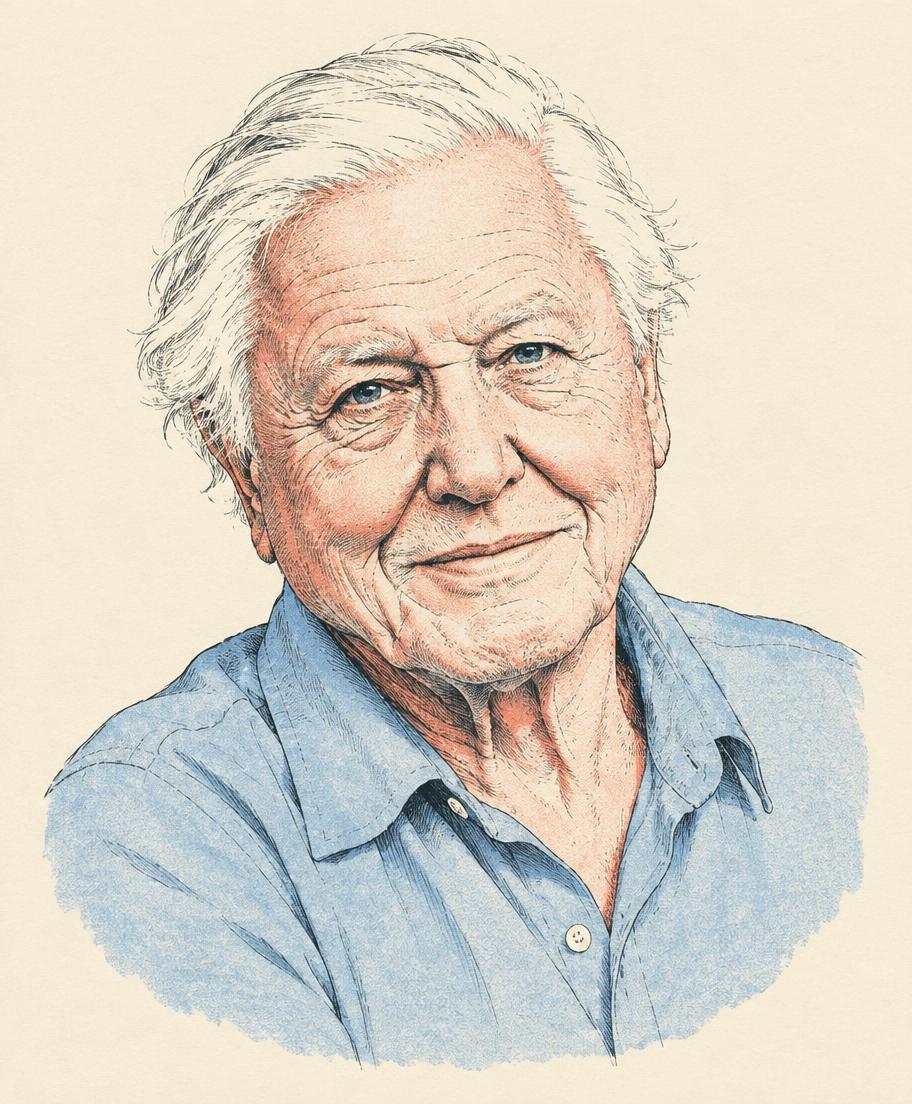
Broadcaster and natural historian
David Attenborough
The broadcaster whose natural history series have shaped how audiences understand life on Earth.
Read biography ↗
Animator and film director
Hayao Miyazaki
The animator and co-founder of Studio Ghibli whose hand-drawn films reached audiences worldwide.
Read biography ↗
Pope
Benedict I
Pope Benedict I was the bishop of Rome from 2 June 575 to his death on 30 July 579.
Read biography ↗