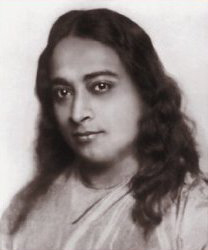
Yogi, Kriya Yoga guru and founder of Self-Realization Fellowship (1893-1952)
Paramahansa Yogananda
Paramahansa Yogananda was an Indian and American Hindu monk, yogi, and guru who founded the Self-Realization Fellowship/Yogoda Satsanga Society of India, a religious meditation and Kriya Yoga organization, to disseminate his teachings.
By globalcelebwiki Editorial Desk, adapted from Wikipedia · Published 29 September 2026
- Profession
- Yogi, Kriya Yoga guru and founder of Self-Realization Fellowship (1893-1952)
- Born
- 5 January 1893
- Birthplace
- Gorakhpur
- Nationality
- Indian
Overview
Paramahansa Yogananda (; born Mukunda Lal Ghosh; January 5, 1893 – March 7, 1952) was an Indian and American Hindu monk, yogi, and guru who founded the Self-Realization Fellowship (SRF)/Yogoda Satsanga Society of India (YSS), a religious meditation and Kriya Yoga organization, to disseminate his teachings. A chief disciple of the yoga guru Swami Sri Yukteswar Giri, he was sent by his lineage to spread yogic teachings to the West. He immigrated to the US at the age of 27, intending to demonstrate a unity between Eastern and Western religions and advocate for a balance between Western material growth and Indian spirituality. His longstanding influence on the American yoga movement, and especially the yoga culture of Los Angeles, led yoga experts to consider him the "Father of Yoga in the West". He lived his final 32 years in the US.
Yogananda was among the first Indian religious teachers to settle in the US, and the first prominent Indian to be hosted in the White House (by President Calvin Coolidge in 1927); his early acclaim led to him being dubbed "the 20th century's first superstar guru" by the Los Angeles Times. Arriving in Boston in 1920, he embarked on a successful transcontinental speaking tour before settling in Los Angeles in 1925. Over the next two and a half decades, he established a monastic order, trained disciples, conducted teaching tours, acquired properties for his organization in California, and initiated thousands into Kriya Yoga. By 1952, SRF had over 100 centers in both India and the United States. As of 2012, they had groups in nearly every major American city. His "plain living and high thinking" principles attracted people from all backgrounds among his followers.
He published his Autobiography of a Yogi in 1946 to critical and commercial acclaim. It has sold over four million copies, with Harper San Francisco listing it as one of the "100 best spiritual books of the 20th Century". Former Apple CEO Steve Jobs ordered 500 copies of the book, for each guest at his memorial to be given a copy. It was also one of Elvis Presley's favorite books, and one he gave out often. The book has been regularly reprinted and is known as "the book that changed the lives of millions". A documentary about his life commissioned by SRF, Awake: The Life of Yogananda, was released in 2014. He remains a leading figure in Western spirituality. A biographer of Yogananda, Phillip Goldberg, considers him "the best known and most beloved of all Indian spiritual teachers who have come to the West".
Early years
Yogananda was born Mukunda Lal Ghosh in Gorakhpur, Uttar Pradesh, India, to a Hindu Bengali Kayastha family. He was the fourth of eight children and second of four sons of Bhagabati Charan Ghosh, the vice president of Bengal-Nagpur Railway, and Gyanprabha Devi. According to his younger brother Sananda, Mukunda's spiritual awareness and experiences were far beyond the ordinary even from his earliest years. His father's job required the family to move several times during Mukunda's childhood, including to Lahore, Bareilly, and Kolkata. According to Autobiography of a Yogi, he was eleven years old when his mother died, just before the marriage of his eldest brother, Ananta. She left behind a sacred amulet for Mukunda, given to her by a holy man, who told her that Mukunda was to possess it for some years, after which it would vanish into the ether from which it came. Throughout his childhood, his father would fund train passes for his many sight-seeing trips to distant cities and pilgrimage spots, which he would often take with friends. In his youth he sought out many of India's Hindu sages and saints, including the Soham "Tiger" Swami, Gandha Baba, and Mahendranath Gupta, hoping to find an illumined teacher to guide him in his spiritual quest.
After finishing high school, Mukunda formally left home and joined a Mahamandal Hermitage in Varanasi; however, he soon became dissatisfied with its insistence on organizational work instead of meditation and God-perception. He began praying for guidance; in 1910, his seeking after various teachers mostly ended when, at the age of 17, he met his guru, Swami Sri Yukteswar Giri; at that time his well-guarded amulet mysteriously vanished, having served its spiritual purpose. In his autobiography, he describes his first meeting with Sri Yukteswar as a rekindling of a relationship that had lasted for many lifetimes:
"We entered a oneness of silence; words seemed the rankest superfluities. Eloquence flowed in soundless chant from heart of master to disciple. With an antenna of irrefragable insight I sensed that my guru knew God, and would lead me to Him. The obscuration of this life disappeared in a fragile dawn of prenatal memories. Dramatic time! Past, present, and future are its cycling scenes. This was not the first sun to find me at these holy feet!"
Training and vows
He went on to train under Sri Yukteswar as his disciple for the next ten years (1910–1920) at his hermitages in Serampore and Puri. Later, Sri Yukteswar informed Mukunda that he had been sent to him by the great guru of their lineage, Mahavatar Babaji, for a special world purpose of yoga dissemination.
After passing his Intermediate Examination in Arts from the Scottish Church College, Calcutta, in 1915, he graduated with a degree similar to a current-day Bachelor of Arts or B.A. (at the time referred to as an A.B.) from Serampore College, the college having two entities, one as a constituent college of the Senate of Serampore College (University) and the other as an affiliated college of the University of Calcutta. This allowed him to spend time at Yukteswar's ashram in Serampore.
In July 1915, several weeks after graduating from college, he took formal vows into the monastic Swami order; Sri Yukteswar allowed him to choose his own name: Swami Yogananda Giri. In 1917, Yogananda founded a school for boys in Dihika, West Bengal that combined modern educational techniques with yoga training and spiritual ideals. A year later, the school relocated to Ranchi. One of the school's first group of pupils was his youngest brother, Bishnu Charan Ghosh. This school would later become the Yogoda Satsanga Society of India, the Indian branch of Yogananda's American organization, the Self-Realization Fellowship.
Teaching in America
In his autobiography, Autobiography of a Yogi, Yogananda writes that he received a vision one day in 1920 while meditating at his Ranchi school: faces of a multitude of Americans passed before his mind's eye, intimating to him that he would soon go to America. After giving charge of the school over to its faculty (and eventually to his childhood friend Swami Satyananda), he left for Calcutta. On the following day, he received an invitation from the American Unitarian Association to serve as India's delegate to an International Congress of Religious Liberals convening that year in Boston. Yogananda sought his guru's advice, and Sri Yukteswar advised him to go. According to Philip Goldberg, Yogananda shared the following account in his Autobiography of a Yogi. While in deep prayer in his room, he received a surprise visit from Mahavatar Babaji, the foremost guru of his lineage, who told him directly that he was the one chosen to spread Kriya Yoga to the West. Reassured and uplifted, Yogananda soon afterwards accepted the offer to go to Boston. This account became a standard feature of his lectures.
Before leaving India, Yogananda sought the blessing of Nagendranath Bhaduri Mahasaya, a saint who had aided Yogananda's spiritual efforts during his college days in Calcutta. Yogananda wrote that Bhaduri Mahasaya had previously foreseen his future mission to America, and that Bhaduri Mahasaya advised him: "Son, go to America. Take the dignity of hoary India for your shield. Victory is written on your brow; the noble distant people will well receive you."
In August 1920, he left for the United States aboard the ship The City of Sparta on a two-month voyage that landed near Boston by late September. He spoke at the International Congress in early October and was well received; later that year he founded Self-Realization Fellowship (SRF) to disseminate worldwide his teachings on India's ancient practices and philosophy of Yoga and its tradition of meditation. Yogananda spent the next four years in Boston; in the interim, he lectured and taught on the East Coast and in 1924 embarked on a cross-continental speaking tour. Thousands came to his lectures. During this time he attracted a number of celebrity followers, including soprano Amelita Galli-Curci, tenor Vladimir Rosing and Clara Clemens Gabrilowitsch, the daughter of Mark Twain. In 1925, he established an international center for Self-Realization Fellowship in Los Angeles, California, which became the spiritual and administrative heart of his growing work. Yogananda was the first Hindu teacher of yoga to spend a major portion of his life in America. He lived in the United States from 1920 to 1952, interrupted by an extended trip abroad in 1935–1936, and through his disciples he developed various temples and meditation centers around the world.
Yogananda was put on a government watch list and kept under surveillance by the FBI and the British authorities, who were concerned about the growing independence movement in India. A confidential file was kept on him from 1926 to 1937 due to concern over his religious and moral practices. Philip Goldberg's biography describes Yogananda as being up against a perfect storm of America's worst defects: media sensationalism, religious bigotry, ethnic stereotyping, paternalism, sexual anxiety, and brazen racism.
In 1928, Yogananda received unfavorable publicity in Miami, and the police chief, Leslie Quigg, prohibited Yogananda from holding any further events. Quiggs said it was not due to a personal grudge against the Swami but rather in the interest of public order and Yogananda's own safety. Quigg had received veiled threats against Yogananda. According to Phil Goldberg:It turns out that Miami officials had summoned the British vice consulate to advise them on the matter ... One consulate officer said that the Miami city manager and Chief Quigg "recognized the fact that the swami was a British subject and apparently an educated man, but unfortunately he was what is considered in this part of the country a coloured man." Given the South's cultural mores, he noted, "the swami was in great danger of suffering bodily harm from the populace."
Visit to India, 1935–1936
In 1935, he returned to India via ocean liner, along with two of his Western students, to visit his guru, Sri Yukteswar Giri, and to help establish his Yogoda Satsanga work in India. While enroute, his ship detoured in Europe and the Middle East; he undertook visits to other living Western saints like Therese Neumann, the Catholic Stigmatist of Konnersreuth, and places of spiritual significance: Assisi, Italy to honor St. Francis, the Athenian temples of Greece and prison cell of Socrates, the Holy Land of Palestine and the regions of the Ministry of Jesus, and Cairo, Egypt to view the ancient Pyramids.
In August 1935, he arrived in India at the port of Mumbai; due to his fame in America, many photographers and journalists came to meet him during his short stay at the Taj Mahal Hotel. Upon taking a train eastward and reaching the Howrah Station near Kolkata, he was received by a huge crowd and a ceremonious procession led by his brother Bishnu Charan Ghosh and the Maharaja of Kasimbazar. Visiting Serampore, he had an emotional reunion with his guru, Sri Yukteswar – this meeting was noted in detail by his Western student C. Richard Wright. During his stay in India, he saw his Ranchi boys' school become legally incorporated, and took a touring group to visit various locales: the Taj Mahal in Agra, the Chamundeshwari Temple in Mysore, Allahabad for the Kumbh Mela of January 1936, and Brindaban to visit an exalted disciple of Lahiri Mahasaya, Swami Keshabananda.
He also met various people who caught his interest: Mahatma Gandhi, whom he initiated into Kriya Yoga; woman-saint Anandamoyi Ma; Giri Bala, an elderly yogi woman who survived without eating; renowned physicist Chandrasekhara Venkata Raman; and several disciples of Sri Yukteswar's guru, Lahiri Mahasaya. While in India, Sri Yukteswar gave Yogananda the monastic title of Paramahansa, meaning "supreme swan" and indicating the highest spiritual attainment. This title formally superseded his previous title of "swami". In March 1936, upon Yogananda's return to Calcutta after visiting Brindaban, Sri Yukteswar died (or, in the yogic tradition, attained mahasamadhi) at his hermitage in Puri. After conducting his guru's funeral rites, Yogananda continued to teach, conduct interviews, and meet with friends for several months, before planning to return to the US in mid-1936.
According to his autobiography, in June 1936, after having a vision of Krishna, he had a supernatural encounter with the resurrected form of his guru, Sri Yukteswar, while in a room at the Regent Hotel in Mumbai. During the experience, in which Yogananda physically grasped and held onto his guru's solid form, Sri Yukteswar explained that he now served as a spiritual guide on a high-astral planet, and expounded truths in deep detail regarding: the astral realm, astral planets and the afterlife; the lifestyles, abilities and varying levels of freedoms of astral beings; the workings of karma; man's various superphysical bodies and how he works through them, and other metaphysical topics.
Yogananda and his two western students left India via ocean liner from Mumbai; staying for several weeks in England, they conducted several yoga classes in London and visited historical sites, before leaving for the US in October 1936.
Return to America, 1936
In late 1936, Yogananda's ship arrived in New York harbor, passing the Statue of Liberty; he and his companions then drove in his Ford car across the continental US back to his Mount Washington, California, headquarters. Rejoined with his American disciples, he continued to lecture, write, and establish centers in southern California. He took up residence at the SRF hermitage in Encinitas, California, which was a surprise gift from his advanced disciple Rajarsi Janakananda. It was at this hermitage that Yogananda wrote his famous Autobiography of a Yogi and other writings. At this time, he created an "enduring foundation for the spiritual and humanitarian work of Self‑Realization Fellowship/Yogoda Satsanga Society of India."
In 1946, Yogananda took advantage of a change in immigration laws and applied for citizenship. His application was approved in 1949, and he became a naturalized U.S. citizen.
The last four years of his life were spent primarily in seclusion with some of his inner circle of disciples at his desert retreat in Twentynine Palms, California, to finish his writings and to finish revising books, articles and lessons written previously over the years. During this period he gave few interviews and public lectures. He told his close disciples, "I can do much more now to reach others with my pen."
Death
Yogananda began hinting to his disciples that it was time for him to leave the world. According to Phil Goldberg, one example was what Yogananda said to Daya Mata just before the dinner, "Do you realize that it is just a matter of hours and I will be gone from this earth?"
On March 7, 1952, he attended a dinner for the visiting Indian Ambassador to the U.S., Binay Ranjan Sen, and his wife at the Biltmore Hotel in Los Angeles. At the conclusion of the banquet, Yogananda spoke of India and America, their contributions to world peace and human progress, and their future co-operation, expressing his hope for a "United World" that would combine the best qualities of "efficient America" and "spiritual India". According to his direct disciple and eventual head of the SRF Daya Mata, who was present at the banquet, as Yogananda ended his speech, he read from his poem My India, concluding with the words "Where Ganges, woods, Himalayan caves, and men dream God—I am hallowed; my body touched that sod." Daya Mata stated that "as he uttered these words, he lifted his eyes to the Kutastha center, and his body slumped to the floor." His funeral service, with hundreds attending, was held at the SRF headquarters atop Mt. Washington in Los Angeles. Rajarsi Janakananda, who Yogananda chose to succeed him as the new president of the Self-Realization Fellowship, "performed a sacred ritual releasing the body to God."
According to the book Divine Interventions: True Stories of Mysteries and Miracles That Change Lives, for three weeks after his death Yogananda's body "showed no signs of physical deterioration and 'his unchanged face shone with the divine luster of incorruptibility.'" A notarized letter from Harry T. Rowe, the mortuary director, added: "The absence of any visual signs of decay... offers the most extraordinary case in our experience... This state of perfect preservation of a body is, so far as we know from mortuary annals, an unparalleled one... Yogananda's body was apparently in a phenomenal state of immutability... No odor of decay emanated from his body at any time... For these reasons we state again that the case of Paramahansa Yogananda is unique in our experience." Rowe wrote that Yogananda's body was embalmed approximately twenty-four hours after his death. On March 26 a barely noticeable desiccation on his nose was seen and on March 27 Rowe noted that Yogananda's body looked fresh and unravaged by decay as it did on the day of his death. Yogananda's remains are interred at the Forest Lawn Memorial Park in the Great Mausoleum (normally closed off to visitors but Yogananda's tomb is accessible) in Glendale, California.
There are differing accounts of his death. The medical verdict was "acute coronary occlusion", i.e., a heart attack. According to other accounts, Self-Realization disciples claim that their teacher entered mahasamadhi (a yogi's conscious exit from the body).
Teachings
In 1917, Yogananda, in India, "began his life's work with the founding of a 'how-to-live' school for boys, where modern educational methods were combined with yoga training and instruction in spiritual ideals." In 1920 "he was invited to serve as India's delegate to an International Congress of Religious Liberals convening in Boston. His address to the Congress, on 'The Science of Religion,' was enthusiastically received." For the next several years he lectured and taught across the United States. His discourses taught of the "unity of 'the original teachings of Jesus Christ and the original Yoga taught by Bhagavan Krishna.'"
In 1920, he founded the Self-Realization Fellowship and in 1925 established in Los Angeles, California, US, the international headquarters for SRF.
Yogananda wrote the Second Coming of Christ: The Resurrection of the Christ Within You and God Talks With Arjuna – The Bhagavad Gita to explain his belief in the harmony and oneness of original Christianity as taught by Jesus Christ and original Yoga as taught by Bhagavan Krishna; and to present that these principles of truth are the common scientific foundation of all true religions.
Yogananda wrote down his Aims and Ideals for Self-Realization Fellowship /Yogoda Satsanga Society:
To disseminate among the nations a knowledge of definite scientific techniques for attaining direct personal experience of God.
Sources and references
Spotted something wrong? Report a correction.
Related profiles
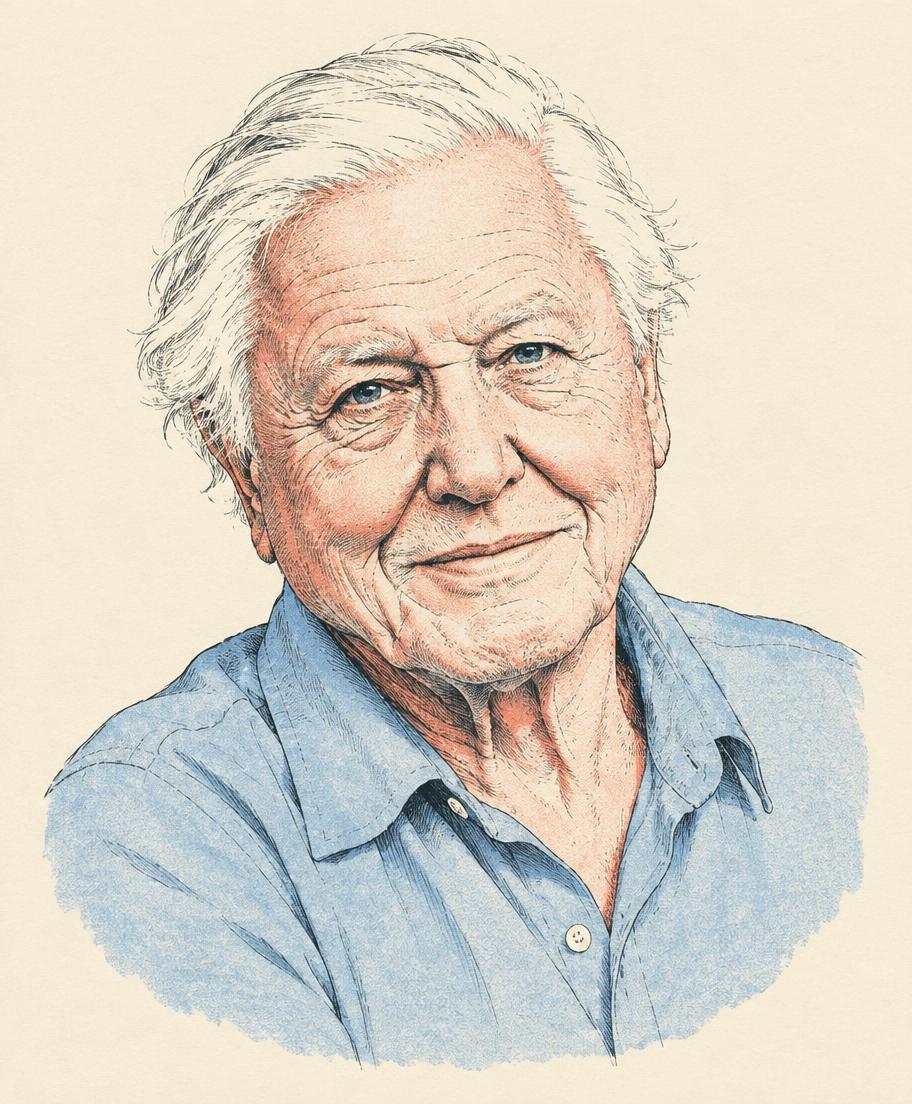
Broadcaster and natural historian
David Attenborough
The broadcaster whose natural history series have shaped how audiences understand life on Earth.
Read biography ↗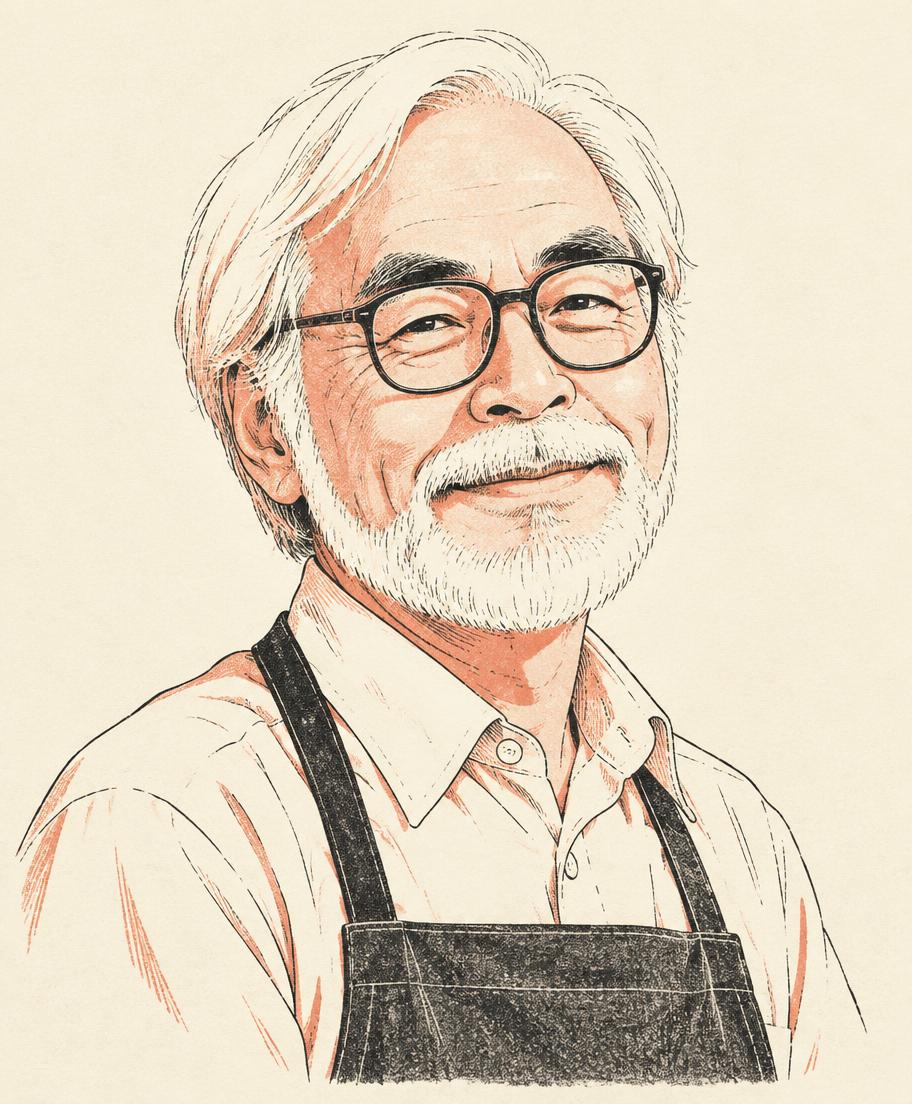
Animator and film director
Hayao Miyazaki
The animator and co-founder of Studio Ghibli whose hand-drawn films reached audiences worldwide.
Read biography ↗
Pope
Benedict I
Pope Benedict I was the bishop of Rome from 2 June 575 to his death on 30 July 579.
Read biography ↗