Indian spiritual teacher (1879–1950)
Ramana Maharshi
Ramana Maharshi was an Indian Hindu sage widely regarded by his followers and by "most advocates of Advaita" as a jivanmukta.
By globalcelebwiki Editorial Desk, adapted from Wikipedia · Published 29 September 2026
- Profession
- Indian spiritual teacher (1879–1950)
- Born
- 31 December 1879
- Birthplace
- Tiruchuli Assembly constituency
- Nationality
- Indian
Overview
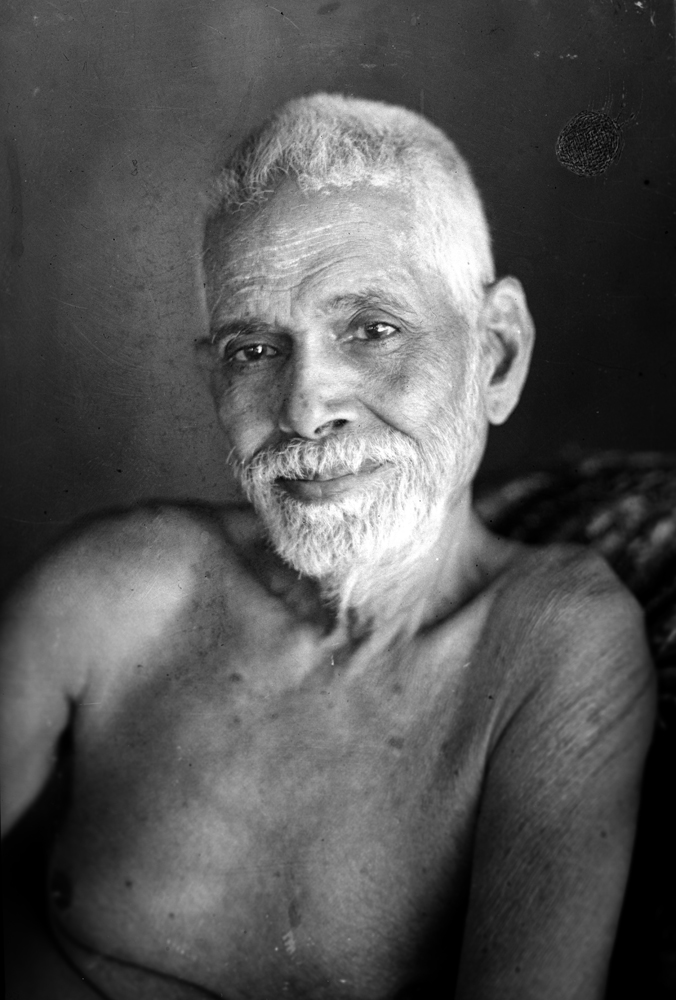
Ramana Maharshi (pronounced [ˈɾɐ.mɐ.ɳɐ mɐˈɦɐɾ.ʂi] ; 30 December 1879 – 14 April 1950) was an Indian Hindu sage widely regarded by his followers and by "most advocates of Advaita" as a jivanmukta (liberated being). He was born Venkataraman Iyer, but is mostly known by the name Bhagavan Sri Ramana Maharshi.
He was born in Tiruchuli, Tamil Nadu, India in 1879. In 1895, an attraction to the sacred hill Arunachala and the 63 Nayanmars was aroused in him, and in 1896, at the age of 16, he had a "death-experience" in which he became aware of a "current" or "force" (avesam) which he recognised as his true "I" or "self", and which he later identified with "the personal God, or Iswara", that is, Shiva. This resulted in a state that he later described as "the state of mind of Iswara or the jnani". Six weeks later he left his uncle's home in Madurai, and journeyed to the holy mountain Arunachala, in Tiruvannamalai, where he took on the role of a sannyasin (though not formally initiated), and remained for the rest of his life.
He attracted devotees who regarded him as an avatar of Shiva and came to him for darshan ("the sight of God"). In later years, an ashram grew up around him, where visitors received upadesa ("spiritual instruction") by sitting silently in his company or by asking questions. Since the 1930s his teachings have been popularised in the West.
Ramana Maharshi approved a number of paths and practices, but recommended self-enquiry as the principal means to remove ignorance and abide in self-awareness, together with bhakti (devotion) or surrender to the Self.
Early years (1879–1895)
Ramana Maharshi was born Venkataraman Iyer on 30 December 1879 in the village Tiruchuzhi near Aruppukkottai, Virudhunagar District in Tamil Nadu, India. He was the second of four children in an orthodox Hindu Brahmin family. His father was Sundaram Iyer (1848–1890), from the lineage of Parashara, and his mother was Azhagammal (1864–1922). He had two brothers Nagaswami (1877–1900) and Nagasundaram (1886–1953), along with a younger sister Alamelu (1887–1953). His father was a court pleader.
Both a paternal uncle of his father and his father's brother had become sannyasins. Venkataraman's family belonged to the Smarta denomination, and regularly worshiped Shiva, Vishnu, Ganesha, Surya and Shakti in their home.
When Venkataraman was seven he had his upanayana, the traditional initiation of the three upper varnas into Brahmanical learning and the knowledge of Self. He had a very good memory, and was able to recall information after hearing it once, an ability he used to memorise Tamil poems.
Narasimha notes that Venkataraman used to sleep very deeply, not waking from loud sounds, nor even when his body was beaten by others. When he was about twelve years old, he may have experienced spontaneous deep meditative states. Sri Ramana Vijayam, the Tamil biography that first appeared in the 1920s, describes a period a few years before the death-experience in Madurai:
Some incomplete practice from a past birth was clinging to me. I would be putting attention solely within, forgetting the body. Sometimes I would be sitting in one place, but when I regained normal consciousness and got up, I would notice that I was lying down in a different narrow space [to the one where I had first sat down].
Venkataraman first attended Scott's Middle School and then the American Mission High School where he became acquainted with Christianity.
In November 1895 Venkataraman realised that Arunachala, the sacred mountain, was a real place. He had known of its existence from an early age, and was overwhelmed by the realisation that it really existed. During this time he also read Sekkizhar's Periyapuranam, a book that describes the lives of the 63 Nayanmars, which "made a great impression" on him, and revealed to him that "Divine Union" is possible. According to Osborne, a new current of awareness started to awaken during his visits to the Meenakshi Temple at Madurai, "a state of blissful consciousness transcending both the physical and mental plane and yet compatible with full use of the physical and mental faculties". But Ramana Maharshi later stated that he remained uninterested in religion or spirituality until his awakening eight months later.
According to Narasimha, in July 1896, at age 16, he had a sudden fear of death. He was struck by "a flash of excitement" or "heat", like some avesam, a "current" or "force" that seemed to possess him, while his body became rigid. A process of self-enquiry was initiated, asking himself, "what it is that dies?" He concluded the body dies, but this "current" or "force" remains alive, and recognised this "current" or "force" as his Self, which he later identified with "the personal God, or Iswara".
In one of his rare written comments on this process Ramana Maharshi wrote, "inquiring within Who is the seer? I saw the seer disappear leaving That alone which stands forever. No thought arose to say I saw. How then could the thought arise to say I did not see."
Later in life, he called his death experience akrama mukti, "sudden liberation", as opposed to the krama mukti, "gradual liberation" as in the Vedanta path of jnana yoga. It resulted in a state of mind which he later described as "the state of mind of Iswara or the jnani:"
When Maharshi arrived in Tiruvannamalai, he went to the temple of Arunachaleswara. He spent the first few weeks in the thousand-pillared hall, then shifted to other spots in the temple, and eventually to the Patala-lingam vault so that he could remain undisturbed. There, he spent days absorbed in such deep samādhi that he was unaware of the bites of vermin and pests. Seshadri Swamigal, a local saint, discovered him in the underground vault and tried to protect him. After about six weeks in the Patala-lingam vault, he was carried out and cleaned up. For the next two months he stayed in the Subramanya Shrine, so unaware of his body and surroundings that food had to be placed in his mouth to keep him from starving.
In February 1897, six months after his arrival at Tiruvannamalai, Ramana Maharshi moved to Gurumurtam, a temple about a mile away. Shortly after his arrival a sadhu named Palaniswami went to see him. Palaniswami's first darshan left him filled with peace and bliss, and from that time on, he served Ramana Maharshi as his permanent attendant. Besides physical protection, Palaniswami would also beg for alms, cook and prepare meals for himself and Ramana Maharshi, and care for him as needed. In May 1898 Ramana Maharshi moved to a mango orchard next to Gurumurtam.
Osborne wrote that during this time Ramana Maharshi completely neglected his body. He also ignored the ants which bit him incessantly. Gradually, despite Ramana Maharshi's desire for privacy, he attracted attention from visitors who admired his silence and austerities, bringing offerings and singing praises. Eventually a bamboo fence was built to protect him.
While living at the Gurumurtam temple his family discovered his whereabouts. First, his uncle Nelliappa Iyer came and pleaded with him to return home, promising that the family would not disturb his ascetic life. Ramana Maharshi sat motionless, and eventually his uncle gave up.
In September 1898 Ramana Maharshi moved to the Shiva-temple at Pavalakkunru, one of the eastern spurs of Arunachala. He refused to return even though his mother begged him to.
Soon after this, in February 1899, Ramana Maharshi left the foothills to live in Arunachala. He stayed briefly in Satguru Cave and Guhu Namasivaya Cave before taking up residence at Virupaksha Cave for the next 17 years, using Mango Tree cave during the summers, except for a six-month period at Pachaiamman Koil during the plague epidemic.
In 1902, a government official named Sivaprakasam Pillai, with writing slate in hand, visited the young Swami in the hope of obtaining answers to questions about "How to know one's true identity". The fourteen questions he asked the young Swami and his answers formed Ramana Maharshi's first teachings on Self-enquiry, the method for which he became widely known, and were eventually published as Nan Yar?, or in English, Who am I?.
Many visitors came to him and some became his devotees. Kavyakantha Sri Ganapati Sastri, a Vedic scholar of repute in his age, with a deep knowledge of the Srutis, Sastras, Tantras, Yoga, and Agama systems, but lacking the personal darshan of Shiva, came to visit Ramana Maharshi in 1907. After receiving upadesa from him on self-enquiry, he proclaimed him as Bhagavan Sri Ramana Maharshi. Ramana Maharshi was known by this name from then on. Ganapati Sastri passed on these instructions to his own students, but later in life confessed that he had never been able to achieve permanent Self-abidance. Nevertheless, he was highly valued by Ramana Maharshi and played an important role in his life.
In 1911, the first westerner, Frank Humphreys, then a police officer stationed in India, discovered Ramana Maharshi and wrote articles about him, which were first published in The International Psychic Gazette in 1913.
In an appendix to Self realisation, Narasimha wrote that in 1912, while in the company of disciples, Ramana Maharshi had an epileptic seizure, in which his vision was suddenly impaired three times by a "white bright curtain" which covered a part of his vision. On the third instance, his vision was completely shut out, while his "head was swimming", and he felt his heart stop beating and his breathing seize. His skin turned blue, as if he was dead. This lasted for about ten or fifteen minutes, after which "a shock passed suddenly through the body", and his blood circulation and his respiration returned. In response to "strange accounts" about this event, Ramana Maharshi later explained that it was a seizure, which he used to have occasionally, and that he did not bring it on himself. According to Osborne, it "marked the final completion of Sri Bhagavan's return to full outer normality".
From 1922 until his death in 1950, Ramana Maharshi lived in Sri Ramanasramam, the ashram that developed around his mother's tomb. Ramana Maharshi often walked from Skandashram to his mother's tomb. In December 1922, he did not return to Skandashram, and settled at the base of the Hill, and Sri Ramanasramam started to develop. At first, there was only one hut at the samadhi, but in 1924 two huts were erected – one opposite the samadhi and the other to the north. The so-called Old Hall was built in 1928, where Ramana Maharshi lived until 1949.
Sri Ramanasramam grew to include a library, hospital, post office, and many other facilities. Ramana Maharshi displayed a natural talent for planning and building projects. Annamalai Swami gave detailed accounts of this in his reminiscences. Until 1938, Annamalai Swami was entrusted with the task of supervising the projects and received his instructions directly from Ramana Maharshi.
Ramana Maharshi led a modest and renunciate life. However, according to David Godman, who has written extensively about Ramana Maharshi, the popular image of him as a person who spent most of his time doing nothing except sitting silently in samadhi is highly inaccurate. From the period when an Ashram began to rise around him after his mother arrived, until his later years when his health failed, Ramana Maharshi was actually quite active in Ashram activities such as cooking and stitching leaf plates.
In 1931 a biography of Ramana Maharshi, Self Realisation: The Life and Teachings of Ramana Maharshi, written by B. V. Narasimha, was published. Ramana Maharshi then became relatively well known in and out of India after 1934 when Paul Brunton, having first visited Ramana Maharshi in January 1931, published the book A Search in Secret India. In this book he describes how he was compelled by the Paramacharya of Kanchi to meet Ramana Maharshi, his meeting with Ramana Maharshi, and the effect this meeting had on him. Brunton also describes how Ramana Maharshi's fame had spread, "so that pilgrims to the temple were often induced to go up the hill and see him before they returned home". Brunton calls Ramana Maharshi "one of the last of India's spiritual supermen", and describes his affection toward Ramana Maharshi:
I like him greatly because he is so simple and modest, when an atmosphere of authentic greatness lies so palpably around him; because he makes no claims to occult powers and hierophantic knowledge to impress the mystery loving nature of his countrymen; and because he is so totally without any traces of pretension that he strongly resists every effort to canonize him during his lifetime.
While staying at Sri Ramanasramam, Brunton had an experience of a "sublimely all-embracing" awareness, a "Moment of Illumination". The book was a best-seller and introduced Ramana Maharshi to a wider audience in the west. Resulting visitors included Paramahansa Yogananda, Somerset Maugham (whose 1944 novel The Razor's Edge models its spiritual guru after Ramana Maharshi), Mercedes de Acosta and Arthur Osborne, the last of whom was the first editor of Mountain Path in 1964, the magazine published by Ramanasramam.
In November 1948, a tiny cancerous lump was found on Ramana Maharshi's arm and was removed in February 1949 by the ashram's doctor. Soon, another growth appeared, and an eminent surgeon performed another operation in March 1949 with radium applied. The doctor told Ramana Maharshi that a complete amputation of the arm to the shoulder was required to save his life, but he refused. Third and fourth operations were performed in August and December 1949, but only weakened him. Other systems of medicine were then tried; all proved fruitless and were stopped by the end of March when devotees gave up all hope. To devotees who begged him to cure himself for the sake of his followers, Ramana Maharshi is said to have replied, "Why are you so attached to this body? Let it go", and "Where can I go? I am here." By April 1950, Ramana Maharshi was too weak to go to the hall and visiting hours were limited. Visitors would file past the small room where he spent his last days to get one final glimpse. He died on 14 April 1950 at 8:47 p.m. At the same time a shooting star was seen, which impressed some of his devotees as a synchronicity.
Devotion
Ramana Maharshi was, and is, regarded by many as an outstanding enlightened being. He was considered to be a charismatic person, and attracted many devotees, some of whom saw him as an avatar and the embodiment of Shiva.
Many devotees visited Ramana Maharshi for darshan, the sight of a holy person or God incarnate, which is advantageous and transmits merit. According to Flood, in Indian religions the guru is akin to the image or statue of a deity in the temple, and both possess power and a sacred energy. According to Osborne, Ramana Maharshi regarded giving darshan as "his task in life", and said that he had to be accessible to all who came. Even during his terminal illness at the end of his life, he demanded to be approachable for all who came for his darshan.
Objects being touched or used by him were highly valued by his devotees, "as they considered it to be prasad and that it passed on some of the power and blessing of the Guru to them". People also tried to touch his feet, which is also considered darshana. When one devotee asked if it would be possible to prostrate before Sri Ramana Maharshi and touch his feet, he replied:
The real feet of Bhagavan exist only in the heart of the devotee. To hold onto these feet incessantly is true happiness. You will be disappointed if you hold onto my physical feet because one day this physical body will disappear. The greatest worship is worshipping the Guru's feet that are within oneself.
In later life, the number of devotees and their devotion grew so large that Ramana Maharshi became restricted in his daily routine. Measures had to be taken to prevent people touching him. Several times Ramana Maharshi tried to escape from the ashram, to return to a life of solitude. Vasudeva reports: "Bhagavan sat on a rock and said with tears in his eyes that he would never again come to the Ashram and would go where he pleased and live in the forests or caves away from all men."
Ramana Maharshi did return to the ashram, but has also reported himself on attempts to leave the ashram:
Some of Ramana Maharshi's devotees regarded him to be as Dakshinamurti; as an avatar of Skanda, a divine form of Shiva popular in Tamil Nadu; as an incarnation of Jnana Sambandar, one of the sixty-three Nayanars; and as an incarnation of Kumārila Bhaṭṭa, the 8th century Mimamsa-philosopher. According to Krishna Bhikshu, one of his early biographers:As Kumarila he established the supremacy of the karma marga, as Jnana Sambandar, a poet, he brought bhakti marga close to the people and as Ramana Maharshi he showed that the purpose of life was to abide in the Self and to stay in the sahaja state by the jnana marga.
A number of Ramana Maharshi's Indian devotees (a more extensive list of devotees can be found in V. Ganesan's Ramana Periya Puranam):
Ganapati Muni (1878–1936), Sanskrit scholar and poet, activist for Indian independence, and one of Ramana Maharshi's foremost devotees. Muni devised the name "Ramana Maharshi".
Gudipati Venkatachalam (1894–1976), a noted Telugu writer, who lived the later part of his life and died near Ramana Maharshi's ashram in Tiruvannamalai.
Annamalai Swami, who came to Ramana Maharshi at the age of 22, served him devotedly, and oversaw the construction of Ramanasramam's buildings under Bhagavan's guidance. Through Bhagavan's grace and rigorous sādhana, he attained Self-realization.
H. W. L. Poonja, who in 1944 visited Ramana Maharshi and realized the Self in his presence. Later, Poonja gave satsang and introduced Maharshi's teachings to seekers of Truth from all over the world.
A list of Western devotees of Ramana Maharshi (not comprehensive):
Paul Brunton's writings about Ramana Maharshi brought considerable attention to him in the West.
Arthur Osborne, the first editor of the ashram journal, The Mountain Path.
Maurice Frydman (a.k.a. Swami Bharatananda), a Polish-Jewish engineer and humanitarian who later translated Nisargadatta Maharaj's work I Am That from Marathi to English, was also deeply influenced by Ramana Maharshi's teachings. Many of the questions published in Maharshi's Gospel (1939) were put by Maurice, and they elicited detailed replies from the Maharshi. Maharshi's Gospel is the only English language text that was personally proofread by Ramana Maharshi – the original manuscript with corrections in Ramana Maharshi's handwriting still exists in the Ashram Archives.
Ethel Merston, who wrote about Ramana Maharshi in her memoirs.
Spiritual instruction
Ramana Maharshi provided upadeśa ("spiritual instruction") by providing darshan and by sitting silently together with devotees and visitors (satsang), but also by answering the questions and concerns raised by those who sought him out. Many of these question-and-answer sessions have been transcribed and published by devotees, some of which have been edited by Ramana Maharshi himself. A few texts have been published which were written by Ramana Maharshi himself, or written down on his behalf and edited by him.
Ramana Maharshi also provided an example by his own devotion to Shiva, which has been extensively described by his devotees, such as walks around the holy hill Arunachala, in which devotees participated, and his hymns to Arunachala.
Ramana Maharshi described his 'real I' as a "force" or "current", which descended on him in his death-experience, and continued throughout his life:
... a force or current, a centre of energy playing on the body, continuing regardless of the rigidity or activity of the body, though existing in connection with it. It was that current, force or centre that constituted my Self, that kept me acting and moving, but this was the first time I came to know it [...] I had no idea at that time of the identity of that current with the personal God, or Iswara as I used to call him [...] I was only feeling that everything was being done by the current and not by me [...] This current, or avesam, now felt as if it was my Self, not a superimposition [...] That avesam continues right up to now.
Ramana Maharshi used various terms to denote this 'real I'. The most frequently used terms were sat-chit-ananda, which translates into English as "being-consciousness-bliss". God, Brahman and Siva were also used, as well as the Heart (not to be confused with the physical heart, or a particular point in space), which is equivalent to the Self, the source from which all appearances manifest.
According to David Godman, the essence of Ramana Maharshi's teachings is that the "Self" or real "I" is a "non-personal, all-inclusive awareness":
The real Self or real 'I' is, contrary to perceptible experience, not an experience of individuality but a non-personal, all-inclusive awareness. It is not to be confused with the individual self which (Ramana Maharshi) said was essentially non-existent, being a fabrication of the mind, which obscures the true experience of the real Self. He maintained that the real Self is always present and always experienced but he emphasized that one is only consciously aware of it as it really is when the self-limiting tendencies of the mind have ceased. Permanent and continuous Self-awareness is known as Self-realization.
Ramana Maharshi's main means of instruction to his devotees, in order to remove ignorance and abide in Self-awareness, was through silently sitting together with his visitors, using words only sparingly. His method of instruction has been compared to Dakshinamurti – Shiva in the ascetic appearance of the Guru, who teaches through silence:
One evening, devotees asked Sri Ramana Maharshi to explain the meaning of Shankara's hymn in praise of Dakshinamurti. They waited for his answer, but in vain. The Maharishi sat motionless on his seat, in total silence.
Commenting upon this silence, Ramana Maharshi said:
Silence is the true upadesa. It is the perfect upadesa. It is suited only for the most advanced seeker. The others are unable to draw full inspiration from it. Therefore, they require words to explain the truth. But truth is beyond words; it does not warrant explanation. All that is possible is to indicate It. How is that to be done?Ankur Barua argues that Ramana Maharshi's method of teaching resembled Socratic questioning, guiding seekers to reflect on the source of their own inquiries, which was often aided by silence. In his dialogues with devotees, Ramana emphasised the importance of exploring the nature of the questioner, and not the question. In such moments, the devotee is left in silence.
Vichara, "Self-enquiry", also called ātma-vichār or jnana-vichara is the constant attention to the inner awareness of "I" or "I am". Ramana Maharshi frequently recommended it as the most efficient and direct way of realising Self-awareness, in response to questions on self-liberation and the classic texts on Yoga and Vedanta. He instructed his disciples to practice self-inquiry "to access the ultimate source of the limited ego," and to experience "the divine Self" through direct experience, rather than through a mere intellectual process. Ramana Maharshi emphasised that without self-enquiry, other methods may temporarily calm the mind but are ineffective in dissolving the ego.
According to Ramana Maharshi, the I-thought is the sense of individuality: "(Aham, aham) 'I-I' is the Self; (Aham idam) "I am this" or "I am that" is the ego." By paying attention to the 'I'-thought, inquiring where it comes from, the 'I'-thought will disappear and the "shining forth" (sphurana) of "I-I" or Self-awareness will appear. This results in an "effortless awareness of being", and by staying with it this "I-I" gradually destroys the vasanas "which cause the 'I'-thought to rise". When the vasanas disappear, the mind, vritti also comes to rest, since it centers around the 'I'-thought, and finally the 'I'-thought never rises again, which is Self-realisation or liberation:
If one remains still without leaving it, even the sphurana – having completely annihilated the sense of the individuality, the form of the ego, 'I am the body' – will itself in the end subside, just like the flame that catches the camphor. This alone is said to be liberation by great ones and scriptures. (The Mountain Path, 1982, p. 98).
Robert Forman notes that Ramana Maharshi made a distinction between samadhi and sahaja samadhi. Samadhi is a contemplative state, which is temporary, while in sahaja samadhi a "silent state" is maintained while engaged in daily activities. Ramana Maharshi himself stated repeatedly that samadhi only suppresses the vāsanās, the karmic impressions, but does not destroy them. Only by abiding in Self-awareness will the vāsanās, which create the sense of a separate self, be destroyed, and sahaja samadhi be attained.
Although Ramana Maharshi advocated self-enquiry as the fastest means to realisation, he also recommended the path of bhakti and self-surrender (to one's deity or guru) either concurrently or as an adequate alternative, which would ultimately converge with the path of self-enquiry. According to Ramana Maharshi, Jnana and Bhakti are not different paths, but both lead to the same goal: the realisation of the Self. He taught that true Bhakti is love for the Self, and since the Self is God, love for the Self is also love for God.
Surrender has to be complete and desireless, without any expectations of solutions or rewards, or even liberation. It is a willingness to accept whatever happens. Surrender is not the willful act of an individual self, but the growing awareness that there is no individual self to surrender. Practice is aimed at the removal of ignorance, not at the attainment of realisation.
Bhagavan: There are only two ways to conquer destiny or to be independent of it. One is to inquire whose this destiny is and discover that only the ego is bound by it and not the Self and that the ego is non-existent. The other way is to kill the ego by completely surrendering to the Lord, realizing one's helplessness and saying all the time: "Not I, but Thou, oh Lord," giving up all sense of "I" and "mine" and leaving it to the Lord to do what He likes with you. Surrender can never be regarded as complete so long as the devotee wants this or that from the Lord. True surrender is the love of God for the sake of love and nothing else, not even for the sake of salvation. In other words, complete effacement of the ego is necessary to conquer destiny, whether you achieve this effacement through Self-inquiry or through bhakti-marga.
According to David Godman, Ramana Maharshi taught that the idea of reincarnation is based on wrong ideas about the individual self as being real. Ramana Maharshi would sometimes say that rebirth does exist, to step forward to those who were not able to fully grasp the non-reality of the individual self. But when this illusoriness is realised, there is no room any more for ideas about reincarnation. When the identification with the body stops, any notions about death and rebirth become inapplicable, since there is no birth or death within Self, a teaching known as Ajativada. Ramana Maharshi:
Reincarnation exists only so long as there is ignorance. There is really no reincarnation at all, either now or before. Nor will there be any hereafter. This is the truth.
Ramana Maharshi viewed yoga as a means to steady the mind and support self-enquiry. He suggested practices like devotion, breath control, and meditation (dhyana) to calm the restless mind and focus it on the self.
According to Wehr, C. G. Jung noted that Ramana Maharshi is not to be regarded as an "isolated phenomenon", but as a token of Indian spirituality, "manifest in many forms in everyday Indian life". According to Zimmer and Jung, Ramana Maharshi's appearance as a mauni, a silent saint absorbed in samadhi, fitted into pre-existing Indian notions of holiness. They placed the Indian devotion toward Ramana Maharshi in this Indian context.
According to Alan Edwards, the popular image of Ramana Maharshi as a timeless saint also served the construction of an Indian identity as inner-oriented and spiritual, in opposition to the oppressive, outer-oriented, materialistic culture of the British colonial rulers:
Hindus from all over India could look to the purely spiritual Maharshi as a symbol that inspired them to preserve their distinctive national culture and identity, which of course entailed forcing the British to quit India.
Though Ramana Maharshi's answers explain and incorporate elements from Advaita Vedanta, his spiritual life is strongly associated with Shaivism. The Tamil compendium of devotional songs known as Tirumurai, along with the Vedas, the Shaiva Agamas and "Meykanda" or "Siddhanta" Shastras, form the scriptural canon of Tamil Shaiva Siddhanta. As a youth, prior to his awakening, Ramana Maharshi read the Periya Puranam, the stories of the 63 Tamil saints. In later life, he told those stories to his devotees:
When telling these stories, he used to dramatize the characters of the main figures in voice and gesture and seemed to identify himself fully with them.
Ramana Maharshi himself considered God, Guru and Self to be the manifestations of the same reality. Ramana Maharshi considered the Self to be his guru, in the form of the sacred mountain Arunachala, which is considered to be the manifestation of Shiva. Arunachala is one of the five main shaivite holy places in South India, which can be worshipped through the mantra "Om arunachala shivaya namah!" and by Pradakshina, walking around the mountain, a practice which was often performed by Ramana Maharshi. Asked about the special sanctity of Arunachala, Ramana Maharshi said that Arunachala is Shiva himself. In his later years, Ramana Maharshi said it was the spiritual power of Arunachala which had brought about his Self-realisation. He composed the Five Hymns to Arunachala as devotional song. On the three occasions Venkataraman (Ramana) referred to himself he used the name Arunachala Ramana. Ramana Maharshi also used to smear his forehead with holy ash, as a token of veneration.
In later life, Ramana Maharshi himself came to be regarded as Dakshinamurthy, an aspect of Shiva as a guru of all types of knowledge, and bestower of jnana. This aspect of Shiva is his personification as the supreme or the ultimate awareness, understanding and knowledge. This form represents Shiva in his aspect as a teacher of yoga, music, and wisdom, and giving exposition on the shastras.
During his lifetime, through contact with educated devotees like Ganapata Muni, Ramana Maharshi became acquainted with works on Shaivism and Advaita Vedanta, and used them to explain his insights:
People wonder how I speak of Bhagavad Gita, etc. It is due to hearsay. I have not read the Gita nor waded through commentaries for its meaning. When I hear a sloka (verse), I think its meaning is clear and I say it. That is all and nothing more.
Already in 1896, a few months after his arrival at Arunachala, Ramana Maharshi attracted his first disciple, Uddandi Nayinar, who recognised in him "the living embodiment of the Holy Scriptures". Uddandi was well-versed in classic texts on Yoga and Vedanta, and recited texts as the Yoga Vasistha and Kaivalya Navaneeta in Ramana Maharshi's presence.
In 1897 Ramana Maharshi was joined by Palaniswami, who became his attendant. Palaniswami studied books in Tamil on Vedanta, such as Kaivalya Navaneeta, Shankara's Vivekachudamani, and Yoga Vasistha. He had difficulties understanding Tamil. Ramana Maharshi read the books too, and explained them to Palaniswami.
As early as 1900, when Ramana Maharshi was 20 years old, he became acquainted with the teachings of the Hindu monk and Neo-Vedanta teacher Swami Vivekananda through Gambhiram Seshayya. Seshayya was interested in yoga techniques, and "used to bring his books and explain his difficulties". Ramana Maharshi answered on small scraps of paper, which were collected after his death in the late 1920s in a booklet called Vichara Sangraham, "Self-enquiry".
In contrast to classical Advaita Vedanta, Ramana Maharshi emphasised the personal experience of self-realisation, instead of philosophical argumentation and the study of scripture. Ramana Maharshi's authority was based on his personal experience, from which he explained classic texts on Yoga and Vedanta, which he became acquainted with via his devotees. Arvind Sharma qualifies Ramana Maharshi as the chief exponent of experiential Advaita, to distinguish his approach from Shankara's classical doctrinal Advaita. Fort classifies him as a neo-Vedantin, because of the focus on self-inquiry instead of philosophical speculation. Ramana Maharshi himself did not call his insights advaita, but said that dvaita and advaita are relative terms, based on a sense of duality, while the Self or Being is all there is.
Although Ramana Maharshi's teaching is consistent with and generally associated with Hinduism, the Upanishads and Advaita Vedanta, there are differences with the traditional Advaitic school. Advaita recommends a negationist neti, neti (Sanskrit, "not this", "not this") path, or mental affirmations that the Self is the only reality, such as "I am Brahman" or "I am He", while Ramana Maharshi advocated Self-enquiry Nan Yar. In contrast with traditional Advaita Vedanta, Ramana Maharshi strongly discouraged devotees from adopting a renunciate lifestyle and renouncing their responsibilities. To one devotee who felt he should abandon his family, whom he described as "samsara" ("illusion"), to intensify his spiritual practice, Sri Ramana Maharshi replied:
Oh! Is that so? What really is meant by samsara? Is it within or without? Wife, children and others. Is that all the samsara? What have they done? Please find out first what really is meant by samsara. Afterwards we shall consider the question of abandoning them.
The scholar of religion Lola Williamson has described Indian gurus such as Ramana Maharshi, Meher Baba, Sri Aurobindo and Swami Satchidananda Saraswati as having developed "Hindu-Inspired Meditation Movements", also called neo-Vedanta and modernist Hinduism.
Legacy
Although many claim to be influenced by him, Ramana Maharshi did not publicise himself as a guru, never claimed to have disciples, and never appointed any successors. While a few who came to see him are said to have become enlightened through association, he did not publicly acknowledge any living person as liberated other than his mother at death. Ramana Maharshi never promoted any lineage.
With regard to the Sri Ramana Ashram, in 1938 Maharshi made a legal will bequeathing all the Ramanashram properties to his younger brother Niranjanananda and his descendants. In 2013, Ramanashram is run by Sri Niranjananda's grandson Sri V.S. Raman. Ramanashram is legally recognised as a public religious trust whose aim is to maintain it in a way that is consistent with Sri Ramana Maharshi's declared wishes. The ashram should remain open as a spiritual institution so that anyone who wishes to can avail themselves of its facilities.
In the 1930s, Maharshi's teachings were brought to the west by Paul Brunton in his A Search in Secret India. Stimulated by Arthur Osborne, in the 1960s Bhagawat Singh actively started to spread Ramana Maharshi's teachings in the US. Ramana Maharshi has been further popularised in the west by the neo-Advaita movement, via the students of H. W. L. Poonja; this movement gives a western re-interpretation of his teachings by placing sole emphasis on insight alone. It has been criticised for this emphasis, omitting the preparatory practices. Nevertheless, Neo-Advaita has become an important constituent of popular western spirituality.
The scholar Philip Goldberg has listed Western religious thinkers influenced by Ramana Maharshi as including Francis X. Clooney, Georg Feuerstein, Bede Griffiths, Andrew Harvey, Thomas Merton, Henri Le Saux (Swami Abhishiktananada), Eckhart Tolle, and Ken Wilber.
The scholar Isaac Portilla has pointed out the importance of Ramana Maharshi for interfaith dialogue, noticing both his universal message of religious unity and his distinctive iconic status:Ramana, in his universalist stance, is an important figure for interfaith dialogue, and scholars such as Thomas Forsthoefel and [Mario] Aguilar have paid due attention to this possibility. From the view I am presenting, in engaging with the complexities of mystical experience and emphasizing distinctiveness, Ramana’s contribution to interfaith dialogue is strengthened—his relevance being greater than that of the sage with a universalist message. That is: in his uniqueness, Ramana is proclaiming with idiosyncratic power and authority (as an avatar of Hinduism) a universal substratum of religion—Brahman, the Self—which cannot be accepted as justifying the erosion of differences; indeed, his varied experiences invite to explore further depths of any tradition considered.Regarding Ramana Maharshi’s uniqueness, Portilla has argued there are several experiences described by Maharshi himself, which together may justify his transformative and powerful presence:
According to Ebert, Ramana Maharshi "never felt moved to formulate his teaching of his own accord, either verbally or in writing". The few writings he is credited with "came into being as answers to questions asked by his disciples or through their urging". Only a few hymns were written on his own initiative. Writings by Ramana Maharshi are:
Gambhiram Sheshayya, Vichāra Sangraham, "Self-Enquiry". Answers to questions, compiled in 1901, published in dialogue-form, republished as essay in 1939 as A Catechism of Enquiry. Also published in 1944 in Heinrich Zimmer's Der Weg zum Selbst.
Sivaprakasam Pillai, Nān Yār?, "Who am I?". Answers to questions, compiled in 1902, first published in 1923.
Akshara Mana Malai, "The Marital Garland of Letters". In 1914, at the request of a devotee, Ramana Maharshi wrote Akshara Mana Malai for his devotees to sing while on their rounds for alms. It's a hymn in praise of Shiva, manifest as the mountain Arunachala. The hymn consists of 108 stanzas composed in poetic Tamil.
Navamani Mālai, "The Necklet of Nine Gems".
Several collections of recorded talks, in which Sri Ramana Maharshi used Tamil, Telugu and Malayalam, have been published. Those are based on written transcripts, which were "hurriedly written down in English by his official interpreters".
Sri Natanananda, Upadesa Manjari, "Origin of Spiritual Instruction". Recordings of dialogues between Sri Ramana Maharshi and devotees. First published in English in 1939 as A Catechism of Instruction.
Munagala Venkataramaiah, Talks with Sri Ramana. Talks recorded between 1935 and 1939. Various editions:
Print: Venkataramaiah, Munagala (2000), Talks With Sri Ramana Maharshi: On Realizing Abiding Peace and Happiness, Inner Directions, ISBN 1-878019-00-7
Online: Venkataramaiah, Munagala (2000), Talks with Sri Ramana. Three volumes in one. Extract version (PDF), Tiruvannamalai: Sriramanasasram
Frank Humphreys, a British policeman stationed in India, visited Ramana Maharshi in 1911 and wrote articles about him which were first published in The International Psychic Gazette in 1913.
Paul Brunton (1935), A Search in Secret India. This book introduced Ramana Maharshi to a western audience.
Cohen, S.S. (2003). Guru Ramana. Sri Ramanashram. First published 1956.
Chadwick, Major A. W. (1961). A Sadhu's Reminiscences of Ramana Maharshi (PDF). Sri Ramanashram. Archived from the original (PDF) on 16 May 2018. Retrieved 31 December 2012.
Nagamma, Suri (1973). Letters from Ramanasram by Suri Nagamma. Tiruvannamalai: Sriramanasasram.
A Day in the Life at Ramana Maharshi Ashram
Abide as the Self: The Essential Teachings of Ramana Maharshi
Talks on Sri Ramana Maharshi: Narrated by David Godman
Who is Sri Ramana... Who am I? Archived 12 August 2020 at the Wayback Machine
The Eternal Light Archived 16 October 2017 at the Wayback Machine
Sources and references
Spotted something wrong? Report a correction.
Related profiles
Broadcaster and natural historian
David Attenborough
The broadcaster whose natural history series have shaped how audiences understand life on Earth.
Read biography ↗
Animator and film director
Hayao Miyazaki
The animator and co-founder of Studio Ghibli whose hand-drawn films reached audiences worldwide.
Read biography ↗
Pope
Benedict I
Pope Benedict I was the bishop of Rome from 2 June 575 to his death on 30 July 579.
Read biography ↗