Indian Hindu monk and philosopher (1863–1902)
Swami Vivekananda
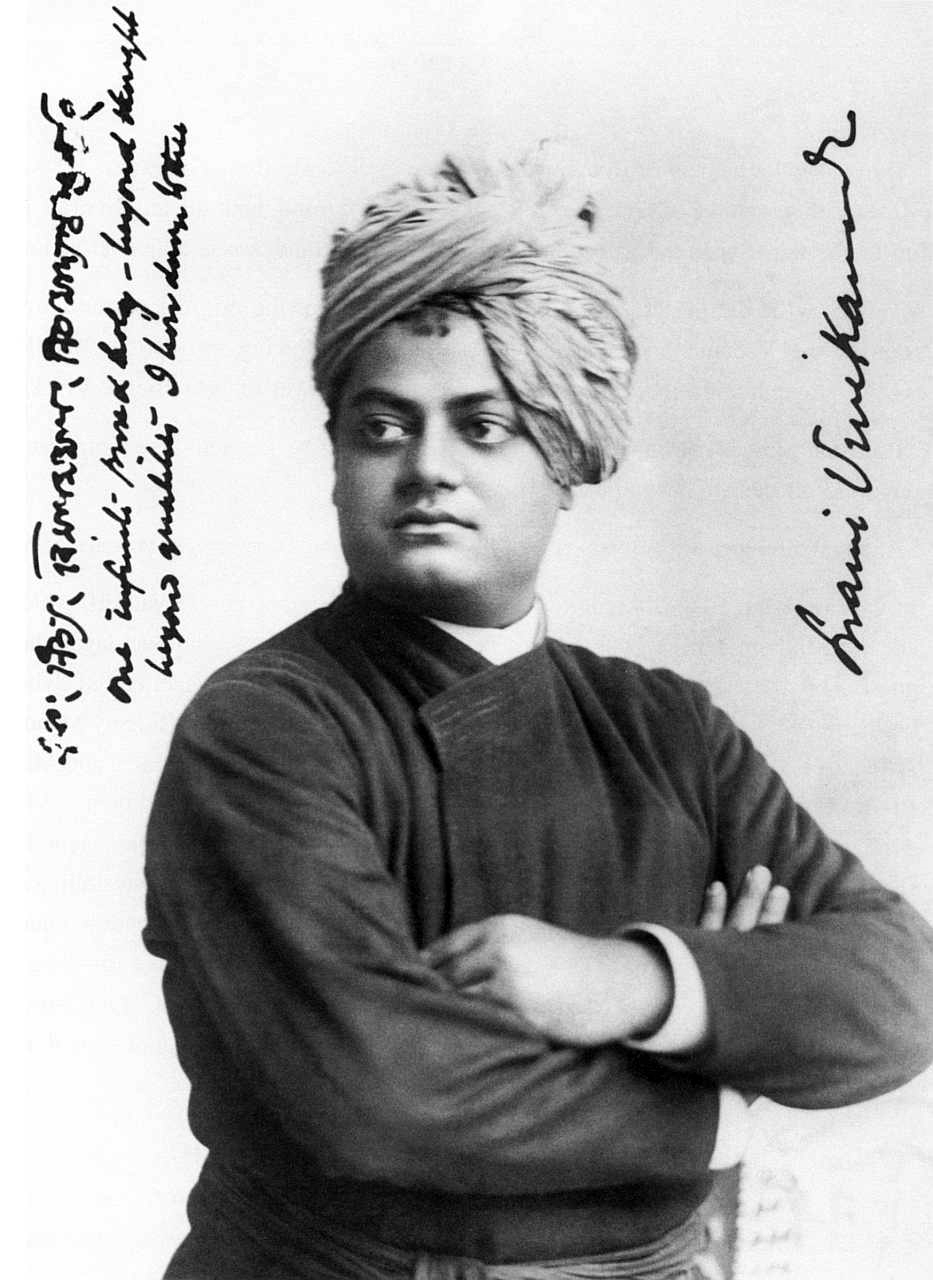
Swami Vivekananda, born Narendranath Datta, was an Indian Hindu monk, philosopher, author, religious teacher, and the chief disciple of the Indian mystic Ramakrishna.
By globalcelebwiki Editorial Desk, adapted from Wikipedia · Published 29 September 2026
- Profession
- Indian Hindu monk and philosopher (1863–1902)
- Born
- 12 January 1863
- Birthplace
- Swami Vivekananda's Ancestral House & Cultural Centre
- Nationality
- British Raj
Overview
Swami Vivekananda () (12 January 1863 – 4 July 1902), born Narendranath Datta, was an Indian Hindu monk, philosopher, author, religious teacher, and the chief disciple of the Indian mystic Ramakrishna. Vivekananda was a major figure in the introduction of Vedanta and Yoga to the Western world during the late 19th century, and is credited with raising interfaith awareness and elevating Hinduism to the status of a major world religion.
Vivekananda showed an early inclination towards religion and spirituality. At the age of 18, he met Ramakrishna and became his devoted disciple, and later took up the vows of a sannyasin (renunciate). Following Ramakrishna’s death, Vivekananda travelled extensively across the Indian subcontinent as a wandering monk, gaining first-hand knowledge of the often harsh living conditions endured by the Indian masses under then British India, he sought a way to alleviate their suffering by establishing social services but lacked capital. In 1893, he travelled to the United States to participate in the Parliament of the World's Religions in Chicago, where he delivered a landmark speech beginning with the words "Sisters and brothers of America...". His powerful message introduced Hindu spiritual thought and advocated for both religious tolerance as well as universal acceptance. The speech made a profound impression; an American newspaper described him as "an orator by divine right and undoubtedly the greatest figure at the Parliament".
Following his success in Chicago, Vivekananda lectured widely across the United States, the United Kingdom, and continental Europe, disseminating the essential principles of Hindu philosophy. He established the Vedanta Society of New York and the Vedanta Society of San Francisco (now the Vedanta Society of Northern California), both of which became the foundations for later Vedanta Societies in the West. In India, he founded the Ramakrishna Math, a monastic order for spiritual training, and the Ramakrishna Mission, dedicated to social services, education, and humanitarian work.
Vivekananda is widely regarded as one of the greatest modern Indian thinkers. He was a prominent philosopher, social reformer, and the most successful proponent of Vedanta philosophy abroad. He played a crucial role in the Hindu revivalist movement and contributed significantly to the rise and development of Indian nationalism in colonial India. Celebrated as a patriotic saint, his birth anniversary is observed in India as National Youth Day.
Birth and childhood
Vivekananda was born as Narendranath Datta (name shortened to Narendra or Naren) in an aristocratic Bengali Kayastha family in his ancestral home at 3 Gourmohan Mukherjee Street in Calcutta, the capital of British India, on 12 January 1863 during the Makar Sankranti festival. He was one of nine siblings. His father, Vishwanath Datta, was an attorney at the Calcutta High Court. Durgacharan Datta, Narendra's grandfather was a Sanskrit and Persian scholar who left his family and became a monk at age twenty-five. His mother, Bhubaneswari Devi, was a devout housewife. The progressive, rational attitude of Narendra's father and the religious temperament of his mother helped shape his thinking and personality. Narendranath was interested in spirituality from a young age and used to meditate before the images of deities such as Shiva, Rama, Sita, and Hanuman. He was fascinated by wandering ascetics and monks. Narendra was mischievous and restless as a child, and his parents often had difficulty controlling him. His mother said, "I prayed to Shiva for a son and he has sent me one of his demons".
In 1871, at the age of eight, Narendranath enrolled at Ishwar Chandra Vidyasagar's Metropolitan Institution, where he went to school until his family moved to Raipur in 1877. In 1879, after his family's return to Calcutta, he was the only student to receive first-division marks in the Presidency College entrance examination. He was an avid reader in a wide range of subjects, including philosophy, religion, history, social science, art and literature. He was also interested in Hindu scriptures, including the Vedas, the Upanishads, the Bhagavad Gita, the Ramayana, the Mahabharata and the Puranas. Narendra was trained in Indian classical music, and regularly participated in physical exercise, sports and organised activities. He studied Western logic, Western philosophy and European history at the General Assembly's Institution (now known as the Scottish Church College). In 1881, he passed the Fine Arts examination, and completed a Bachelor of Arts degree in 1884. Narendra studied the works of David Hume, Immanuel Kant, Johann Gottlieb Fichte, Baruch Spinoza, Georg W. F. Hegel, Arthur Schopenhauer, Auguste Comte, John Stuart Mill and Charles Darwin. He became fascinated with the evolutionism of Herbert Spencer and corresponded with him. He translated Spencer's book Education (1861) into Bengali. While studying Western philosophers, he also learned Sanskrit scriptures and Bengali literature.
William Hastie (the principal of Scottish Church College, Calcutta, from where Narendra graduated) wrote of him: "Narendra is really a genius. I have travelled far and wide but I have never come across a lad of his talents and possibilities, even in German universities, among philosophical students. He is bound to make his mark in life". He was known for his prodigious memory and speed reading ability, and a number of anecdotes attest to this. Some accounts have called Narendra a shrutidhara (a person with a prodigious memory).
In 1880, Narendra joined Keshab Chandra Sen's Nava Vidhan, which was established by Sen after meeting Ramakrishna Paramahamsa and reconverting from Christianity to Hinduism. Narendra became a member of a Freemasonry lodge "at some point before 1884" and of the Sadharan Brahmo Samaj in his twenties, a breakaway faction of the Brahmo Samaj led by Keshab Chandra Sen and Debendranath Tagore. From 1881 to 1884, he was also active in Sen's Band of Hope, which tried to discourage youths from smoking and drinking.
It was in this cultic milieu that Narendra became acquainted with Western esotericism. His initial beliefs were shaped by Brahmo concepts, which denounced polytheism and caste restrictions, and proposed a "streamlined, rationalized, monotheistic theology strongly coloured by a selective and modernistic reading of the Upanisads and of the Vedanta." Rammohan Roy, the founder of the Brahmo Samaj who was strongly influenced by unitarianism, strove towards a universalistic interpretation of Hinduism. His ideas were "altered [...] considerably" by Debendranath Tagore, who had a romantic approach to the development of these new doctrines, and questioned central Hindu beliefs like reincarnation and karma, and rejected the authority of the Vedas. Tagore, and later Sen, also brought this "neo-Hinduism" closer in line with western esotericism. Sen was influenced by transcendentalism, an American philosophical-religious movement strongly connected with unitarianism, which emphasised personal religious experience over mere reasoning and theology. Sen's focus on creating "an accessible, non-renunciatory, everyman type of spirituality" that introduced "lay systems of spiritual practice" was an influence on the teachings Vivekananda later popularised in the west.
Not satisfied with his knowledge of philosophy, Narendra came to "the question which marked the real beginning of his intellectual quest for God." He asked several prominent Calcutta residents if they had come "face to face with God", but none of their answers satisfied him. At this time, Narendra met Debendranath Tagore (the leader of Brahmo Samaj) and asked if he had seen God. Instead of answering his question, Tagore said, "My boy, you have the Yogi's eyes." According to Banhatti, it was Ramakrishna who first truly answered Narendra's question, by saying "Yes, I see Him as I see you, only in an infinitely intenser sense." De Michelis, however, suggests that Vivekananda was more influenced by the Brahmo Samaj and its new ideas than by Ramakrishna. According to De Michelis, it was Sen's influence that brought Vivekananda fully into contact with western esotericism, and it was via Sen that he met Ramakrishna. Swami Medhananda agrees that the Brahmo Samaj was a formative influence, but affirms that "it was Narendra's momentous encounter with Ramakrishna that changed the course of his life by turning him away from Brahmoism."
Narendra first met Ramakrishna in 1881. When Narendra's father died in 1884, Ramakrishna became his primary spiritual focus.
Narendra's introduction to Ramakrishna occurred in a literature class at General Assembly's Institution, when Professor William Hastie was lecturing on William Wordsworth's poem, The Excursion. While explaining the word "trance" in the poem, Hastie suggested that his students visit Ramakrishna of Dakshineswar to understand the true meaning of trance. This prompted Narendra, among others in the class, to visit Ramakrishna.
They probably first met personally in November 1881, though Narendra did not consider this their first meeting, and neither man mentioned this meeting later. At the time, Narendra was preparing for his upcoming F. A. examination. Ram Chandra Datta accompanied him to Surendra Nath Mitra's house where Ramakrishna had been invited to deliver a lecture. According to Makarand Paranjape, at this meeting Ramakrishna asked Narendra to sing. Impressed by his talent, he asked Narendra to come to Dakshineshwar.
Narendra went to Dakshineswar in late 1881 or early 1882 and met Ramakrishna. This meeting proved to be a turning point in his life. Although he did not initially accept Ramakrishna as his teacher and rebelled against his ideas, he was attracted by his personality and frequently visited him. He initially saw Ramakrishna's ecstasies and visions as "mere figments of imagination" and "hallucinations". As a member of Brahmo Samaj, he opposed idol worship, polytheism, and Ramakrishna's worship of Kali. He even rejected the Advaita Vedanta teaching of "identity with the absolute" as blasphemy and madness, and often ridiculed the idea. Ramakrishna was unperturbed and advised him: "Try to see the truth from all angles".
Narendra's father's sudden death in 1884 left the family bankrupt; creditors began demanding the repayment of loans, and relatives threatened to evict the family from their ancestral home. Once the son of a well-to-do family, Narendra became one of the poorest students in his college. His attempts to find work were unsuccessful. He questioned God's existence, but found solace in Ramakrishna, and his visits to Dakshineswar increased.
After Ramakrishna's death, support from devotees and admirers diminished. Unpaid rent accumulated, forcing Narendra and the other disciples to look for a new place to live. Many returned home, adopting a Grihastha (family-oriented) way of life. Narendra decided to convert a dilapidated house at Baranagar into a new math (monastery) for the remaining disciples. Rent for the Baranagar Math was low, and was raised by mādhukarī (holy begging). It became the first building of the Ramakrishna Math, the monastery of the monastic order of Ramakrishna. Narendra and other disciples used to spend many hours practicing meditation and religious austerities every day. Narendra recalled the early days of practice in the monastery:
We used to get up at 3:00 am and become absorbed in japa and meditation. What a strong spirit of detachment we had in those days! We had no thought even as to whether the world existed or not.
In 1887, Narendra compiled a Bengali song anthology named Sangeet Kalpataru with Vaishnav Charan Basak. Narendra collected and arranged most of the songs in this compilation, but unfavourable circumstances prevented its completion.
In December 1886, the mother of one of the monks, Baburam, invited Narendra and his brother monks to Antpur village. In Antpur, on the Christmas Eve of 1886, the 23 year old Narendra and eight other disciples took formal monastic vows at the Radha Gobinda Jiu temple. They decided to live their lives as their master lived.
Travels in India (1888–1893)
In 1888, Narendra left the monastery as a Parivrâjaka – a wandering monk, "without fixed abode, without ties, independent and strangers wherever they go". His sole possessions were a kamandalu (water pot), staff and his two favourite books: the Bhagavad Gita and The Imitation of Christ. Narendra travelled extensively in India for five years, visiting centres of learning and acquainting himself with diverse religious traditions and social patterns. He developed sympathy for the suffering and poverty of the people, and resolved to uplift the nation. Living primarily on bhiksha (alms), he travelled on foot and by railway. During his travels he met and stayed with Indians from all religions and walks of life: scholars, dewans, rajas, Hindus, Muslims, Christians, paraiyars (low-caste workers) and government officials. On the suggestion of his patron, friend and disciple Raja Ajit Singh of Khetri, he adopted the name "Vivekananda"–a conglomerate of the Sanskrit words: viveka and ānanda, meaning "the bliss of discerning wisdom". As Vivekananda he departed Bombay for Chicago, on 31 May 1893, intending to participate in the World's Parliament of Religions.
First visit to the West (1893–1897)
Vivekananda visited several cities in Japan (including Nagasaki, Kobe, Yokohama, Osaka, Kyoto and Tokyo), China and Canada en route to the United States, reaching Chicago on 30 July 1893. The "Parliament of Religions" took place in September 1893. An initiative of the Swedenborgian layman and Illinois Supreme Court judge Charles C. Bonney, the Congress sought to gather all the religions of the world, with the aim of showing "the substantial unity of many religions in the good deeds of the religious life." The Brahmo Samaj and the Theosophical Society were invited as representative of Hinduism.
Vivekananda wished to participate, but learned that only individuals with credentials from a bona fide organisation would be accepted as delegates. Disappointed, he contacted Professor John Henry Wright of Harvard University, who had invited him to speak at Harvard. Vivekananda wrote of the professor: "He urged upon me the necessity of going to the Parliament of Religions, which he thought would give an introduction to the nation". On hearing that Vivekananda lacked the credentials to speak at the Parliament, Wright said: "To ask for your credentials is like asking the sun to state its right to shine in the heavens". Vivekananda submitted an application introducing himself as a monk "of the oldest order of sannyāsis ... founded by Sankara". The application was supported by the Brahmo Samaj representative Protap Chandra Mozoomdar, who was also a member of the Parliament's selection committee.
The Parliament of the World's Religions opened on 11 September 1893 at the Art Institute of Chicago, as part of the World's Columbian Exposition. On this day, Vivekananda gave a brief speech representing India and Hinduism. He bowed to Saraswati (the Hindu goddess of learning) and began his speech with "Sisters and brothers of America!". At these words, Vivekananda received a two-minute standing ovation from the crowd of seven thousand. When silence was restored he began his address, greeting the youngest of the nations on behalf of "the most ancient order of monks in the world, the Vedic order of sannyasins, a religion which has taught the world both tolerance and universal acceptance". Vivekananda quoted one illustrative passage from the "Shiva mahimna stotram" (Verse 7): "As the different streams having their sources in different places all mingle their water in the sea, so, O Lord, the different paths which men take, through different tendencies, various though they appear, crooked or straight, all lead to Thee!" and another from the Bhagavad Gita (4.11) "Whosoever comes to Me, through whatsoever form, I reach him; all men are struggling through paths that in the end lead to Me." According to Sailendra Nath Dhar, "it was only a short speech, but it voiced the spirit of the Parliament."
Parliament President John Henry Barrows said, "India, the Mother of religions was represented by Swami Vivekananda, the Orange-monk who exercised the most wonderful influence over his auditors". Vivekananda attracted widespread attention in the press, which called him the "cyclonic monk from India". The New York Critique wrote, "He is an orator by divine right, and his strong, intelligent face in its picturesque setting of yellow and orange was hardly less interesting than those earnest words, and the rich, rhythmical utterance he gave them". The New York Herald noted, "Vivekananda is undoubtedly the greatest figure in the Parliament of Religions. After hearing him we feel how foolish it is to send missionaries to this learned nation". American newspapers reported Vivekananda as "the greatest figure in the parliament of religions" and "the most popular and influential man in the parliament".
The Boston Evening Transcript reported that Vivekananda was "a great favourite at the parliament... if he merely crosses the platform, he is applauded". He spoke several more times "at receptions, the scientific section, and private homes" on topics related to Hinduism, Buddhism and harmony among religions. Vivekananda's speeches at the Parliament had the common theme of universality, emphasising religious tolerance. He soon became known as a "handsome oriental" and made a huge impression as an orator. Hearing Vivekananda speak, Harvard psychology professor William James said, "that man is simply a wonder for oratorical power. He is an honor to humanity."
After the Parliament of Religions, Vivekananda toured many parts of the US as a guest. His popularity gave him an unprecedented opportunity to communicate his views on life and religion to great numbers of people. During a question-answer session at Brooklyn Ethical Society, he remarked, "I have a message to the West as Buddha had a message to the East." On another occasion he described his mission thus:I do not come to convert you to a new belief. I want you to keep your own belief; I want to make the Methodist a better Methodist; the Presbyterian a better Presbyterian; the Unitarian a better Unitarian. I want to teach you to live the truth, to reveal the light within your own soul.
Vivekananda spent nearly two years lecturing in the eastern and central United States, primarily in Chicago, Detroit, Boston, and New York. He founded the Vedanta Society of New York in 1894. His demanding schedule eventually began to affect his health, and in Spring 1895 he ended his lecture tours and began giving free, private classes in Vedanta and yoga. Beginning in June 1895, he gave private lectures to a dozen of his disciples at Thousand Island Park, New York for two months. Vivekananda was offered academic positions in two American universities (one the chair in Eastern Philosophy at Harvard University and a similar position at Columbia University); he declined both, since his duties would conflict with his commitment as a monk.
Vivekananda travelled to the United Kingdom in 1895 and again in 1896. In November 1895 he met an Irish woman, Margaret Elizabeth Noble, who would become one of his closest disciples, known as Sister Nivedita (a name given her by the Swami, meaning "dedicated to God"). On his second visit, in May 1896, Vivekananda met Max Müller, a noted Indologist from Oxford University who wrote Ramakrishna's first biography in the West. From the UK, he visited other European countries. In Germany, he met Paul Deussen, another renowned Indologist.
Vivekananda's success led to a change in mission, namely the establishment of Vedanta centres in the West. He adapted traditional Hindu ideas and religiosity to suit the needs and understandings of his western audiences, who were more familiar with western esoteric traditions and movements. An important element in his adaptation of Hindu religiosity was the introduction of his "four yogas" model, based in Raja yoga, which offered a practical means to realise the divine force within, a central goal of modern western esotericism. In 1896, his book Raja Yoga, an interpretation and adaptation of Patanjali's Yoga Sutras, was published, becoming an instant success; it became highly influential in the western understanding of yoga, in Elizabeth de Michelis's view marking the beginning of modern yoga.
Vivekananda attracted followers and admirers in the US and Europe, including Josephine MacLeod, Betty Leggett, Lady Sandwich, William James, Josiah Royce, Robert G. Ingersoll, Lord Kelvin, Harriet Monroe, Ella Wheeler Wilcox, Sarah Bernhardt, Nikola Tesla, Emma Calvé and Hermann Ludwig Ferdinand von Helmholtz. He initiated several followers, including Marie Louise (a French woman) who became Swami Abhayananda, and Leon Landsberg who became Swami Kripananda, so that they could serve the mission of the Vedanta Society. He also initiated Christina Greenstidel of Detroit, who became Sister Christine, with whom he developed a close father–daughter relationship.
Back in India (1897–1899)
Vivekananda arrived in Colombo, British Ceylon (now Sri Lanka) on 15 January 1897, and received a warm welcome. In Colombo, he gave his first public speech in the East. He travelled from Colombo to Pamban, Rameswaram, Ramnad, Madurai, Kumbakonam and Madras, delivering lectures. Common people and rajas gave him an enthusiastic reception. During his train travels, people often sat on the rails to force the train to stop, so they could hear him. From Madras (now Chennai), he continued his journey to Calcutta and Almora. While in the West, Vivekananda spoke about India's great spiritual heritage; in India, he repeatedly addressed social issues: uplifting the people, eliminating the caste system, promoting science and industrialisation, addressing widespread poverty, and ending colonial rule. The lectures, published as Lectures from Colombo to Almora, demonstrated his fervent nationalism and spiritual ideology.
On 1 May 1897 in Calcutta, Vivekananda founded the Ramakrishna Mission, an institution dedicated to social service, with ideals based on Karma Yoga. Its governing body consists of the trustees of the Ramakrishna Math (which conducts religious work). Both Ramakrishna Math and Ramakrishna Mission have their headquarters at Belur Math. Vivekananda founded two other monasteries: one in Mayavati in the Himalayas (near Almora), the Advaita Ashrama and another in Madras (now Chennai). Two journals were founded: Prabuddha Bharata in English and Udbhodan in Bengali. That year, famine-relief work was begun by Swami Akhandananda in the Murshidabad district.
Vivekananda earlier inspired Jamsetji Tata to set up a research and educational institution when they travelled together from Yokohama to Chicago on Vivekananda's first visit to the West in 1893. Tata now asked him to head his Research Institute of Science; Vivekananda declined the offer, citing a conflict with his "spiritual interests". He visited Punjab, attempting to mediate an ideological conflict between Arya Samaj (a reformist Hindu movement) and sanatan (orthodox Hindus). After brief visits to Lahore, Delhi and Khetri, Vivekananda returned to Calcutta in January 1898. He consolidated the work of the math and trained disciples for several months. Vivekananda composed "Khandana Bhava–Bandhana", a prayer song dedicated to Ramakrishna, in 1898.
Second visit to the West and final years (1899–1902)
Despite declining health, Vivekananda left for the West for a second time in June 1899. On this occasion, he was accompanied by Sister Nivedita and Swami Turiyananda. After a brief stay in England, he went to the United States where he established Vedanta Societies in San Francisco and New York and founded a shanti ashrama (peace retreat) in California. He travelled to Paris for the Congress of Religions in 1900. His lectures at the Congress concerned the worship of the lingam and the authenticity of the Bhagavad Gita. Vivekananda then visited Brittany, Vienna, Istanbul, Athens and Egypt. The French philosopher Jules Bois was his host for most of this period. Vivekananda returned to Calcutta on 9 December 1900.
After a brief visit to the Advaita Ashrama in Mayavati, Vivekananda settled at Belur Math, where he continued co-ordinating the works of the Ramakrishna Mission, the math, and the initiatives in England and the US. He had many visitors, including royalty and politicians. Due to deteriorating health, Vivekananda was unable to attend the Congress of Religions in Japan in 1901, but he made pilgrimages to Bodhgaya and Varanasi. His health problems, including asthma, diabetes and chronic insomnia, restricted his activity.
Death
On 4 July 1902 (the day of his death), Vivekananda awoke early, went to the monastery at Belur Math and meditated for three hours. He taught Shukla-Yajur-Veda, Sanskrit grammar and the philosophy of yoga to pupils, later discussing with colleagues a planned Vedic college in the Ramakrishna Math. At 7:00 pm Vivekananda went to his room, asking not to be disturbed; he died at 9:20 p.m. while meditating. The rupture of a blood vessel in his brain was reported as a possible cause of death. According to his disciples, the rupture was due to his brahmarandhra (an opening in the crown of his head) being pierced when he attained mahasamādhi. Vivekananda fulfilled his prophecy that he would not live forty years. He was cremated on a sandalwood funeral pyre on the bank of the Ganga in Belur, opposite where Ramakrishna was cremated sixteen years earlier.
Teachings and philosophy
Vivekananda synthesised and popularised various strands of Hindu thought, most notably classical yoga and Advaita Vedanta. As a young man, he had been influenced by western ideas such as Universalism, via Unitarian missionaries who collaborated with the Brahmo Samaj. His initial beliefs were shaped by Brahmo concepts, which included belief in a formless God, the deprecation of idolatry, and, according to Michelis, a "streamlined, rationalized, monotheistic theology strongly coloured by a selective and modernistic reading of the Upanisads and of the Vedanta".
Influenced by Ramakrishna, he came to see the Vedanta as providing the ontological basis for śivajñāne jīver sevā – the spiritual practice of serving human beings as actual manifestations of the divine. For Vivekananda, the practice of remembering the presence of the divine in all people, regardless of social status, promoted social harmony and helped develop the capacity for love.
Sources and references
Spotted something wrong? Report a correction.
Related profiles

Singer and songwriter
Beyoncé
A singer, songwriter and performer whose career spans Destiny's Child and a run of genre-shifting solo albums.
Read biography ↗
Cellist
Yo-Yo Ma
A cellist known for his recordings of the Bach cello suites and for decades of cross-cultural musical collaboration.
Read biography ↗
British singer (1949–2012)
Robin Gibb
Robin Hugh Gibb was a British singer and songwriter.
Read biography ↗