US-British poet (1888–1965)
T. S. Eliot
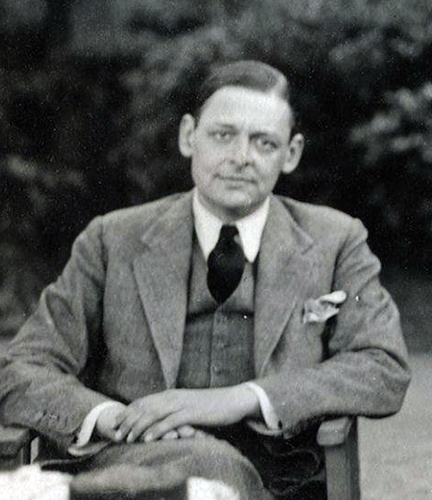
Thomas Stearns Eliot was a poet, essayist and playwright.
By globalcelebwiki Editorial Desk, adapted from Wikipedia · Published 29 September 2026
- Profession
- US-British poet (1888–1965)
- Born
- 26 September 1888
- Birthplace
- St. Louis
- Nationality
- American
Overview
Thomas Stearns Eliot (26 September 1888 – 4 January 1965) was a poet, essayist and playwright. He was a leading figure of modernist poetry in the English language where he altered the art through his use of pessimistic language, writing style, and verse structure. Awarded the 1948 Nobel Prize in Literature, he is considered one of the greatest poets of the English language. He is also noted for his critical essays, which often re-evaluated long-held cultural beliefs.
Born in St. Louis, Missouri, United States, to a prominent Boston Brahmin family, he moved to England in 1914 at the age of 25 and went on to settle, work, and marry there. He became a British subject in 1927 at the age of 39 and renounced his American citizenship.
Eliot first attracted widespread attention for "The Love Song of J. Alfred Prufrock" (1915), which, at the time of its publication, was considered outlandish. It was followed by The Waste Land (1922), "The Hollow Men" (1925), Ash Wednesday (1930), and Four Quartets (1943). He wrote seven plays, including Murder in the Cathedral (1935) and The Cocktail Party (1949). He was awarded the 1948 Nobel Prize in Literature "for his outstanding, pioneer contribution to present-day poetry".
Early life and education
The Eliots were a Boston Brahmin family with roots in England and New England. Eliot's paternal grandfather, William Greenleaf Eliot, had moved to St. Louis, Missouri, to establish a Unitarian Christian church there. His father, Henry Ware Eliot, was a successful businessman, president and treasurer of the Hydraulic-Press Brick Company in St. Louis. His mother, Charlotte Champe Stearns, who wrote poetry, was a social worker, then a new profession in the US. Eliot was the last of six surviving children.
Known to family and friends as Tom, he was the namesake of his maternal grandfather, Thomas Stearns. Eliot lived in St. Louis for the first 16 years of his life at the house on Locust Street where he was born. After going away to school in 1905, he returned to St. Louis only for holidays and visits. Despite moving away from the city, Eliot wrote to a friend that "Missouri and the Mississippi have made a deeper impression on me than any other part of the world."
Eliot was drawn to literature in childhood. Struggling from a congenital double inguinal hernia, he could not participate in many physical activities. Often isolated, his love for literature developed. Once he learned to read, the young boy immediately became obsessed with books, favouring tales of savage life, the Wild West, or Mark Twain's Tom Sawyer. In his memoir about Eliot, his friend Robert Sencourt comments that the young Eliot "would often curl up in the window-seat behind an enormous book, setting the drug of dreams against the pain of living." Eliot credited his hometown with fuelling his literary vision: "It is self-evident that St. Louis affected me more deeply than any other environment has ever done. I feel that there is something in having passed one's childhood beside the big river, which is incommunicable to those people who have not. I consider myself fortunate to have been born here, rather than in Boston, or New York, or London."
From 1898 to 1905, Eliot attended Smith Academy, the boys college preparatory division of Washington University, where his studies included Ancient Greek, Latin, French, and German. He began to write poetry when he was 14, under the influence of Edward FitzGerald's translation of the Rubaiyat of Omar Khayyam. He said the results were gloomy and despairing and he destroyed them. His first published poem, "A Fable For Feasters", was written as a school exercise and was published in the Smith Academy Record in February 1905. Also published there in April 1905 was his oldest surviving poem in manuscript, an untitled lyric, later revised and reprinted as "Song" in The Harvard Advocate. He published three short stories in 1905, "Birds of Prey", "A Tale of a Whale" and "The Man Who Was King". The last mentioned story reflected his exploration of the Igorot Village while visiting the 1904 St. Louis World's Fair. His interest in indigenous peoples thus predated his anthropological studies at Harvard University.
Following graduation from Smith Academy, Eliot attended Milton Academy in Massachusetts for a preparatory year, where he met Scofield Thayer, who later published The Waste Land. He studied at Harvard College from 1906 to 1909, earning a Bachelor of Arts in an elective programme similar to comparative literature in 1909 and a Master of Arts in English literature the following year. Because of his year at Milton Academy, Eliot was allowed to earn his Bachelor of Arts after three years instead of the usual four. Frank Kermode writes that the most important moment of Eliot's undergraduate career was in 1908 when he discovered Arthur Symons's The Symbolist Movement in Literature. This introduced him to Jules Laforgue, Arthur Rimbaud and Paul Verlaine. Without Verlaine, Eliot wrote, he might never have heard of Tristan Corbière and his book Les amours jaunes, a work that affected the course of Eliot's life. The Harvard Advocate published some of his poems and he became lifelong friends with Conrad Aiken.
Before leaving the US, Eliot had told Emily Hale that he was in love with her. He exchanged letters with her from Oxford during 1914 and 1915, but they did not meet again until 1927. In a letter to Aiken late in December 1914, Eliot, aged 26, wrote: "I am very dependent upon women (I mean female society)." Less than four months later, Thayer introduced Eliot to Vivienne Haigh-Wood, a Cambridge governess. They were married at Hampstead Register Office on 26 June 1915.
After a short visit, alone, to his family in the United States, Eliot returned to London and took several teaching jobs. The philosopher Bertrand Russell took an interest in Vivienne while the newlyweds stayed in his flat. Some scholars have suggested that she and Russell had an affair, but the allegations were never confirmed.
After leaving Merton, Eliot worked as a schoolteacher, notably at Highgate School in London, where he taught French and Latin; his students included John Betjeman. He subsequently taught at the Royal Grammar School, High Wycombe in Buckinghamshire. To earn extra money, he wrote book reviews and lectured at evening extension courses at University College London and Oxford. In 1917 he took a position at Lloyds Bank in London, working on foreign accounts. On a trip to Paris in August 1920 with the artist Wyndham Lewis, he met James Joyce. Eliot said he found Joyce arrogant, and Joyce doubted Eliot's ability as a poet at the time, but the two writers soon became friends, with Eliot visiting Joyce whenever he was in Paris. Eliot and Wyndham Lewis also maintained a close friendship, leading to Lewis's later making his well-known portrait painting of Eliot in 1938.
Charles Whibley recommended Eliot to Geoffrey Faber. In 1925 Eliot left Lloyds to become a director in the publishing firm Faber and Gwyer (later Faber & Faber), where he remained for the rest of his career. At Faber & Faber, he was responsible for publishing distinguished English poets, including W. H. Auden, Stephen Spender, Charles Madge and Ted Hughes.
On 29 June 1927 Eliot converted from Unitarianism to Anglicanism, and in November that year he took British citizenship, thereby renouncing his United States citizenship in the event he had not officially done so previously. He became a churchwarden of his parish church, St Stephen's, Gloucester Road, London, and a life member of the Society of King Charles the Martyr. He specifically identified as Anglo-Catholic, proclaiming himself "classicist in literature, royalist in politics, and anglo-catholic in religion".
About 30 years later Eliot commented on his religious views that he combined "a Catholic cast of mind, a Calvinist heritage, and a Puritanical temperament". He also had wider spiritual interests, commenting that "I see the path of progress for modern man in his occupation with his own self, with his inner being" and citing Johann Wolfgang von Goethe and Rudolf Steiner as exemplars of such a direction.
One of Eliot's biographers, Peter Ackroyd, commented that "the purposes of [Eliot's conversion] were two-fold. One: the Church of England offered Eliot some hope for himself, and I think Eliot needed some resting place. But secondly, it attached Eliot to the English community and English culture."
By 1932, Eliot had been contemplating a separation from his wife for some time. When Harvard offered him the Charles Eliot Norton professorship for the 1932–1933 academic year, he accepted and left Vivienne in England. Upon his return, he arranged for a formal separation from her, avoiding all but one meeting with her between his leaving for America in 1932 and her death in 1947. Vivienne was committed to the Northumberland House mental hospital in Woodberry Down, Manor House, London, in 1938, and remained there until she died. Although Eliot was still legally her husband, he never visited her. From 1933 to 1946 Eliot had a close emotional relationship with Emily Hale. Eliot later destroyed Hale's letters to him, but Hale donated Eliot's to Princeton University Library where they were sealed, following Eliot's and Hale's wishes, for 50 years after both had died, until 2020. When Eliot heard of the donation he deposited his own account of their relationship with Harvard University to be opened whenever the Princeton letters were.
From 1938 to 1957 Eliot's public companion was Mary Trevelyan of London University, who wanted to marry him and left a detailed memoir.
Eliot died of emphysema at his home in Kensington in London, on 4 January 1965, and was cremated at Golders Green Crematorium. In accordance with his wishes, his ashes were taken to St Michael and All Angels' Church, East Coker, the village in Somerset from which his Eliot ancestors had emigrated to America. A wall plaque in the church commemorates him with a quotation from his poem East Coker: "In my beginning is my end. In my end is my beginning."
In 1967, on the second anniversary of his death, Eliot was commemorated by the placement of a large stone in the floor of Poets' Corner in Westminster Abbey. The stone, cut by the designer Reynolds Stone, is inscribed with his life dates, his Order of Merit, and a quotation from his poem Little Gidding, "the communication / of the dead is tongued with fire beyond / the language of the living."
In 1986 a blue plaque was placed on the building – No. 3 Kensington Court Gardens – where he lived and died.
Poetry
For a poet of his stature, Eliot produced relatively few poems. He was aware of this even early in his career; he wrote to J. H. Woods, one of his former Harvard professors, "My reputation in London is built upon one small volume of verse, and is kept up by printing two or three more poems in a year. The only thing that matters is that these should be perfect in their kind, so that each should be an event."
Typically, Eliot first published his poems individually in periodicals or in small books or pamphlets and then collected them in books. His first collection was Prufrock and Other Observations (1917). In 1920, he published more poems in Ara Vos Prec (London) and Poems: 1920 (New York). These had the same poems (in a different order) except that "Ode" in the British edition was replaced with "Hysteria" in the American edition. In 1925, he collected The Waste Land and the poems in Prufrock and Poems into one volume and added The Hollow Men to form Poems: 1909–1925. From then on, he updated this work as Collected Poems. Exceptions are Old Possum's Book of Practical Cats (1939), a collection of light verse; Poems Written in Early Youth, posthumously published in 1967 and consisting mainly of poems published between 1907 and 1910 in The Harvard Advocate, and Inventions of the March Hare: Poems 1909–1917, material Eliot never intended to have published, which appeared posthumously in 1996.
During an interview in 1959, Eliot said of his nationality and its role in his work: "I'd say that my poetry has obviously more in common with my distinguished contemporaries in America than with anything written in my generation in England. That I'm sure of. ... It wouldn't be what it is, and I imagine it wouldn't be so good; putting it as modestly as I can, it wouldn't be what it is if I'd been born in England, and it wouldn't be what it is if I'd stayed in America. It's a combination of things. But in its sources, in its emotional springs, it comes from America."
Cleo McNelly Kearns notes in her biography that Eliot was deeply influenced by Indic traditions, notably the Upanishads. From the Sanskrit ending of The Waste Land to the "What Krishna meant" section of Four Quartets shows how much Indic religions and more specifically Hinduism made up the philosophical basis for his thought process. It must also be acknowledged, as Chinmoy Guha showed in his book Where the Dreams Cross: T S Eliot and French Poetry (Macmillan, 2011) that he was deeply influenced by French poets from Baudelaire to Paul Valéry. He himself wrote in his 1940 essay on W. B. Yeats: "The kind of poetry that I needed to teach me the use of my own voice did not exist in English at all; it was only to be found in French." ("Yeats", On Poetry and Poets, 1948).
In 1915 Ezra Pound, overseas editor of Poetry magazine, recommended to Harriet Monroe, the magazine's founder, that she should publish "The Love Song of J. Alfred Prufrock". Although the character Prufrock seems to be middle-aged, Eliot wrote most of the poem when he was only twenty-two. Its now-famous opening lines, comparing the evening sky to "a patient etherised upon a table", were considered shocking and offensive, especially at a time when Georgian Poetry was hailed for its derivations of the 19th-century Romantic poets.
The poem's structure was heavily influenced by Eliot's extensive reading of Dante Alighieri and refers to a number of literary works, including William Shakespeare's play Hamlet and those of the French Symbolists. Its reception in London can be gauged from an unsigned review in The Times Literary Supplement on 21 June 1917. "The fact that these things occurred to the mind of Mr. Eliot is surely of the very smallest importance to anyone, even to himself. They certainly have no relation to poetry."
In October 1922 Eliot published The Waste Land in The Criterion. His dedication to il miglior fabbro ('the better craftsman') refers to Pound's significant hand in editing and reshaping the poem from a longer manuscript to the shortened version that appears in publication.
It was composed during a period of personal difficulty for Eliot—his marriage was failing, and both he and Vivienne were suffering from nervous disorders. Before the poem's publication as a book in December 1922, Eliot distanced himself from its vision of despair. On 15 November 1922 he wrote to Richard Aldington saying, "As for The Waste Land, that is a thing of the past so far as I am concerned and I am now feeling toward a new form and style."
The poem is often read as a representation of the disillusionment of the post-war generation. Dismissing this view, Eliot commented in 1931, "When I wrote a poem called The Waste Land, some of the more approving critics said that I had expressed 'the disillusion of a generation', which is nonsense. I may have expressed for them their own illusion of being disillusioned, but that did not form part of my intention."
The poem is known for its disjointed nature due to its usage of allusion and quotation and its abrupt changes of speaker, location, and time. This structural complexity is one of the reasons that the poem has become a touchstone of modern literature, a poetic counterpart to a novel published in the same year, James Joyce's Ulysses.
Among its best-known phrases are "April is the cruellest month", "I will show you fear in a handful of dust", and "These fragments I have shored against my ruins".
"The Hollow Men" appeared in 1925. For the critic Edmund Wilson, it marked "The nadir of the phase of despair and desolation given such effective expression in 'The Waste Land'." It is Eliot's major poem of the late 1920s. Similar to Eliot's other works, its themes are overlapping and fragmentary. Post-war Europe under the Treaty of Versailles (which Eliot despised), the difficulty of hope and religious conversion, Eliot's failed marriage.
Allen Tate perceived a shift in Eliot's method, writing, "The mythologies disappear altogether in 'The Hollow Men'." This is a striking claim for a poem as indebted to Dante as anything else in Eliot's early work, to say little of the modern English mythology—the "Old Guy Fawkes" of the Gunpowder Plot—or the colonial and agrarian mythos of Joseph Conrad and James George Frazer, which, at least for reasons of textual history, echo in The Waste Land. The "continuous parallel between contemporaneity and antiquity" that is so characteristic of his mythical method remained in fine form. "The Hollow Men" contains some of Eliot's most famous lines, notably its conclusion: This is the way the world endsNot with a bang but a whimper.
"Ash-Wednesday" is the first long poem written by Eliot after his 1927 conversion to Anglicanism. Published in 1930, it deals with the struggle that ensues when a person who has lacked faith acquires it. Sometimes referred to as Eliot's "conversion poem", it is richly but ambiguously allusive, and deals with the aspiration to move from spiritual barrenness to hope for human salvation. Eliot's style of writing in "Ash-Wednesday" showed a marked shift from the poetry he had written prior to his 1927 conversion, and his post-conversion style continued in a similar vein. His style became less ironic, and the poems were no longer populated by multiple characters in dialogue. Eliot's subject matter also became more focused on his spiritual concerns and his Christian faith.
Many critics were particularly enthusiastic about "Ash-Wednesday". Edwin Muir maintained that it is one of the most moving poems Eliot wrote, and perhaps the "most perfect", though it was not well received by everyone. The poem's groundwork of orthodox Christianity discomfited many of the more secular literati.
In 1939 Eliot published a book of light verse, Old Possum's Book of Practical Cats. ("Old Possum" was Ezra Pound's friendly nickname for Eliot.) The first edition had an illustration of the author on the cover. In 1954, the composer Alan Rawsthorne set six of the poems for speaker and orchestra in a work titled Practical Cats. After Eliot's death, the book was the basis of the musical Cats by Andrew Lloyd Webber, first produced in the West End in 1981 and opening on Broadway the following year.
Eliot regarded Four Quartets as his masterpiece, and it is the work that most of all led him to being awarded the Nobel Prize in Literature. It consists of four long poems, each first published separately: "Burnt Norton" (1936), "East Coker" (1940), "The Dry Salvages" (1941) and "Little Gidding" (1942). Each has five sections. Although they resist easy characterisation, each poem includes meditations on the nature of time in some important respect—theological, historical, physical—and its relation to the human condition. Each poem is associated with one of the four classical elements, respectively: air, earth, water, and fire.
"Burnt Norton" is a meditative poem that begins with the narrator trying to focus on the present moment while walking through a garden, focusing on images and sounds such as the bird, the roses, clouds and an empty pool. The meditation leads the narrator to reach "the still point" in which there is no attempt to get anywhere or to experience place and/or time, instead experiencing "a grace of sense". In the final section, the narrator contemplates the arts ("words" and "music") as they relate to time. The narrator focuses particularly on the poet's art of manipulating "Words [which] strain, / Crack and sometimes break, under the burden [of time], under the tension, slip, slide, perish, decay with imprecision, [and] will not stay in place, / Will not stay still." By comparison, the narrator concludes that "Love is itself unmoving, / Only the cause and end of movement, / Timeless, and undesiring."
"East Coker" continues the examination of time and meaning, focusing in a famous passage on the nature of language and poetry. Out of darkness, Eliot offers a solution: "I said to my soul, be still, and wait without hope."
"The Dry Salvages" treats the element of water, via images of river and sea. It strives to contain opposites: "The past and future / Are conquered, and reconciled."
"Little Gidding" (the element of fire) is the most anthologised of the Quartets. Eliot's experiences as an air raid warden in the Blitz power the poem, and he imagines meeting Dante during the German bombing. The beginning of the Quartets ("Houses / Are removed, destroyed") had become a violent everyday experience; this creates an animation, where for the first time he talks of love as the driving force behind all experience. From this background, the Quartets ends with an affirmation of Julian of Norwich: "All shall be well and / All manner of thing shall be well."
Plays
With the important exception of Four Quartets, Eliot directed much of his creative energies after Ash Wednesday to writing plays in verse, mostly comedies or plays with redemptive endings. He was long a critic and admirer of Elizabethan and Jacobean verse drama; witness his allusions to John Webster, Thomas Middleton, Shakespeare and Thomas Kyd in The Waste Land. In a 1933 lecture he said "Every poet would like, I fancy, to be able to think that he had some direct social utility . . . . He would like to be something of a popular entertainer and be able to think his own thoughts behind a tragic or a comic mask. He would like to convey the pleasures of poetry, not only to a larger audience but to larger groups of people collectively; and the theatre is the best place in which to do it."
After The Waste Land (1922), he wrote that he was "now feeling toward a new form and style". One project he had in mind was writing a play in verse, using some of the rhythms of early jazz. The play featured "Sweeney", a character who had appeared in a number of his poems. Although Eliot did not finish the play, he did publish two scenes from the piece. These scenes, titled Fragment of a Prologue (1926) and Fragment of an Agon (1927), were published together in 1932 as Sweeney Agonistes. Although Eliot noted that this was not intended to be a one-act play, it is sometimes performed as one.
A pageant play by Eliot called The Rock was performed in 1934 for the benefit of churches in the Diocese of London. Much of it was a collaborative effort; Eliot accepted credit only for the authorship of one scene and the choruses. George Bell, the Bishop of Chichester, had been instrumental in connecting Eliot with the producer E. Martin Browne for the production of The Rock, and later commissioned Eliot to write another play for the Canterbury Festival in 1935. This one, Murder in the Cathedral, concerning the martyrdom of Thomas Becket, was more under Eliot's control. Eliot's biographer Peter Ackroyd comments that "for [Eliot], Murder in the Cathedral and succeeding verse plays offered a double advantage; it allowed him to practice poetry but it also offered a convenient home for his religious sensibility." After this, he worked on more "commercial" plays for more general audiences: The Family Reunion (1939), The Cocktail Party (1949), The Confidential Clerk, (1953) and The Elder Statesman (1958) (the latter three were produced by Henry Sherek and directed by Browne). The Broadway production in New York of The Cocktail Party received the 1950 Tony Award for Best Play. Eliot wrote The Cocktail Party while he was a visiting scholar at the Institute for Advanced Study.
Regarding his method of playwriting, Eliot explained, "If I set out to write a play, I start by an act of choice. I settle upon a particular emotional situation, out of which characters and a plot will emerge. And then lines of poetry may come into being: not from the original impulse but from a secondary stimulation of the unconscious mind."
Influence
Eliot influenced many poets, novelists, and songwriters, including Seán Ó Ríordáin, Máirtín Ó Díreáin, Virginia Woolf, Ezra Pound, Bob Dylan, Hart Crane, Beryl Price, William Gaddis, Allen Tate, Andrew Lloyd Webber, Trevor Nunn, Ted Hughes, Geoffrey Hill, Seamus Heaney, F. Scott Fitzgerald, Russell Kirk, George Seferis (who in 1936 published a modern Greek translation of The Waste Land) and James Joyce. Eliot was a strong influence on 20th-century Caribbean poetry written in English, including the epic Omeros (1990) by the Nobel laureate Derek Walcott, and Islands (1969) by Barbadian Kamau Brathwaite.
Honours and awards
Below is a partial list of honours and awards received by Eliot or bestowed or created in his honour.
These honours are displayed in order of precedence based on Eliot's nationality and rules of protocol, not awarding date.
Nobel Prize in Literature "for his outstanding, pioneer contribution to present-day poetry" (1948)
Hanseatic Goethe Prize (of Hamburg) (1955)
1950 Tony Award for Best Play for the Broadway production of The Cocktail Party
1983 Tony Award for Best Book of a Musical for his poems used in the musical Cats (posthumous award)
1983 Tony Award for Best Original Score for his poems used in the musical Cats (shared with Andrew Lloyd Webber) (posthumous award)
Ivor Novello Award for Best Song Musically and Lyrically for his poems used in the song "Memory" (1982)
Elected to the American Academy of Arts and Sciences (1954)
Elected to the American Philosophical Society (1960)
Thirteen honorary doctorates (including ones from Oxford, Cambridge, the Sorbonne, and Harvard)
Eliot College of the University of Kent, England, named in his honour
Celebrated on U.S. commemorative postage stamps
Works
Source: "The Nobel Prize in Literature 1948 | T.S. Eliot | Bibliography". nobelprize.org. Archived from the original on 7 November 2012.
The Eliot Quartet by Australian author Steven Carroll (2009–2022)
The quartet comprises: The Lost Life: A Novel (2009); A World of Other People (2013); A New England Affair (2017); and Goodnight, Vivienne, Goodnight (2022)
Tom & Viv, a play by Michael Hastings (1984)
Tom & Viv directed by Brian Gilbert (1994) - an adaptation of the Michael Hastings play
Sources and references
Spotted something wrong? Report a correction.
Related profiles
Broadcaster and natural historian
David Attenborough
The broadcaster whose natural history series have shaped how audiences understand life on Earth.
Read biography ↗
Animator and film director
Hayao Miyazaki
The animator and co-founder of Studio Ghibli whose hand-drawn films reached audiences worldwide.
Read biography ↗
Pope
Benedict I
Pope Benedict I was the bishop of Rome from 2 June 575 to his death on 30 July 579.
Read biography ↗