American baseball player (1895–1948)
Babe Ruth
George Herman "Babe" Ruth was an American professional baseball player whose career in Major League Baseball spanned 22 seasons, from 1914 through 1935.
By globalcelebwiki Editorial Desk, adapted from Wikipedia · Published 29 September 2026
- Profession
- American baseball player (1895–1948)
- Born
- 6 February 1895
- Birthplace
- Baltimore
- Nationality
- American

Overview
George Herman "Babe" Ruth (February 6, 1895 – August 16, 1948) was an American professional baseball player whose career in Major League Baseball (MLB) spanned 22 seasons, from 1914 through 1935. Nicknamed "the Bambino" and "the Sultan of Swat", he began his MLB career as a star left-handed pitcher for the Boston Red Sox, but achieved his greatest fame as a slugging outfielder for the New York Yankees. Ruth is regarded as one of the greatest sports heroes in American culture and is considered by many to be the greatest baseball player of all time. In 1936, Ruth was elected to the Baseball Hall of Fame as one of its "first five" members.
Born in Baltimore, at age seven, Ruth was sent to St. Mary's Industrial School for Boys. In 1914, Ruth was signed to play Minor League baseball for the Baltimore Orioles but was soon sold to the Red Sox. By 1916, he had built a reputation as an outstanding pitcher who sometimes hit long home runs, a feat unusual for any player in the dead-ball era. Although Ruth twice won 23 games in a season as a pitcher and was a member of three World Series championship teams with the Red Sox, he wanted to play every day and was allowed to convert to an outfielder. With regular playing time, he broke the MLB single-season home run record in 1919 with 29.
After that season, Red Sox owner Harry Frazee sold Ruth to the Yankees amid controversy. The trade fueled Boston's subsequent 86-year championship drought and popularized the "Curse of the Bambino" superstition. In his 15 years with the Yankees, Ruth helped the team win seven American League (AL) pennants and four World Series championships. His big swing led to escalating home run totals that not only drew fans to the ballpark and boosted the sport's popularity but also helped usher in baseball's live-ball era, which evolved from a low-scoring game of strategy to a sport where the home run was a major factor. As part of the Yankees' vaunted "Murderers' Row" lineup of 1927, Ruth hit 60 home runs, which extended his own MLB single-season record by a single home run. Ruth's last season with the Yankees was 1934, and he retired after a short stint with the Boston Braves the following year. In his career, he led the AL in home runs 12 times.
During Ruth's career, he was the target of intense press and public attention for his baseball exploits and off-field penchants for drinking and womanizing. After his retirement as a player, he was denied the opportunity to manage a major league club, most likely because of poor behavior during parts of his playing career. In his final years, Ruth made many public appearances, especially in support of American efforts in World War II. In 1946, he became ill with nasopharyngeal cancer and died from the disease two years later. Ruth remains a major figure in American culture.
Early life
George Herman Ruth Jr. was born on February 6, 1895, at 216 Emory Street in the Pigtown neighborhood of Baltimore, in a house which belonged to his maternal grandfather Pius Schamberger, a German immigrant and trade unionist. Ruth's parents, Katherine (née Schamberger) and George Herman Ruth Sr., were both of German ancestry. Ruth Sr. worked a series of jobs that included lightning rod salesman and streetcar operator. The elder Ruth then became a counterman in a family-owned combination grocery and saloon business. Only one of Ruth's seven siblings, his younger sister Mamie, survived infancy.
Many details of Ruth's childhood are unknown. As a child, Ruth spoke German. When Ruth was a toddler, the family moved to 339 South Woodyear Street; by the time he was six years old, his father had a saloon with an upstairs apartment at 426 West Camden Street. Details are equally scanty about why Ruth was sent at the age of seven to St. Mary's Industrial School for Boys, a reformatory and orphanage. However, according to Julia Ruth Stevens' recount in 1999, because George Sr. was a saloon owner and had given Ruth little supervision, he became a delinquent. As an adult, Ruth admitted that as a youth he ran the streets, rarely attended school, and drank beer when his father was not looking. Some accounts say that following a violent incident at his father's saloon, the city authorities decided that this environment was unsuitable for a child. Ruth entered St. Mary's on June 13, 1902. He was recorded as "incorrigible" and spent much of the next 12 years there.
Although St. Mary's boys received an education, students were also expected to learn work skills and help operate the school, particularly once the boys turned 12. Ruth became a shirtmaker and was also a proficient carpenter. He would adjust his own shirt collars, even during his well-paid baseball career. The boys, aged 5 to 21, did most of the work around the facility, and renovated St. Mary's in 1912. The food was simple, and the Xaverian Brothers who ran the school insisted on strict discipline; corporal punishment was common. Ruth's nickname there was "Niggerlips", as he had large facial features and was darker than most boys at the all-white reformatory.
Ruth was sometimes allowed to rejoin his family or was placed at St. James's Home, a supervised residence with work in the community, but he was always returned to St. Mary's. He was rarely visited by his family; his mother died when he was 12 and, by some accounts, he was permitted to leave St. Mary's only to attend the funeral. How Ruth came to play baseball there is uncertain: according to one account, his placement at St. Mary's was due in part to repeatedly breaking windows with long hits while playing street ball; by another, he was told to join a team on his first day at St. Mary's by the school's athletic director, Brother Herman, becoming a catcher even though left-handers rarely play that position. During his time there he also played third base and shortstop, again unusual for a left-hander, and was forced to wear gloves made for right-handers. He was encouraged in his pursuits by the school's Prefect of Discipline, Brother Matthias Boutlier. Brother Matthias was greatly respected by the boys both for his strength and for his fairness. For the rest of his life, Ruth would praise Brother Matthias, and his running and hitting styles closely resembled his teacher's. Ruth stated, "I think I was born as a hitter the first day I ever saw him hit a baseball." The older man became a mentor and role model to Ruth; biographer Robert W. Creamer commented on the closeness between the two:
Ruth revered Brother Matthias ... which is remarkable, considering that Matthias was in charge of making boys behave and that Ruth was one of the great natural misbehavers of all time. ... George Ruth caught Brother Matthias' attention early, and the calm, considerable attention the big man gave the young hellraiser from the waterfront struck a spark of response in the boy's soul ... [that may have] blunted a few of the more savage teeth in the gross man whom I have heard at least a half-dozen of his baseball contemporaries describe with admiring awe and wonder as "an animal."
In early 1914, Ruth signed a professional baseball contract with Jack Dunn, who owned and managed the minor-league Baltimore Orioles, an International League team. The circumstances of Ruth's signing are not known with certainty. By some accounts, Dunn was urged to attend a game between an all-star team from St. Mary's and one from another Xaverian facility, Mount St. Mary's College. Some versions have Ruth running away before the eagerly awaited game, to be punished, and then returning to pitch St. Mary's to victory as Dunn watched. Others have Washington Senators pitcher Joe Engel, a Mount St. Mary's graduate, pitching in an alumni game after watching a preliminary contest between the college's freshmen and a team from St. Mary's, including Ruth. Engel watched Ruth play, then told Dunn about him at a chance meeting in Washington. Ruth, in his autobiography, stated only that he worked out for Dunn for a half hour, and was signed. According to biographer Kal Wagenheim, there were legal difficulties to be straightened out as Ruth was supposed to remain at the school until he turned 21, though SportsCentury stated in a documentary that Ruth had already been discharged from St. Mary's when he turned 19, and earned a monthly salary of $100.
The train journey to spring training in Fayetteville, North Carolina, in March was likely Ruth's first outside the Baltimore area. The rookie ballplayer was the subject of various pranks by veteran players, who were probably also the source of his famous nickname. There are various accounts of how Ruth came to be called "Babe", but most center on his being referred to as "Dunnie's babe" (or some variant). SportsCentury reported that his nickname was gained because he was the new "darling" or "project" of Dunn, not only because of Ruth's raw talent, but also because of his lack of knowledge of the proper etiquette of eating out in a restaurant, being in a hotel, or being on a train. "Babe" was, at that time, a common nickname in baseball, with perhaps the most famous to that point being Pittsburgh Pirates pitcher and 1909 World Series hero Babe Adams, who appeared younger than his actual age.
Ruth made his first appearance as a professional ballplayer in an inter-squad game on March 7, 1914. He played shortstop and pitched the last two innings of a 15–9 victory. In his second at-bat, Ruth hit a long home run to right field; the blast was locally reported to be longer than a legendary shot hit by Jim Thorpe in Fayetteville. Ruth made his first appearance against a team in organized baseball in an exhibition game versus the major-league Philadelphia Phillies. Ruth pitched the middle three innings and gave up two runs in the fourth, but then settled down and pitched a scoreless fifth and sixth innings. In a game against the Phillies the following afternoon, Ruth entered during the sixth inning and did not allow a run the rest of the way. The Orioles scored seven runs in the bottom of the eighth inning to overcome a 6–0 deficit, and Ruth was the winning pitcher.
Once the regular season began, Ruth was a star pitcher who was also dangerous at the plate. The team performed well, yet received almost no attention from the Baltimore press. A third major league, the Federal League, had begun play, and the local franchise, the Baltimore Terrapins, restored that city to the major leagues for the first time since 1902. Few fans visited Oriole Park, where Ruth and his teammates labored in relative obscurity. Ruth may have been offered a bonus and a larger salary to jump to the Terrapins; when rumors to that effect swept Baltimore, giving Ruth the most publicity he had experienced to date, a Terrapins official denied it, stating it was their policy not to sign players under contract to Dunn.
The competition from the Terrapins caused Dunn to sustain large losses. Although by late June the Orioles were in first place, having won over two-thirds of their games, the paid attendance dropped as low as 150. Dunn explored a possible move by the Orioles to Richmond, Virginia, as well as the sale of a minority interest in the club. These possibilities fell through, leaving Dunn with little choice other than to sell his best players to major league teams to raise money. He offered Ruth to the reigning World Series champions, Connie Mack's Philadelphia Athletics, but Mack had his own financial problems. The Cincinnati Reds and New York Giants expressed interest in Ruth, but Dunn sold his contract, along with those of pitchers Ernie Shore and Ben Egan, to the Boston Red Sox of the American League (AL) on July 4. The sale price was announced as $25,000 but other reports lower the amount to half that, or possibly $8,500 plus the cancellation of a $3,000 loan. Ruth remained with the Orioles for several days while the Red Sox completed a road trip, and reported to the team in Boston on July 11.
On July 11, 1914, Ruth arrived in Boston with Egan and Shore. Ruth later told the story of how that morning he had met Helen Woodford, who would become his first wife. She was a 16-year-old waitress at Landers Coffee Shop, and Ruth related that she served him when he had breakfast there. Other stories, though, suggested that the meeting occurred on another day, and perhaps under other circumstances. Regardless of when he began to court his first wife, he won his first game as a pitcher for the Red Sox that afternoon, 4–3, over the Cleveland Naps. His catcher was Bill Carrigan, who was also the Red Sox manager. Shore was given a start by Carrigan the next day; he won that and his second start and thereafter was pitched regularly. Ruth lost his second start, and was thereafter little used. In his major league debut as a batter, Ruth went 0-for-2 against left-hander Willie Mitchell, striking out in his first at bat before being removed for a pinch hitter in the seventh inning. Ruth was not much noticed by the fans, as Bostonians watched the Red Sox's crosstown rivals, the Braves, begin a legendary comeback that would take them from last place on the Fourth of July to the 1914 World Series championship.
Egan was traded to Cleveland after two weeks on the Boston roster. During his time with the Red Sox, he kept an eye on the inexperienced Ruth, much as Dunn had in Baltimore. When he was traded, no one took his place as supervisor. Ruth's new teammates considered him brash and would have preferred him as a rookie to remain quiet and inconspicuous. When Ruth insisted on taking batting practice despite being both a rookie who did not play regularly and a pitcher, he arrived to find his bats sawed in half. His teammates nicknamed him "the Big Baboon", a name the swarthy Ruth, who had disliked the nickname "Niggerlips" at St. Mary's, detested. Ruth had received a raise on promotion to the major leagues and quickly acquired tastes for fine food, liquor, and women, among other temptations.
Manager Carrigan allowed Ruth to pitch two exhibition games in mid-August. Although Ruth won both against minor-league competition, he was not restored to the pitching rotation. It is uncertain why Carrigan did not give Ruth additional opportunities to pitch. There are legends—incorporated into the 1948 film The Babe Ruth Story—that Ruth had a habit of signaling his intent to throw a curveball by sticking out his tongue slightly, and that he was easy to hit until this changed. Creamer pointed out that it is common for inexperienced pitchers to display such habits, and needing to break this habit would not constitute a reason to not use him at all; Creamer suggested Carrigan was unwilling to use Ruth due to the rookie's poor behavior.
On July 30, 1914, Boston owner Joseph Lannin had purchased the minor-league Providence Grays, members of the International League. The Providence team had been owned by several people associated with the Detroit Tigers, including star hitter Ty Cobb, and as part of the transaction, a Providence pitcher was sent to the Tigers. To soothe Providence fans upset at losing a star, Lannin announced that the Red Sox would soon send a replacement to the Grays. This was intended to be Ruth, but his departure for Providence was delayed when Cincinnati Reds owner Garry Herrmann claimed him by waiver. After Lannin wrote to Herrmann explaining that the Red Sox wanted Ruth in Providence so he could develop as a player, and would not release him to a major league club, Herrmann allowed Ruth to be sent to the minors. Carrigan later stated that Ruth was not sent down to Providence to make him a better player, but to help the Grays win the International League pennant (league championship).
Ruth joined the Grays on August 18, 1914. After Dunn's deals, the Baltimore Orioles managed to hold on to first place until August 15, after which they continued to fade, leaving the pennant race between Providence and Rochester. Ruth was deeply impressed by Providence manager "Wild Bill" Donovan, previously a star pitcher with a 25–4 win–loss record for Detroit in 1907; in later years, he credited Donovan with teaching him much about pitching. Ruth was often called upon to pitch, in one stretch starting (and winning) four games in eight days. On September 5 at Maple Leaf Park in Toronto, Ruth pitched a one-hit 9–0 victory, and hit his first professional home run, his only one as a minor leaguer, off Ellis Johnson. Recalled to Boston after Providence finished the season in first place, he pitched and won a game for the Red Sox against the New York Yankees on October 2, getting his first major league hit, a double. Ruth finished the season with a record of 2–1 as a major leaguer and 23–8 in the International League (for Baltimore and Providence). Once the season concluded, Ruth married Helen in Ellicott City, Maryland. Creamer speculated that they did not marry in Baltimore, where the newlyweds boarded with George Ruth Sr., to avoid possible interference from those at St. Mary's—both bride and groom were not yet of age and Ruth remained on parole from that institution until his 21st birthday.
Ruth pitched a league-leading 35 complete games and went 24–13 with a 2.01 ERA and six shutouts in 1917, but the Sox finished in second place in the league, nine games behind the Chicago White Sox in the standings. On June 23 at Washington, when home plate umpire 'Brick' Owens called the first four pitches as balls, Ruth was ejected from the game and threw a punch at him, for which Ruth was suspended for ten days and fined $100. Ernie Shore was called in to relieve Ruth, and was allowed eight warm-up pitches. The runner who had reached base on the walk was caught stealing, and Shore retired all 26 batters he faced to win the game. Until 1991, this was listed as a perfect game for Ernie Shore. In 1991, Major League Baseball's (MLB) Committee on Statistical Accuracy amended it to be listed as a combined no-hitter. In 1917, Ruth was used little as a batter, other than for his plate appearances while pitching, and hit .325 with two home runs.
The United States' entry into World War I occurred at the start of the season and overshadowed baseball. Conscription was introduced in September 1917, and most baseball players in the big leagues were of draft age. This included Barry, who was a player-manager, and who joined the Naval Reserve in an attempt to avoid the draft, only to be called up after the 1917 season. Frazee hired International League President Ed Barrow as Red Sox manager. Barrow had spent the previous 30 years in a variety of baseball jobs, though he never played the game professionally. With the major leagues shorthanded because of the war, Barrow had many holes in the Red Sox lineup to fill.
Ruth also noticed these vacancies in the lineup. He was dissatisfied in the role of a pitcher who appeared every four or five days and wanted to play every day at another position. Barrow used Ruth at first base and in the outfield during the exhibition season, but he restricted him to pitching as the team moved toward Boston and the season opener. At the time, Ruth was possibly the best left-handed pitcher in baseball, and allowing him to play another position was an experiment that could have backfired.
Inexperienced as a manager, Barrow had player Harry Hooper advise him on baseball game strategy. Hooper urged his manager to allow Ruth to play another position when he was not pitching, arguing to Barrow, who had invested in the club, that the crowds were larger on days when Ruth played, as they were attracted by his hitting. In early May, Barrow gave in; Ruth promptly hit home runs in four consecutive games (one an exhibition), the last off of Walter Johnson. For the first time in his career (disregarding pinch-hitting appearances), Ruth was assigned a place in the batting order higher than ninth.
Although Barrow predicted that Ruth would beg to return to pitching the first time he experienced a batting slump, that did not occur. Barrow used Ruth primarily as an outfielder in the war-shortened 1918 season. Ruth hit .300, with 11 home runs, enough to secure him a share of the major league home run title with Tilly Walker of the Philadelphia Athletics. He was still occasionally used as a pitcher, and had a 13–7 record with a 2.22 ERA. On July 8, in the bottom of the ninth inning in a scoreless game, with a runner on first base Ruth hit a ball out of the ballpark to drive in the game-winning run; this was recorded as a triple, since the rules at that time considered the game over once the winning run scored. In 1968 the Special Baseball Records Committee unanimously ruled this, along with 36 other hits, a home run, but in part due to the perceived importance of preserving Ruth's home run total at 714, in 1969 the committee reversed this decision.
As an out-of-towner from New York City, Frazee had been regarded with suspicion by Boston's sportswriters and baseball fans when he bought the team. He won them over with success on the field and a willingness to build the Red Sox by purchasing or trading for players. He offered the Senators $60,000 for Walter Johnson, but Washington owner Clark Griffith was unwilling. Even so, Frazee was successful in bringing other players to Boston, especially as replacements for players in the military. This willingness to spend for players helped the Red Sox secure the 1918 title. The 1919 season saw record-breaking attendance, and Ruth's home runs for Boston made him a national sensation. In March 1919 Ruth was reported as having accepted a three-year contract for a total of $27,000, after protracted negotiations. Nevertheless, on December 26, 1919, Frazee sold Ruth's contract to the New York Yankees.
Not all the circumstances concerning the sale are known, but brewer and former congressman Jacob Ruppert, the New York team's principal owner, reportedly asked Yankee manager Miller Huggins what the team needed to be successful. "Get Ruth from Boston", Huggins supposedly replied, noting that Frazee was perennially in need of money to finance his theatrical productions. An often-told story is that Frazee needed money, and sold Ruth to finance the musical No, No, Nanette; that play did not open until 1925, by which time Frazee had sold the Red Sox, but was based on a Frazee-produced play, My Lady Friends, which opened in 1919. There were also other financial pressures on Frazee, despite his team's success. Ruth, fully aware of baseball's popularity and his role in it, wanted to renegotiate his contract, signed before the 1919 season for $10,000 per year through 1921. He demanded that his salary be doubled, or he would sit out the season and cash in on his popularity through other ventures. Ruth's salary demands were causing other players to ask for more money. Additionally, Frazee still owed Lannin as much as $125,000 from the purchase of the club.
Although Ruppert and his co-owner, Colonel Tillinghast Huston, were both wealthy, and had aggressively purchased and traded for players in 1918 and 1919 to build a winning team, Ruppert faced losses in his brewing interests as Prohibition was implemented, and if their team left the Polo Grounds, where the Yankees were the tenants of the New York Giants, building a stadium in New York would be expensive. Nevertheless, when Frazee, who moved in the same social circles as Huston, hinted to the colonel that Ruth was available for the right price, the Yankees owners quickly pursued the purchase.
Frazee sold the rights to Babe Ruth for $100,000, the largest sum ever paid for a baseball player. The deal also involved a $350,000 loan from Ruppert to Frazee, secured by a mortgage on Fenway Park. Once it was agreed, Frazee informed Barrow, who, stunned, told the owner that he was getting the worse end of the bargain. Cynics have suggested that Barrow may have played a larger role in the Ruth sale, as less than a year after, he became the Yankee general manager, and in the following years made a number of purchases of Red Sox players from Frazee. The $100,000 price included $25,000 in cash, and notes for the same amount due November 1 in 1920, 1921, and 1922; Ruppert and Huston assisted Frazee in selling the notes to banks for immediate cash.
The transaction was contingent on Ruth signing a new contract, which was quickly accomplished—Ruth agreed to fulfill the remaining two years on his contract, but was given a $20,000 bonus, payable over two seasons. The deal was announced on January 6, 1920. Reaction in Boston was mixed: some fans were embittered at the loss of Ruth; others conceded that Ruth had become difficult to deal with. The New York Times suggested that "The short right field wall at the Polo Grounds should prove an easy target for Ruth next season and, playing seventy-seven games at home, it would not be surprising if Ruth surpassed his home run record of twenty-nine circuit clouts next Summer." According to Reisler, "The Yankees had pulled off the sports steal of the century."
When Ruth signed with the Yankees, his transition from a pitcher to a power-hitting outfielder was complete. His 15-season Yankee career consisted of over 2,000 games, and Ruth broke many batting records while making only five widely scattered appearances on the mound, winning all of them.
At the end of April 1920, the Yankees were 4–7, with the Red Sox leading the league with a 10–2 mark. Ruth had done little, having injured himself swinging the bat. Both situations began to change on May 1, when Ruth hit a tape measure home run that sent the ball completely out of the Polo Grounds, a feat believed to have been previously accomplished only by Shoeless Joe Jackson. The Yankees won, 6–0, taking three out of four from the Red Sox. Ruth hit his second home run on May 2, and by the end of the month had set a major league record for home runs in a month with 11, and promptly broke it with 13 in June. Fans responded with record attendance figures. On May 16, Ruth and the Yankees drew 38,600 to the Polo Grounds, a record for the ballpark, and 15,000 fans were turned away. Large crowds jammed stadiums to see Ruth play when the Yankees were on the road.
The home runs kept on coming. Ruth tied his own record of 29 on July 15 and broke it with home runs in both games of a doubleheader four days later. By the end of July, he had 37, but his pace slackened somewhat after that. Nevertheless, on September 4, he both tied and broke the organized baseball record for home runs in a season, snapping Perry Werden's 1895 mark of 44 in the minor Western League. The Yankees played well as a team, battling for the league lead early in the summer, but slumped in August in the AL pennant battle with Chicago and Cleveland. The pennant and the World Series were won by Cleveland, who surged ahead after the Black Sox Scandal broke on September 28 and led to the suspension of many of Chicago's top players, including Shoeless Joe Jackson. The Yankees finished third, but drew 1.2 million fans to the Polo Grounds, the first time a team had drawn a seven-figure attendance. The rest of the league sold 600,000 more tickets, many fans there to see Ruth, who led the league with 54 home runs, 158 runs, and 137 runs batted in (RBIs).
In 1920 and afterwards, Ruth was aided in his power hitting by the fact that A.J. Reach Company—the maker of baseballs used in the major leagues—was using a more efficient machine to wind the yarn found within the baseball. The new baseballs went into play in 1920 and ushered the start of the live-ball era; the number of home runs across the major leagues increased by 184 over the previous year. Baseball statistician Bill James pointed out that while Ruth was likely aided by the change in the baseball, there were other factors at work, including the gradual abolition of the spitball (accelerated after the death of Ray Chapman, struck by a pitched ball thrown by Mays in August 1920) and the more frequent use of new baseballs (also a response to Chapman's death). Nevertheless, James theorized that Ruth's 1920 explosion might have happened in 1919, had a full season of 154 games been played rather than 140, had Ruth refrained from pitching 133 innings that season, and if he were playing at any other home field but Fenway Park, where he hit only 9 of 29 home runs.
Yankees business manager Harry Sparrow had died early in the 1920 season. Ruppert and Huston hired Barrow to replace him. The two men quickly made a deal with Frazee for New York to acquire some of the players who would be mainstays of the early Yankee pennant-winning teams, including catcher Wally Schang and pitcher Waite Hoyt. The 21-year-old Hoyt became close to Ruth:
In 1924, the Yankees were favored to become the first team to win four consecutive pennants. Plagued by injuries, they found themselves in a battle with the Senators. Although the Yankees won 18 of 22 at one point in September, the Senators beat out the Yankees by two games. Ruth hit .378, winning his only AL batting title, with a league-leading 46 home runs.
Ruth did not look like an athlete; he was described as "toothpicks attached to a piano", with a big upper body but thin wrists and legs. Ruth had kept up his efforts to stay in shape in 1923 and 1924, but by early 1925 weighed nearly 260 pounds (120 kg). His annual visit to Hot Springs, Arkansas, where he exercised and took saunas early in the year, did him no good as he spent much of the time carousing in the resort town. He became ill while there, and relapsed during spring training. Ruth collapsed in Asheville, North Carolina, as the team journeyed north. He was put on a train for New York, where he was briefly hospitalized. A rumor circulated that he had died, prompting British newspapers to print a premature obituary. In New York, Ruth collapsed again and was found unconscious in his hotel bathroom. He was taken to a hospital where he had multiple convulsions. After sportswriter W. O. McGeehan wrote that Ruth's illness was due to binging on hot dogs and soda pop before a game, it became known as "the bellyache heard 'round the world". However, the exact cause of his ailment has never been confirmed and remains a mystery. Glenn Stout, in his history of the Yankees, writes that the Ruth legend is "still one of the most sheltered in sports"; he suggests that alcohol was at the root of Ruth's illness, pointing to the fact that Ruth remained six weeks at St. Vincent's Hospital but was allowed to leave, under supervision, for workouts with the team for part of that time. He concludes that the hospitalization was behavior-related. Playing just 98 games, Ruth had his worst season as a Yankee; he finished with a .290 average and 25 home runs. The Yankees finished next to last in the AL with a 69–85 record, their last season with a losing record until 1965.
Ruth spent part of the offseason of 1925–26 working out at Artie McGovern's gym, where he got back into shape. Barrow and Huggins had rebuilt the team and surrounded the veteran core with good young players like Tony Lazzeri and Lou Gehrig, but the Yankees were not expected to win the pennant.
Ruth returned to his normal production during 1926, when he batted .372 with 47 home runs and 146 RBIs. The Yankees built a 10-game lead by mid-June and coasted to win the pennant by three games. The St. Louis Cardinals had won the National League with the lowest winning percentage for a pennant winner to that point (.578) and the Yankees were expected to win the World Series easily. Although the Yankees won the opener in New York, St. Louis took Games Two and Three. In Game Four, Ruth hit three home runs—the first time this had been done in a World Series game—to lead the Yankees to victory. In the fifth game, Ruth caught a ball as he crashed into the fence. The play was described by baseball writers as a defensive gem. New York took that game, but Grover Cleveland Alexander won Game Six for St. Louis to tie the Series at three games each, then got very drunk. He was nevertheless inserted into Game Seven in the seventh inning and shut down the Yankees to win the game, 3–2, and win the Series. Ruth had hit his fourth home run of the Series earlier in the game and was the only Yankee to reach base off Alexander; he walked in the ninth inning before being thrown out to end the game when he attempted to steal second base. Although Ruth's attempt to steal second is often deemed a baserunning blunder, Creamer pointed out that the Yankees' chances of tying the game would have been greatly improved with a runner in scoring position.
The 1926 World Series was also known for Ruth's promise to Johnny Sylvester, a hospitalized 11-year-old boy who had been injured by a kick from a horse. A friend of Sylvester's father gave the boy two autographed baseballs signed by the Yankees and Cardinals. On the Yankees ball, Ruth, who did not know Sylvester, wrote, "I'll knock a homer for you on Wednesday." Ruth went on to hit three home runs in Game 4 of the World Series that Wednesday. After the Series, Ruth visited the boy in the hospital. When the matter became public, the press greatly inflated the story, and by some accounts, Ruth allegedly saved the boy's life by visiting him, emotionally promising to hit a home run, and doing so. Ruth's 1926 salary of $52,000 was far more than any other baseball player, but he made at least twice as much in other income, including $100,000 from 12 weeks of vaudeville.
The 1927 New York Yankees team is considered one of the greatest squads to ever take the field. Known as Murderers' Row because of the power of its lineup, the team clinched first place on Labor Day, won a then-AL-record 110 games and took the AL pennant by 19 games. There was no suspense in the pennant race, and the nation turned its attention to Ruth's pursuit of his own single-season home run record of 59 round trippers. Ruth was not alone in this chase. Teammate Lou Gehrig proved to be a slugger who was capable of challenging Ruth for his home run crown; he tied Ruth with 24 home runs late in June. Through July and August, the dynamic duo was never separated by more than two home runs. Gehrig took the lead, 45–44, in the first game of a doubleheader at Fenway Park early in September; Ruth responded with two blasts of his own to take the lead, as it proved permanently—Gehrig finished with 47. Even so, as of September 6, Ruth was still several games off his 1921 pace, and going into the final series against the Senators, had only 57. He hit two in the first game of the series, including one off of Paul Hopkins, facing his first major league batter, to tie the record. The following day, September 30, he broke it with his 60th homer, in the eighth inning off Tom Zachary to break a 2–2 tie. "Sixty! Let's see some son of a bitch try to top that one", Ruth exulted after the game. In addition to his career-high 60 home runs, Ruth batted .356, drove in 164 runs and slugged .772. In the 1927 World Series, the Yankees swept the Pittsburgh Pirates in four games; the National Leaguers were disheartened after watching the Yankees take batting practice before Game One, with ball after ball leaving Forbes Field. According to Appel, "The 1927 New York Yankees. Even today, the words inspire awe ... all baseball success is measured against the '27 team."
The following season started off well for the Yankees, who led the league in the early going. But the Yankees were plagued by injuries, erratic pitching and inconsistent play. The Philadelphia Athletics, rebuilding after some lean years, erased the Yankees' big lead and even took over first place briefly in early September. The Yankees, however, regained first place when they beat the Athletics three out of four games in a pivotal series at Yankee Stadium later that month, and clinched the pennant in the final weekend of the season. Ruth's play in 1928 mirrored his team's performance. He got off to a hot start and on August 1, he had 42 home runs. This put him ahead of his 60 home run pace from the previous season. He then slumped for the latter part of the season, and he hit just twelve home runs in the last two months. Ruth's batting average also fell to .323, well below his career average. Nevertheless, he ended the season with 54 home runs. The Yankees swept the favored Cardinals in four games in the World Series, with Ruth batting .625 and hitting three home runs in Game Four, including one off Alexander.
Before the 1929 season, Ruppert (who had bought out Huston in 1923) announced that the Yankees would wear uniform numbers to allow fans at cavernous Yankee Stadium to easily identify the players. The Cardinals and Indians had each experimented with uniform numbers; the Yankees were the first to use them on both home and away uniforms. Ruth batted third and was given number 3. According to a long-standing baseball legend, the Yankees adopted their now-iconic pinstriped uniforms in hopes of making Ruth look slimmer. In truth, though, they had been wearing pinstripes since 1915.
Although the Yankees started well, the Athletics soon proved they were the better team in 1929, splitting two series with the Yankees in the first month of the season, then taking advantage of a Yankee losing streak in mid-May to gain first place. Although Ruth performed well, the Yankees were not able to catch the Athletics—Connie Mack had built another great team. Tragedy struck the Yankees late in the year when manager Huggins died at 51 of erysipelas, a bacterial skin infection, on September 25, only ten days after he had last directed the team. Despite their past differences, Ruth praised Huggins and described him as a "great guy". The Yankees finished second, 18 games behind the Athletics. Ruth hit .345 during the season, with 46 home runs and 154 RBIs.
On October 17, the Yankees hired Bob Shawkey as manager; he was their fourth choice. Ruth had politicked for the job of player-manager, but Ruppert and Barrow never seriously considered him for the position. Stout deemed this the first hint Ruth would have no future with the Yankees once he retired as a player. Shawkey, a former Yankees player and teammate of Ruth, would prove unable to command Ruth's respect.
On January 7, 1930, salary negotiations between the Yankees and Ruth quickly broke down. Having just concluded a three-year contract at an annual salary of $70,000, Ruth promptly rejected both the Yankees' initial proposal of $70,000 for one year and their 'final' offer of two years at seventy-five—the latter figure equaling the annual salary of then US President Herbert Hoover; instead, Ruth demanded at least $85,000 and three years. When asked why he thought he was "worth more than the President of the United States," Ruth responded: "Say, if I hadn't been sick last summer, I'd have broken hell out of that home run record! Besides, the President gets a four-year contract. I'm only asking for three." Exactly two months later, a compromise was reached, with Ruth settling for two years at an unprecedented $80,000 per year. Ruth's salary was more than 2.4 times greater than the next-highest salary that season, a record margin as of 2025.
In 1930, Ruth hit .359 with 49 home runs (his best in his years after 1928) and 153 RBIs, and pitched his first game in nine years, a complete game victory. Nevertheless, the Athletics won their second consecutive pennant and World Series, as the Yankees finished in third place, sixteen games back. At the end of the season, Shawkey was fired and replaced with Cubs manager Joe McCarthy, though Ruth again unsuccessfully sought the job.
By this time, Ruth knew he was nearly finished as a player. He desired to remain in baseball as a manager. He was often spoken of as a possible candidate as managerial jobs opened up, but in 1932, when he was mentioned as a contender for the Red Sox position, Ruth stated that he was not yet ready to leave the field. There were rumors that Ruth was a likely candidate each time when the Cleveland Indians, Cincinnati Reds, and Detroit Tigers were looking for a manager, but nothing came of them.
Just before the 1934 season, Ruppert offered to make Ruth the manager of the Yankees' top minor-league team, the Newark Bears, but he was talked out of it by his wife, Claire, and his business manager, Christy Walsh. Tigers owner Frank Navin seriously considered acquiring Ruth and making him player-manager. However, Ruth insisted on delaying the meeting until he came back from a trip to Hawaii. Navin was unwilling to wait. Ruth opted to go on his trip, despite Barrow advising him that he was making a mistake; in any event, Ruth's asking price was too high for the notoriously tight-fisted Navin. The Tigers' job ultimately went to Mickey Cochrane.
Early in the 1934 season, Ruth made no secret of his desire to manage the Yankees. However, that job was never a serious possibility. Ruppert always supported McCarthy, who would remain in his position for another 12 seasons. The relationship between Ruth and McCarthy had been lukewarm at best, and Ruth's open campaigning to replace him further chilled their interpersonal relations. By the end of the season, Ruth hinted that he would retire unless Ruppert named him manager of the Yankees. When the time came, Ruppert wanted Ruth to leave the team without drama or hard feelings.
During the 1934–35 offseason, Ruth circled the world with his wife; the trip included a barnstorming tour of the Far East. At his final stop in the United Kingdom before returning home, Ruth was introduced to cricket by Australian player Alan Fairfax, and after having little luck in a cricketer's stance, he stood as a baseball batter and launched some massive shots around the field, destroying the bat in the process. Although Fairfax regretted that he could not have the time to make Ruth a cricket player, Ruth had lost any interest in such a career upon learning that the best batsmen made only about $40 per week.
Also during the offseason, Ruppert had been sounding out the other clubs in hopes of finding one that would be willing to take Ruth as a manager or player. However, the only serious offer came from Athletics owner-manager Connie Mack, who gave some thought to stepping down as manager in favor of Ruth. However, Mack later dropped the idea, saying that Ruth's wife would be running the team in a month if Ruth ever took over.
Career overall
At the time of his retirement, Ruth held many baseball batting records. These include the career records for home runs (714), slugging percentage (0.690), runs batted in (2,213), bases on balls (2,062) and on-base percentage (.474). He still remains in the top ten of many statistical rankings.
Retirement
Although Fuchs had given Ruth his unconditional release, no major league team expressed an interest in hiring him in any capacity. Ruth still hoped to be hired as a manager if he could not play anymore, but only one managerial position, Cleveland, became available between Ruth's retirement and the end of the 1937 season. Asked if he had considered Ruth for the job, Indians owner Alva Bradley replied negatively. Of the five members in the inaugural class of Baseball Hall of Fame in 1936 (Ty Cobb, Honus Wagner, Christy Mathewson, Walter Johnson and Ruth), only Ruth was not given an offer to manage a baseball team. Team owners and general managers assessed Ruth's flamboyant personal habits as a reason to exclude him from a managerial job; Barrow said of him, "How can he manage other men when he can't even manage himself?" Creamer believed Ruth was unfairly treated in never being given an opportunity to manage a major league club. The author believed there was not necessarily a relationship between personal conduct and managerial success, noting that John McGraw, Billy Martin, and Bobby Valentine were winners despite character flaws.
Ruth played much golf and in a few exhibition baseball games, where he demonstrated a continuing ability to draw large crowds. This appeal contributed to the Dodgers hiring him as first base coach in 1938. When Ruth was hired, Brooklyn general manager Larry MacPhail made it clear that Ruth would not be considered for the manager's job if, as expected, Burleigh Grimes retired at the end of the season. Although much was said about what Ruth could teach the younger players, in practice, his duties were to appear on the field in uniform and encourage base runners—he was not called upon to relay signs. In August, shortly before the baseball rosters expanded, Ruth sought an opportunity to return as an active player in a pinch hitting role. Ruth often took batting practice before games and felt that he could take on the limited role. Grimes denied his request, citing Ruth's poor vision in his right eye, his inability to run the bases, and the risk of an injury to Ruth.
Ruth got along well with everyone except team captain Leo Durocher, who was hired as Grimes' replacement at season's end. Ruth then left his job as a first base coach and would never again work in any capacity in the game of baseball.
On July 4, 1939, Ruth spoke on Lou Gehrig Appreciation Day at Yankee Stadium as members of the 1927 Yankees and a sellout crowd turned out to honor the first baseman, who was forced into premature retirement by ALS, which would kill him two years later. The next week, Ruth went to Cooperstown, New York, for the formal opening of the Baseball Hall of Fame. Three years earlier, he was one of the first five players elected to the hall. As radio broadcasts of baseball games became popular, Ruth sought a job in that field, arguing that his celebrity and knowledge of baseball would assure large audiences, but he received no offers. During World War II, he made many personal appearances to advance the war effort, including his last appearance as a player at Yankee Stadium, in a 1943 exhibition for the Army-Navy Relief Fund. He hit a long fly ball off Walter Johnson; the blast left the field, curving foul, but Ruth circled the bases anyway. In 1946, he made a final effort to gain a job in baseball when he contacted new Yankees boss MacPhail, but he was sent a rejection letter. In 1999, Ruth's granddaughter, Linda Tosetti, and his daughter, Julia Ruth Stevens, said that Babe's inability to land a managerial role with the Yankees caused him to feel hurt and slump into a severe depression.
Ruth started playing golf when he was 20 and continued playing the game throughout his life. His appearance at many New York courses drew spectators and headlines. Rye Golf Club was among the courses he played with teammate Lyn Lary in June 1933. With birdies on 3 holes, Ruth posted the best score. In retirement, he became one of the first celebrity golfers participating in charity tournaments, including one where he was pitted against Ty Cobb.
Personal life
Ruth met Helen Woodford, by some accounts, in a coffee shop in Boston, where she was a waitress. They married as teenagers on October 17, 1914. Although Ruth later claimed to have been married in Elkton, Maryland, records show that they were married at St. Paul's Catholic Church in Ellicott City. They adopted a daughter, Dorothy, in 1921. Ruth and Helen separated around 1925 reportedly because of Ruth's repeated infidelities and neglect. They appeared in public as a couple for the last time during the 1926 World Series. Helen died in January 1929 at age 31 in a fire in a house in Watertown, Massachusetts owned by Edward Kinder, a dentist with whom she had been living as "Mrs. Kinder". In her book, My Dad, the Babe, Dorothy claimed that she was Ruth's biological child by a mistress named Juanita Jennings. In 1980, Juanita, who was at the time very ill, admitted this to Dorothy and Dorothy's sister, Julia.
On April 17, 1929, three months after the death of his first wife, Ruth married actress and model Claire Merritt Hodgson and adopted her daughter Julia. It was the second and final marriage for both parties. Claire was well-travelled and educated, and put structure into Ruth's life, like Miller Huggins did for him on the field.
Cancer and death (1946–1948)
As early as the war years, doctors had cautioned Ruth to take better care of his health, and he grudgingly followed their advice, limiting his drinking and not going on a proposed trip to support the troops in the South Pacific. In 1946, Ruth began experiencing severe pain over his left eye and had difficulty swallowing. In November 1946, Ruth entered French Hospital in New York for tests, which revealed that he had an inoperable malignant tumor at the base of his skull and in his neck. The malady was a lesion known as nasopharyngeal carcinoma, or lymphoepithelioma. A physician who reviewed Ruth's autopsy in 1998 concluded that Ruth's lifelong use of tobacco "probably played a part" in his cancer. His name and fame gave him access to experimental treatments, and he was one of the first cancer patients to receive both drugs and radiation treatment simultaneously. Having lost 80 pounds (36 kg), he was discharged from the hospital in February and went to Florida to recuperate. He returned to New York and Yankee Stadium after the season started. The new commissioner, Happy Chandler (Judge Landis had died in 1944), proclaimed April 27, 1947, Babe Ruth Day around the major leagues, with the most significant observance to be at Yankee Stadium. A number of teammates and others spoke in honor of Ruth, who briefly addressed the crowd of almost 60,000. By then, his voice was a soft whisper with a very low, raspy tone.
Around this time, developments in chemotherapy offered some hope for Ruth. The doctors had not told Ruth he had cancer because of his family's fear that he might do himself harm. They treated him with pterolyl triglutamate (Teropterin), a folic acid derivative; he may have been the first human subject. Ruth showed dramatic improvement during the summer of 1947, so much so that his case was presented by his doctors at a scientific meeting, without using his name. He was able to travel around the country, doing promotional work for the Ford Motor Company on American Legion Baseball. He appeared again at another day in his honor at Yankee Stadium in September, but was not well enough to pitch in an old-timers game as he had hoped.
The improvement was only a temporary remission, and by late 1947, Ruth was unable to help with the writing of his autobiography, The Babe Ruth Story, which was almost entirely ghostwritten. In and out of the hospital in Manhattan, he left for Florida in February 1948, doing what activities he could. After six weeks he returned to New York to appear at a book-signing party. He also traveled to California to witness the filming of the movie based on the book.
On June 5, 1948, a "gaunt and hollowed-out" Ruth visited Yale University to donate a manuscript of The Babe Ruth Story to its library. At Yale, he met with future president George H. W. Bush, who was the captain of the Yale baseball team. On June 13, Ruth visited Yankee Stadium for the final time in his life, appearing at the 25th-anniversary celebrations of "The House that Ruth Built". By this time he had lost much weight and had difficulty walking. Introduced along with his surviving teammates from 1923, Ruth used a bat as a cane. Nat Fein's photo of Ruth taken from behind, standing near home plate and facing "Ruthville" (right field) became one of baseball's most famous and widely circulated photographs, and won the Pulitzer Prize.
Ruth made one final trip on behalf of American Legion Baseball. He then entered Memorial Hospital, where he would die. He was never told he had cancer; however, before his death, he surmised it. He was able to leave the hospital for a few short trips, including a final visit to Baltimore. On July 26, 1948, Ruth left the hospital to attend the premiere of the film The Babe Ruth Story. Shortly thereafter, he returned to the hospital for the final time. He was barely able to speak. Ruth's condition gradually grew worse, and only a few visitors were permitted to see him, one of whom was National League president and future Commissioner of Baseball Ford C. Frick. "Ruth was so thin it was unbelievable. He had been such a big man and his arms were just skinny little bones, and his face was so haggard", Frick said years later.
Memorial and museum
On April 19, 1949, the Yankees unveiled a granite monument in Ruth's honor in center field of Yankee Stadium. The monument was located in the field of play next to a flagpole and similar tributes to Huggins and Gehrig until the stadium was remodeled from 1974 to 1975, which resulted in the outfield fences moving inward and enclosing the monuments from the playing field. This area was known thereafter as Monument Park. Yankee Stadium, "the House that Ruth Built", was replaced after the 2008 season with a new Yankee Stadium across the street from the old one; Monument Park was subsequently moved to the new venue behind the center field fence. Ruth's uniform number 3 has been retired by the Yankees, and he is one of five Yankees players or managers to have a granite monument within the stadium.
In 1974, Ruth's birthplace in Baltimore was renovated and opened to the public as the Babe Ruth Birthplace and Museum. The museum houses a collection of artifacts from Ruth's life, including some rare baseball cards and the earliest known signature of Ruth, from when he was still pitching in the schoolyard. Ruth's widow, Claire, his two daughters, Dorothy and Julia, and his sister, Mamie, helped select and install exhibits for the museum.
Impact
Ruth was the first baseball star to be the subject of overwhelming public adulation. Baseball had been known for star players such as Ty Cobb and "Shoeless Joe" Jackson, but both men had uneasy relations with fans. In Cobb's case, the incidents were sometimes marked by violence. Ruth's biographers agreed that he benefited from the timing of his ascension to "Home Run King". The country had been hit hard by both the war and the 1918 flu pandemic and longed for something to help put these traumas behind it. Ruth also resonated in a country which felt, in the aftermath of the war, that it took second place to no one. Montville argued that Ruth was a larger-than-life figure who was capable of unprecedented athletic feats in the nation's largest city. Ruth became an icon of the social changes that marked the early 1920s. In his history of the Yankees, Glenn Stout writes that "Ruth was New York incarnate—uncouth and raw, flamboyant and flashy, oversized, out of scale, and absolutely unstoppable".
During his lifetime, Ruth became a symbol of the United States. During World War II, Japanese soldiers yelled in English, "To hell with Babe Ruth", to anger American soldiers. Ruth replied that he hoped "every Jap that mention[ed] my name gets shot". He eventually reconciled with the Japanese after the war ended. Creamer recorded that "Babe Ruth transcended sport and moved far beyond the artificial limits of baselines and outfield fences and sports pages". Wagenheim stated, "He appealed to a deeply rooted American yearning for the definitive climax: clean, quick, unarguable." According to Glenn Stout, "Ruth's home runs were [an] exalted, uplifting experience that meant more to fans than any runs they were responsible for. A Babe Ruth home run was an event unto itself, one that meant anything was possible."
Although Ruth was not just a power hitter—he was the Yankees' best bunter, and an excellent outfielder—Ruth's penchant for hitting home runs altered how baseball is played. Prior to 1920, home runs were unusual, and managers tried to win games by getting a runner on base and bringing him around to score through such means as the stolen base, the bunt, and the hit and run. Advocates of what was dubbed "inside baseball", such as Giants manager McGraw, disliked the home run, considering it a blot on the purity of the game. According to sportswriter W. A. Phelon, after the 1920 season, Ruth's breakout performance that season and the response in excitement and attendance, "settled, for all time to come, that the American public is nuttier over the Home Run than the Clever Fielding or the Hitless Pitching. Viva el Home Run and two times viva Babe Ruth, exponent of the home run, and overshadowing star." Bill James states, "When the owners discovered that the fans liked to see home runs, and when the foundations of the games were simultaneously imperiled by disgrace [in the Black Sox Scandal], then there was no turning back." While a few, such as McGraw and Cobb, decried the passing of the old-style play, teams quickly began to seek and develop sluggers.
According to sportswriter Grantland Rice, only two sports figures of the 1920s approached Ruth in popularity—boxer Jack Dempsey and racehorse Man o' War. One of the factors that contributed to Ruth's broad appeal was the uncertainty about his family and early life. Ruth appeared to exemplify the American success story, that even an uneducated, unsophisticated youth, without any family wealth or connections, can do something better than anyone else in the world. Montville writes that "the fog [surrounding his childhood] will make him forever accessible, universal. He will be the patron saint of American possibility." Similarly, the fact that Ruth played in the pre-television era, when a relatively small portion of his fans had the opportunity to see him play, allowed his legend to grow through word of mouth and the hyperbole of sports reporters. Reisler states that recent sluggers who surpassed Ruth's 60-home run mark, such as Mark McGwire and Barry Bonds, generated much less excitement than when Ruth repeatedly broke the single-season home run record in the 1920s. Ruth dominated a relatively small sports world, while Americans of the present era have many sports available to watch.
Sources and references
Spotted something wrong? Report a correction.
Related profiles
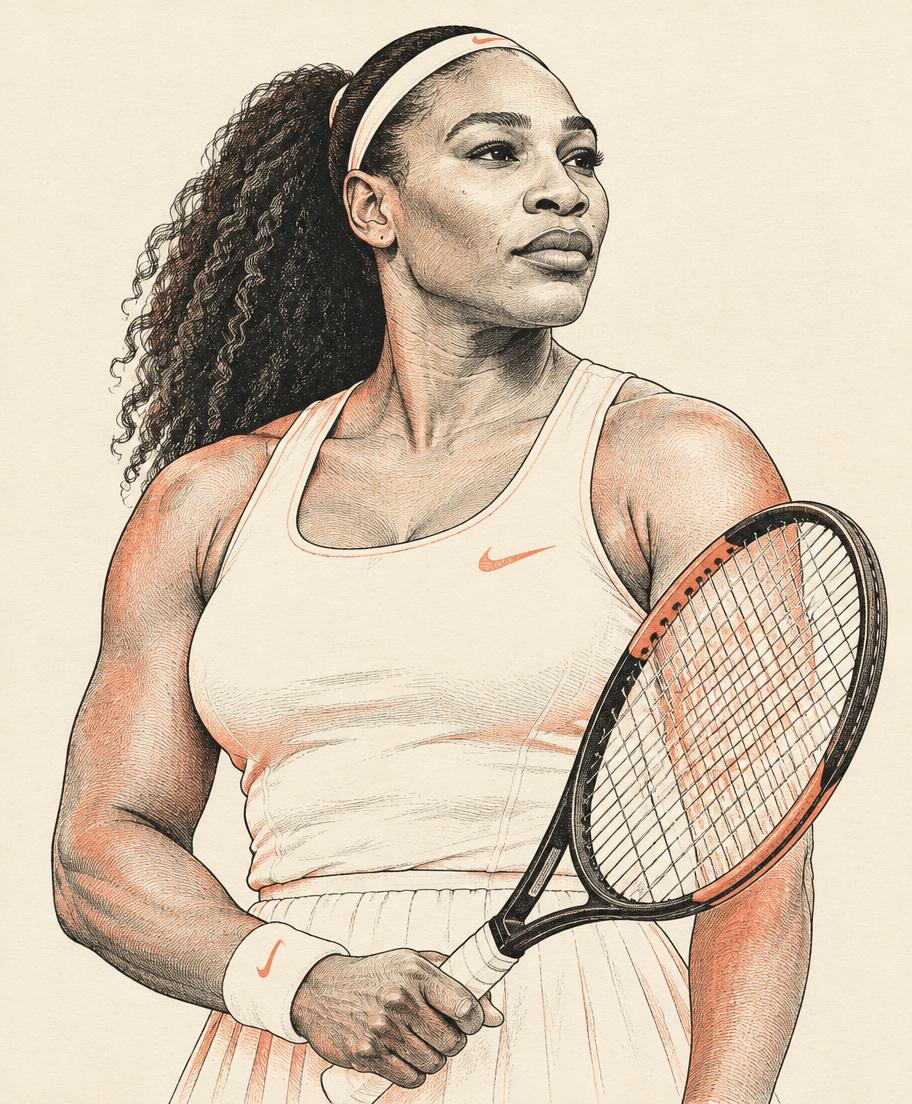
Tennis player
Serena Williams
One of the most successful tennis players in the history of the sport, with 23 Grand Slam singles titles.
Read biography ↗
Footballer
Lionel Messi
An Argentine footballer whose record haul of individual honours is matched by a World Cup title in 2022.
Read biography ↗
Argentine association football player (born 1987)
Lionel Messi
Lionel Andrés "Leo" Messi is an Argentine professional footballer who plays as a forward for the Major League Soccer club Inter Miami, which he captains, and the Argentina national team.
Read biography ↗